Keep Punching

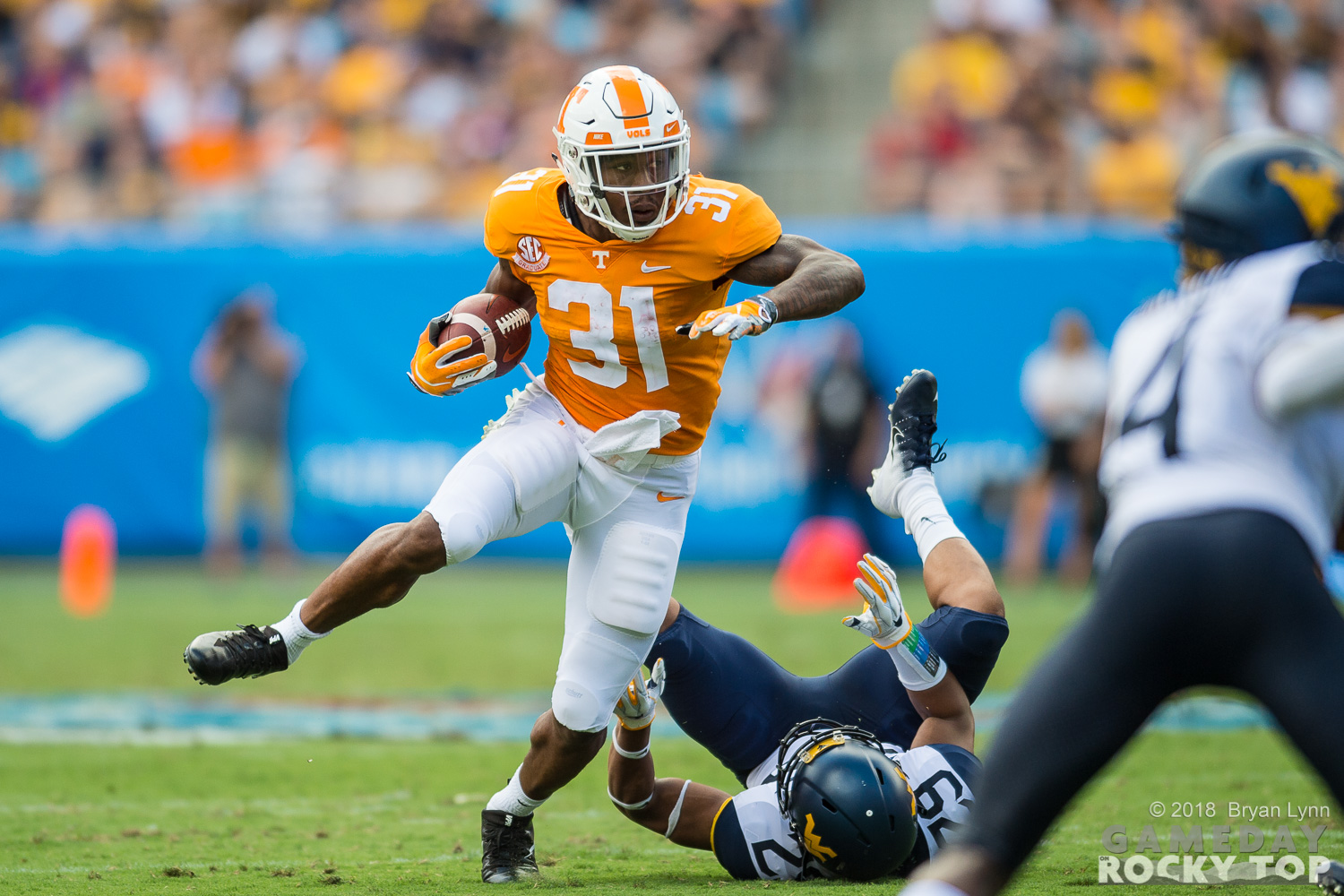
Progress looks smallest against Alabama and doesn’t feel like much progress at all. But the right feel was indeed present yesterday, even if briefly: down 28-0 with more than 11 minutes left in the second quarter, Tennessee forced consecutive three-and-outs on Alabama’s first-team offense. Then Tennessee’s own offense, which at that point had earned all of one first down (plus a second via penalty), came alive: Guarantano-to-Palmer for 30, then consecutive completions from Keller Chryst to Ty Chandler for a touchdown. And when Alabama answered after another near-miss on an onside kick, so too did the Vols: Jauan Jennings on 3rd-and-12, Jennings on a flea flicker (I was impressed but not surprised by the number of people in the stands who were absolutely confident Jennings would come out of the pile with that fumble), then Tyler Byrd (!) for a 20-yard touchdown.

The Vols were down 35-14 with 2:18 to play in the second quarter, and would receive the second half kickoff. I don’t think any of us thought we were winning. But Tennessee was alive, not just throwing wildly but landing some punches.

It didn’t last, of course: Tua’s six yard run on 3rd-and-5 three plays later was one of the game’s more important snaps, Bama punched it in with 15 seconds left before halftime, and more shenanigans on the second half kickoff ended most of the interest. But for Tennessee, against Alabama, this was progress.

It’s much more noticeable on paper. The Vols gained 258 yards in 55 plays against the Tide, 4.69 yards per play. Almost all of the damage was done against Bama’s first team: in the second half Tennessee ran only 24 plays for 84 yards (3.5 per play). It’s not just that Tennessee’s offense had a better day than Louisville, Ole Miss, and Missouri against Alabama’s defense. It’s how much better this Tennessee team was against the Crimson Tide than last year’s…and the year before that.

Hopelessness in this rivalry was last season, when the Vols gained 108 yards on 46 plays (2.35 per). The year before, still ranked ninth and with plenty of NFL talent, Tennessee gained 163 yards in 63 plays (2.59 per). Even trailing only 21-7 at halftime in 2016, there was a sense of impending doom quickly realized in the second half. To be fair, that team was decimated by injuries coming off Texas A&M, but Alabama made inept an offense that would go on to be the best in college football in the month of November.

We’ve been saying it all year, and it was true again yesterday: this year, competence is progress. Doing much of anything right against this Alabama team is competence, and the Vols showed it with a little flair in the second quarter. It was never going to be enough to win. But I like both the fight of this team, and the way that fight manifests itself versus last year.

Of course, the Vols already have their signature win, seem to have avoided any catastrophic injuries coming out of Bama, and still need just a split of their secondary SEC East rivals (plus a win over Charlotte) to get bowl eligible. So far Jeremy Pruitt has pushed the right buttons with this team.

Were his postgame quotes the right button? Pruitt is no doubt tired of losing, and tired of being non-competitive in the final analysis. So far he has not lost his team, and they have not lost their fight. It’s different, perhaps, when you’re coming off the worst season in school history and not a mediocre finish that ended the tenure of a longtime coach. These players, so far, have been invested as Pruitt has done the same in them.

This next part – South Carolina, Kentucky, Missouri, and Vanderbilt – was always going to be the most important for Tennessee to achieve its goals this year. And the Vols picked up a signature win along the way at Auburn. Tennessee seems to be entering the backstretch physically okay.

This has been the question all year: can the Vols be better in November than they were in September? To do that, Pruitt will have to keep his team together while continuing to challenge them to improve. I don’t doubt Tennessee’s spirit at this point. But can the Vols continue to throw and land meaningful punches and score meaningful wins against the rest of the schedule? Or will this team be beaten down, throwing punches with less behind them before collapsing to the canvas themselves?

These things are always a marathon, and in many ways the toughest miles should be behind us now. Does Tennessee have enough left to take advantage of what’s in front of them? If the answer is yes, progress will start looking better every week.
 

On Leaving Fingerprints in the Museum

This one feels a bit like the Tennessee-Kentucky basketball rivalry through the mid-90’s. The Cats, fueled by Antoine Walker, Ron Mercer, and Nazr Mohammed among others, won the NCAA Tournament in 1996, lost in the title game in 1997, and won it again in 1998. During a stretch of 11 straight wins over Tennessee, Kentucky won in Thompson-Boling by 20 in 1995, then by 40 in 1996. You’d show up to these games with that 1% hope, then watch a dunk contest unfold for as long as you could stand it, consoling yourself that at least you could say you watched a championship team and, in Walker’s case, a three-time NBA All-Star.

The last time Alabama was in Knoxville, it wasn’t just the final margin (49-10). The Vols, still ranked ninth and in every championship chase after a double overtime loss at Texas A&M, were scattered, smothered, and covered by Alabama’s defense under Jeremy Pruitt: 2.59 yards per play for Dobbs, Hurd, Kamara, etc. Much has changed since then, for the Vols and Pruitt. Last year in Tuscaloosa was even worse – 2.35 yards per play – but that was to be expected given the state of the Vols this time a year ago.

I don’t think anyone expects the outcome to change this year. But is this going to turn into a dunk contest again, where we say, “Oh well, at least we can say we saw Tua play in Neyland”? Or can the Vols show signs of life?

There are a handful of things that would be tangible progress against this bunch:

  • Alabama doesn’t score a touchdown on its opening drive
  • Tua throws an interception
  • Tua throws a pass in the fourth quarter
  • Alabama scores 38 points or less

But beyond that, I think a good goal for Tennessee – aside from keeping Jarrett Guarantano alive – is to leave this game still feeling good about its chances the rest of the way home. That happened four years ago against Alabama in Knoxville, when the Tide raced to a 27-0 lead before Josh Dobbs started writing his legend in an eventual 34-20 Alabama win. This one should be less about individual ascension and more about the entire team continuing to pull in the same direction.

And against this bunch, we’d better pull real hard.

This could end up in the conversation for the best team Tennessee has ever faced. The Tide are currently playing in the 99.4 percentile in S&P+. The aforementioned 2016 Tide finished the year at 99.8%; 2012 Alabama at 99.3%. The Vols faced both LSU (99.3%) and Alabama (99.1%) in 2011. Tim Tebow’s 2008 Gators were at 99.5%; Danny Wuerffel’s 1996 Gators were at 99.2%.

Two years ago at Rocky Top Talk, we ranked the best teams Tennessee has beaten in S&P+. 2001 Florida topped that list at 98.9%. All this to say, this Bama team is operating at a rare level…and this Tennessee team is trying to make its way into their atmosphere, but just getting off the ground. The history major in me is curious to see the Tide.

Tua might also be the fourth Heisman winner the Vols have faced in the last five years. We saw Baker Mayfield two years before he won it and Marcus Mariota the year before. The Vols last faced a Heisman winner in the same season with Derrick Henry in 2015. Much the same with Mark Ingram in 2009, they almost pulled the upset. The last Heisman winner Tennessee beat: Eddie George in 1995. Chris Weinke was famously inactive when the Vols beat Florida State to win the BCS title.

But on the list of the best quarterbacks Tennessee has ever faced – Mariota, Tebow, Wuerffel, plus future NFL standouts like McNabb – what Tua is doing right now stands out. Averaging 14.3 yards per attempt is just stupid. So is a 21-0 TD-INT ratio. Stop it. This is high school stuff. It’s up to the Vols to not look like a high school team out there.

Back in Thompson-Boling in the 90’s, Kentucky came back to Knoxville in 1997, and the Vols were game. Tennessee lost by just ten. We left that game feeling hopeful, and though it took another season to get there, the Vols swept Kentucky in 1999 and took a major step forward under Jerry Green. Sometimes progress looks like a 10-point loss. I don’t know exactly what number would represent progress tomorrow, but I do believe it’s available beyond just the outcome. Stay healthy and stay alive, of course. But after two years of throwing completely ineffective punches against Alabama, perhaps Jeremy Pruitt’s Vols can land one or two in there, and leave their own mark on this game.

We might get to see something historic in this Alabama team and its quarterback. Will we also see progress from Tennessee?

Sunday Stats: Biggest Upsets, First Down Runs, Third Down Conversions and more

A few more observations on this fine Sunday:

This was Tennessee’s biggest win as an underdog since Florida in 2001. Covers.com has the closing line from that night in The Swamp at +16.5. The line closed at +14.5 yesterday, just ahead of other classic upsets like 2003 Miami (+12.5) and 2004 Georgia (+13). The Vols were +7 against South Carolina in 2013. Obviously the Vols weren’t big underdogs in the 90’s, so other than Florida 2001 you have to go back to 1989 at UCLA (+15.5) to find a bigger upset win.

The Vols are 98th in yards per carry at 3.86 and the only SEC team under 4.00. One big run early did not heal the wounds of the first quarter: the Vols now have 52 carries for 116 yards in the opening stanza, with 2.23 yards per carry ranking 128th nationally. One thing the Vols are actually worse at than last year, so far: Tennessee gives up an average of eight tackles for loss per game, 120th nationally, up from 7.42 last season. (Stats via Sports Source Analytics)

Tennessee’s rushing production on first down isn’t as bad as you might think: 125 carries for 558 yards (4.46 per, 69th nationally). That average does drop to 3.84 yards per carry if you take away Ty Chandler’s 81 yard touchdown against UTEP.

Here’s a list of teams with fewer first down passing attempts than Tennessee (45): Coastal Carolina, Georgia Tech, Maryland, San Diego State, Navy, Air Force, Army, Georgia Southern. So yeah, your eyes aren’t deceiving you there. When the Vols have turned it loose on first down, they’ve typically gotten the desired result in catching the defense off-guard: 32-of-45 (71.1%, 12th nationally on first down), for 467 yards (10.4 ypa). Fifteen of those attempts have gone for 10+ yards, five of them for 25+. I’m not sure how much the Vols will seek to change this against Alabama, but it might be worth a look after that.

On third-and-short, the Vols still struggle to move the ball. When running on 3rd-&-1-to-3, Tennessee has 14 carries for 16 yards and only six first downs. 1.14 yards per carry is 127th nationally. Weirdly, the Vols are also 1-for-6 passing on third-and-short. So consider this:

  • 3rd-&-1-to-3:  20 plays, 7 first downs (35% conversion rate)
  • 3rd-&-4-to-6:  17 plays, 7 first downs (41.2%)
  • 3rd-&-7-to-9:  23 plays, 13 first downs (56.5%)
  • 3rd-&-10+:  23 plays, 5 first downs (21.7%)

That’s impressive and concerning at the same time. Open it up!

Speaking of which, here’s to Jarrett Guarantano: on 3rd-&-4-to-9, Guarantano is 19-of-24 (79.2%) for 248 yards (10.3 ypa) and 15 first downs. He’s also 16th nationally in overall yards per attempt (9.0).

At the midway point of the season, the Vols have 16 plays of 30+ yards. Last year they had 18 in the entire year.

We didn’t need it yesterday, and Auburn was the best red zone defense in the country coming into the game. But the Vols are now just 11-of-19 scoring touchdowns in the red zone this year; that’s 88th nationally. On the other side of the ball, Tennessee is one of just five teams nationally to surrender points on every red zone trip. Opponents are 17-for-17 against the Vols, with 11 touchdowns and six field goals. Plenty of room for improvement here.

The last time the Vols were +3 or better in turnovers against an FBS opponent: Kentucky last year, when the Vols were +4 and still lost. Some of the best wins of the Butch Jones era, as you might expect, came via huge turnover margins: 2016 Virginia Tech, 2016 Missouri, and 2015 Northwestern were all +4.

Quietly, Brent Cimaglia is 7-of-8 on field goals this year. The miss was the blocked kick yesterday. 87.5% is 14th nationally. The best percentage for Vol kickers this decade is Daniel Lincoln and Michael Palardy combining to go 15-of-18 (83.3%) in 2010.

It seemed like the Vols were penalized for a lot of little things yesterday, but Tennessee is still 20th nationally in penalty yards per game (42.5). The Vols have been relatively good at avoiding major 15-yard penalties this year. The flip side: Tennessee’s opponents average just 45.5 penalty yards per game, 107th nationally. The Vols aren’t giving or getting much help from the yellow flags.


Tennessee is Full of Surprises, Beats Auburn 30-24

So I allowed myself to dream this week, and went back to read what we wrote when Butch Jones and the 2013 Vols beat #11 South Carolina in his first season. Much has changed since then: the full buy-in language of five years ago reflected the exhaustion of trying to defend Derek Dooley the three years before that with no such victories to stand on. Five years later, maybe I’m a little wiser about too much weight too fast.

It struck me, reading that piece, that you can make a very good argument that the 2013 Gamecocks – #11 on that day, #4 at the end of the year – were the single best team Jones’ Vols ever beat. The win that was supposed to be first ended up, in some ways, never being topped.

You just never know. And in some ways, that should make us celebrate days like today even more.

If there is a good connection to that 2013 South Carolina game today, it was Tennessee’s wide receivers simply willing it to happen. Marquez North did it by himself back then. Today, Marquez Callaway, Jauan Jennings, and Josh Palmer played more snaps on the field at the same time than ever before. It’s as if Tennessee’s offense decided to ditch the idea of a dedicated slot receiver and just put its three best players on the field together. And boy, did it work: 10 catches for 210 yards, almost all of them some combination of impressive and critical.

What Tennessee did on third down today was stunning. There will be time later in the week and/or the year to talk about how we cannot keep living this way: 10-of-19 against a good-to-great defense like Auburn is an unreasonable expectation. Even more: on the go-ahead drive, the Vols converted 3rd-and-10, 3rd-and-2 after 2nd-and-14, 3rd-and-9, and 3rd-and-10 for a touchdown. What?

The last time Tennessee converted double-digit third downs: Josh Dobbs’ arrival against Alabama in 2014. There’s no need to grant asterisks when the opponent is Alabama, but the 11 conversions on that night were probably aided by the Tide’s early 27-0 lead. Today, all of them mattered to the final outcome. And it wasn’t just the one drive: the Vols converted 3rd-and-10 on the blocked field goal drive, 3rd-and-13 before connecting with Ty Chandler for a 42-yard touchdown later in the second quarter, 3rd-and-8 on the first drive of the second half, and 3rd-and-10 when running the clock down on their final possession before the kneel down. That’s seven conversions of 3rd-and-8 or longer. What?

Pulling the trigger on those seven conversions was Jarrett Guarantano, who quarterbacked the second half of the worst season in program history last fall. Not the first half with an overtime win over Georgia Tech and an almost in Gainesville, but the half with the Vols getting blown out by Missouri and Vanderbilt. And it’s not even that Guarantano was bad last year, it’s that he almost died every time he dropped back to pass.

I’m not sure how much better that part actually is, which is a credit to Guarantano: that dude stands in the pocket knowing he’s going to get rocked. But here’s what he did mostly from said pocket today: 21-of-32 for 328 yards (10.25 yards per attempt), two touchdowns, zero interceptions, W. The last quarterback to throw for 10+ yards per attempt against the Tigers was Baker Mayfield in the January 2017 Sugar Bowl. Before that it was Blake Sims in the 2014 Iron Bowl.

I think plenty of us thought there was a way to get this done today that included some of what we saw: +3 in turnovers, Auburn’s offense struggling (not early, but late?). But I don’t think any of us thought the recipe would include such a dominant performance in the passing game from the Vols. And what’s more, Tennessee had a field goal blocked, got no points out of a golden opportunity on Kongbo’s interception, and were the more penalized team for most of the day. Tennessee could’ve played better! That’s incredibly encouraging going forward. But they also won today, straight up.

So. The Vols go to 3-3 and put a bowl game back on the radar. A successful end to the season is what makes memories like this one really last; when the Vols failed against Vanderbilt five years ago, that South Carolina memory lost much of its power. Today’s win is plenty potent. But if Tennessee finds a way to get to six wins, it’ll transform from a building block to a bridge.

Tennessee is getting better; that much was evident in the second half against Georgia and was true far before the outcome was sealed today. But the Vols now appear to be good enough to have a chance to win against good teams, a happy acceleration of our expectations for this season. We all know what we’re getting into next week. But this week, this day, was incredibly important for Jeremy Pruitt and these Vols. These kids did a lot of losing last year, and some of them did a lot of almost the year before. To take all that after three 26-point losses in September and make it a winner on The Plains in October? It’s a big step forward for Jeremy Pruitt, and for Tennessee.

Go Vols.

Tennessee & Auburn: A Tale of Two Decades

It’s been ten years since the Vols played at Auburn, one of the best arguments for policy change in SEC scheduling. We faced the Tigers every year from 1956-1991, the series becoming Tennessee’s second-biggest rivalry during that time. Now we have to wait a decade to travel to each other’s place.

The last trip in 2008 remains an infamous one: trailing 14-12, the Vols’ final four possessions began at the Auburn 38, Tennessee 42, Auburn 46, and Tennessee 46. A field goal would have won it. But the Clawfense went three-and-out four times, gaining 12 yards in those 12 plays, and Auburn survived.

Tony Franklin, Auburn’s first-year offensive coordinator, would not: he was fired two weeks later with Tommy Tuberville on the hot seat. Phillip Fulmer elected to stay with Dave Clawson. But both head coaches would be out by season’s end, Fulmer a decade removed from his national championship, Tuberville just four years from Auburn’s undefeated season.

Tennessee won the hiring battle: Lane Kiffin promised to sing Rocky Top after beating Florida to our delight, while Gene Chizik was heckled on the runway. But Auburn won the war: Chizik hired Gus Malzahn to run the offense and signed a junior college quarterback named Cam Newton. While Tennessee struggled in Derek Dooley’s first season, Auburn won the national championship. And two years later when both Chizik and Dooley were on their way out, Auburn got their guy in Malzahn, while the Vols swung and missed on Charlie Strong before settling for Butch Jones.

The total damage: since 2009, Auburn is 82-43 with a national championship, a second BCS title game appearance, two straight New Year’s Six bowls and three SEC West titles in the Age of Saban. Tennessee is a dead even 59-59 with no trips to Atlanta, and hasn’t played in anything more prestigious than the Outback Bowl.

Malzahn is a fascinating case study, setting an impossibly high bar in 2010 and 2013. After that Auburn went 8-5, 7-6, 8-5, 10-2 before losing to Georgia and Central Florida in postseason last year, and now 4-2 off a preseason #9 ranking. Auburn’s defense has been remarkable so far this year, but Malzahn’s offense has been the opposite.

The Tigers are 91st in yards per play (5.38), besting only Arkansas in the SEC. The Vols, for reference, are 71st at 5.68. Tennessee has faced a pair of Top 20 yards-per-play-allowed defenses, Auburn three in the Top 25. (Stats via Sports Source Analytics)

But Auburn has lacked explosiveness against its entire schedule: just eight plays of 30+ yards in six games, 104th nationally and better than only seven teams who have played six games. And Auburn has only one run of 30+ yards so far this year.

The Tigers beat Washington in large part thanks to a 9-of-18 performance on third down. But since then, Auburn is a woeful 18-of-65 (27.7%). And as good as Auburn’s defense is in the red zone, the offense once again does the opposite: six of their 28 trips have ended with no points, and only 15 have reached the end zone. A red zone touchdown percentage of 53.57% is 107th nationally.

And so a decade after their last meeting on The Plains, when two storied programs made similar choices for similar reasons, the Vols and Tigers will meet tomorrow with frustration in the air once more. Jeremy Pruitt is Tennessee’s fourth attempt at a post-Fulmer answer in what is now Fulmer’s world once more. Gus Malzahn has really been the only answer for the Tigers in this decade, but his signature unit is struggling like never before. It would be fitting, perhaps, if Tennessee could reverse their own fortunes at Auburn’s expense. To do so, it’ll probably take something just as ugly as what we saw ten years ago…but that result would look mighty good on Jeremy Pruitt’s Vols right about now.

Auburn’s Defense May Not Believe in Trap Games

So the ingredients are there, right? Sleepy 11:00 am local kickoff, preseason Top 10 team sitting at a disappointing 4-2, offense looking sluggish…plus the underdog Vols coming off a bye, new head coach with plenty of experience against this particular opponent looking for his first big win.

We can talk ourselves into just about anything, of course. The quickest way to talk yourself back towards reality this weekend is the Auburn defense.

The Tigers have the best defense in the country in S&P+. Not great news for your upset dreams. Five past and future Tennessee opponents are currently in the Top 20 in S&P+ defense, including Kentucky (3rd!), Florida (11th), Alabama (18th), and Georgia (19th).

The Vols had limited success against Florida (when not turning it over) and Georgia, both of which have significantly better offenses than the Tigers at the moment. Auburn is 93rd in offensive S&P+, which might conjure hope of the Vols squeaking out a 13-10 upset. We’ll see if Tennessee’s defense can hold up if Auburn simply decides to run right at them all day. But on the other side of the ball, the Vols will need to be smart, clean, and hope for a big play or two to find enough points to be in the conversation.

The Tigers allow 4.68 yards per play, 18th nationally. It’s even more impressive considering they’ve faced three Top 25 teams in the first six weeks. And they’re 15th in turnovers forced, though four of their 12 came against Alabama State. But where Auburn’s defense really shines is the red zone.

Opposing teams have made 18 trips to the red zone against the Auburn defense. They’ve scored five touchdowns. Their touchdowns allowed percentage (27.78%) is not only the best in the nation, only four teams are allowing under 40%. Washington got inside the 20 six times and found the end zone once. LSU went three times and scored a single touchdown. Mississippi State: four times, one touchdown. That’s incredible.

This isn’t something Tennessee’s offense is particularly great at either, with 11 touchdowns in 18 red zone attempts (61.11%, 80th nationally). The Vols went 2-for-5 scoring red zone touchdowns against UTEP, 2-for-4 against the Gators, and didn’t take a single red zone snap against Georgia.

There’s some good news there, potentially, for the Vol offense: they’ve had success with explosive plays so far this year, with five passes of 50+ yards still good for seventh nationally after the bye week. It’s how the Vols found the end zone twice against Georgia, and should have before fumbling through the end zone against Florida. Auburn’s defense isn’t noteworthy in stopping explosive plays: the Tigers are 86th nationally in 20+ yard plays allowed, 85th in 20+ yard passing plays allowed. With Tennessee’s offense struggling in short yardage situations and Auburn’s defense so good in the red zone, big plays may be the best answer for the Vols on the plains.

Inside the Numbers of Tennessee’s Running Game

It will not surprise you to find (via data from Sports Source Analytics) the Vols are still near the bottom in running the football in the first quarter: 46 carries for 74 yards, a robust 1.61 yards per carry. That first quarter average is 128th nationally (good news: Charlotte is 130th). The Vols are a not-great-but-not-terrible 78th nationally in rushing average overall (4.2 yards per carry); of note, that’s better than Auburn (4.17), among others. Tennessee averages 4.02 yards in the second quarter, 7.33 in the third (bolstered by Ty Chandler’s 81-yard touchdown), and back to 4.02 in the fourth. In our running theme (no pun intended) for this year, the ground game never achieves excellence, but becomes competent as the game goes on. But that is far from the truth in the first quarter.

When you look at each player’s overall stats, it seems more simple than it actually is: Ty Chandler has 40 carries for 247 yards (6.18 per), and Madre London has 36 for 205 (5.69). But Chandler had only four carries before getting hurt against West Virginia, and had a good-but-not-great 19-for-66 (3.47 per) against Florida. London had 11-for-66 against the Gators, but only six yards on three carries last week. Tim Jordan, who looked very much like the answer against West Virginia, has just 43 carries for 140 yards in the last four games. It’s tough when you’re trying to rotate carries among four backs. But none of them are getting the Vols off to a good start in the first quarter.

The Vols are also 24th nationally in carries on first down: 105 runs, 39 passes. If the desire is to make defenses expect the run early, it’s working fairly well when the Vols actually do throw it on first down: 28-of-39 for 407 yards (10.4 yards per attempt). A 71.8% completion percentage is 13th nationally on first down.

But a lot of the issues in the run game aren’t just about running early in the game or a series, but on third-and-short. Tennessee has repeatedly tried to muscle their way forward on 3rd-and-1, and the results haven’t been pretty. On 3rd-and-1-to-3, the Vols have 12 carries for 11 yards. Only five of those 12 runs have picked up the first down. I’ve found myself almost wishing for the Vols to be in 3rd-and-4 than 3rd-and-1, because they’ll at least give themselves more options. The numbers back this up too: on 3rd-and-4-to-6, the Vols have converted five first downs on nine passing attempts. Tennessee is more successful throwing the ball on third-and-medium than running it on third-and-short.


Survival is Progress

Last year my wife and I brought our firstborn home from the hospital the day Tennessee played Georgia, the best of all ways to not be thinking about the game. “Did we really fumble it right back to them? Hey, he peed on the floor!” But from there, I’d imagine your October and November with the Vols were a little like mine no matter what ages you had at home: outcomes a little blurry, details inconsequential, lots of losing and little hope.

Yesterday friends and family gathered round to celebrate our son’s first birthday in the morning, then watch the Georgia game at 3:30. It seemed like another well-timed teacher of perspective. And we were all, spoken or unspoken, afraid of the same thing happening to the Vols again. Not the result, which seemed automatic with Tennessee at +32.5. But the outcome: a we’re-so-bad-none-of-this-matters hopelessness.

Tennessee made it matter. Right now, that’s a win.

It wasn’t simply in beating Vegas or playing better than last year against this particular opponent. The 2017 version featured not only a shutout but, far worse, 2.73 yards per play from the Vol offense. This time around Tennessee averaged 4.54. Not great, but it had a pulse. As has been the case since the West Virginia game, this is a theme for 2018: far from excellent, but capable of competence (when not turning it over six times).

Heart failure was a major concern coming in: new coach not used to losing, brutal loss to your most relevant rival last week, players sent to the locker room, uh oh. We’ve been staring down the oncoming train of this particular gauntlet for a long time. If what happened last year happened again this year, we wouldn’t have liked it but we might’ve understood it. And, as was the case when the calendar turned to October last year, the rest of the season would have been about next season.

But Tennessee showed heart on both sides of the ball, particularly on defense. They got little help from an offense that ran only 42 plays before Jeremy Banks fumbled with less than four minutes to go. The Vols seem committed to running the football, even if they’re not running it particularly well: Jarrett Guarantano remains fourth among SEC quarterbacks in yards per attempt (8.6), but the Vols are still last in the league in attempts (21.2 per game). Tennessee runs it almost literally twice as much as they throw it (211-106).

And this answer, like many things with this team, may simply come back to what they believe about the offensive line. Guarantano stayed relatively clean on Saturday – another big win – but you still feel nervous every time we don’t run. The gameplan for a while felt like Lane Kiffin’s against Urban Meyer when the Vols were 30-point underdogs on the road in 2009, with a quarterback we thought was fragile behind patchwork offensive line. Tennessee leaned on its defense, which worked to prevent big plays, and took few chances on the offensive end. Keep it close, and keep everyone – players, fans, etc. – invested.

It worked, eventually, in 2009. And it seemed to work this week too.

And it’s really selling our defense short to say they just worked to prevent big plays. In the run game, if you take out Isaac Nauta’s 31-yard gift with our defense in pass coverage, Georgia averaged 4.4 yards per carry. The only defenses to hold them to less than that the last two years: Notre Dame, Auburn (the first time), and Alabama. It’s a full day even trying to slow down Georgia’s run game. The Vol defense put in a full day’s work.

Speaking of heart, you’ll probably see what you want to see out of this:

…but regardless of whatever way you lean on coach emotion, etc., the Vols had already proven Pruitt’s point before he got choked up. I’m not in the locker room to see it behind the scenes, but you saw it on the field yesterday.

So far, the Vols are better than they were last year. That part you can back up statistically, but we’re aiming for a higher bar than that. Given the opportunity to write themselves off, or be written off by the number two team in the country, Tennessee’s heart is instead still beating. Six wins still feels like an uphill climb, but the Vols still have their hands on the rope. Just as important, the Vols are still relatively healthy. Brandon Kennedy’s loss was obviously unhelpful, and one hopes Marquez Callaway can get out of concussion protocol by the Auburn game. But on the whole, Tennessee seems largely intact in mind, body, and quarterback.

Alabama, of course, is still to come; we all know what we’re getting into there. But the rest feels a little less known today. Auburn, despite their persistence in the Top 10, could drift slowly toward “trap game” territory in the next two weeks. Kentucky is in the Top 15 in both the polls and S&P+. I don’t know.

I don’t know about Tennessee either. But on a day when many were worried about us being put out of our misery on the last weekend of September, the Vols showed signs of life. It’s enough to get us through the bye week, and send us to Auburn with a spark. I don’t know if it’ll catch fire. But I’m eager to find out. Hope remains valuable around these parts. And while it may have gone to Athens to die, it came back to Knoxville alive.

Go Vols.

What Tennessee Does Well (So Far)

(This is a real list!)

It’s not easy to measure progress when you’ve taken a pair of 26-point losses to teams you talked yourself into beating leading up to game week. It’s only Friday, but I don’t think many of us are talking ourselves into much against Georgia. But it’s also possible – especially after a six-turnover performance – to swing too hard the other way.

It may feel like baby steps, but so far this team does a couple things really well, especially compared to their predecessors.

Third Down Defense

Let’s start with the most straightforward way to understand it: the Vols allow a conversion on 24.5% of opponent attempts (stats from Sports Source Analytics). That’s currently sixth-best in the nation. Last year the Vols allowed conversions on 45.2% of opponent attempts, 113th nationally.

But there’s more. What caught my eye on this stat was Bill Connelly’s advanced statistical profiles, where Tennessee is currently first in the country in defending third-and-medium.

We charted every one of the 49 third downs against the Vol defense this season. Jeremy Pruitt’s troops have allowed a dozen conversions. Five of them were in the second half of the West Virginia game. Tennessee hasn’t been great at stopping third-and-short: teams are 6-of-9 when needing three yards or less on third down. The Vols are 83rd nationally in Connelly’s categorization of thid-and-short.

But once it gets to 3rd-and-4+, it’s been a very different story. The Vols have allowed first downs on just 6-of-40 (15%) attempts of 3rd-and-4+. One of those was in garbage time on the final drive last week.

Tennessee may not be built to handle third-and-short right now, but they’ve done an excellent job so far handling everything else, especially when not facing West Virginia’s offense.

Explosive Plays in the Passing Game

As you’ve probably heard, Tennessee already has more plays of 50+ yards (six) in four games than they had all of last season (four). Five of those have come via the passing game, plus Ty Chandler’s run against UTEP. Only Hawaii, with the benefit of an extra game in week zero, has more 50+ yard passing plays so far this year; the Vols are tied with five other teams for second nationally.

What’s most impressive about that: Tennessee has only attempted 85 passes this year, 115th nationally.

The Vols do indeed run the ball a lot, and I worry about our quarterback getting hit every single time we don’t. But when he gets it off, Guarantano has been pretty good at getting the most out of his attempts. He is currently fourth among SEC quarterbacks and 20th nationally at 9.1 yards per attempt. The bad news: Jake Fromm is third (10.7), and Tua Tagovailoa is first at…12.9? Get out of here with that. (Fulmerized).

These numbers, like many other things for Tennessee, may go south the next few weeks. But in the first four games, we may have also seen enough to suggest some truth here that might show up in November. And they are significant steps of progress from last year, even in the middle of a frustrating start in the win column.

Florida 47 Tennessee 21 – Lost and Found

I don’t know if the Florida series just feels like it’s full of weirdness to us because they’ve won around three-out-of-four times we’ve faced each other since 1990 and, of course, all but one of them since 2004. I think about some of the ways we beat Kentucky over the years, games that felt like the right team winning to us but, I assume, incredibly cruel and unfortunate to them. And I hate that comparison, sharing Kentucky’s past but not their present.

But last night goes on a crowded list with the second half of ’95, first half of ’96, Alex Brown, Jabar Gaffney, fumbled snaps in the rain, Nathan Peterman, and everything that’s gone wrong in the last five years against this team. Tennessee lost a chance for its new coach to write a new chapter in this rivalry, instead taking a well-worn page from the past: Florida wins, something inexplicable happens to Tennessee.

No matter who you root for, consider the near-impossibility of Tennessee’s first 11 possessions ending without a punt or a touchdown, the two most likely outcomes of any drive. It felt a bit like the reverse Battle of Bristol: I’m quite sure Tennessee wasn’t actually 42 points better than Virginia Tech in the midst of their five fumbles that turned a 14-0 game into a 45-17 hole, but we were happy to oblige if they wanted to keep putting it on the ground. Last night Florida had three touchdown drives of less than 25 yards, and only one required more than 70 yards.

So yes, we know Florida can dominate Tennessee when the Vols turn it over six times. Did we learn anything else that could be useful going forward?

Pruitt’s Aggressiveness

One way the Vols attempted to write a new story in this rivalry, especially after erring on the conservative side under Butch Jones, was to be incredibly aggressive:

  • 1Q 4th-and-4 at FLA 38 (14-0 FLA): Incomplete
  • 2Q Onside Kick (14-3 FLA): Florida recovers
  • 2Q 4th-and-1 at TEN 45 (23-3 FLA): 54-yard completion, fumbled out of the end zone for a touchback

It’s interesting to note that none of these decisions directly hurt the Vols. Florida fumbled immediately following the failed fourth down, the Gators went three-and-out after the onside kick (but did pin the Vols deep for a safety), and obviously the fumble through the end zone was the equivalent of a punt doing the same. Tennessee didn’t lose because they were overly aggressive, but they failed to make those aggressive choices count.

What did those decisions tell us about Jeremy Pruitt? Time will tell if that was big-game aggressiveness or something we can expect from him every week. But, if anything can be refreshing in a six-turnover loss, that was. His decision to go for two and try another onside kick when the Vols cut it to 19 with five minutes to go falls in line here too, and I thought this…

…was straight out of Madden. We’ll always be quick to praise the new guy for not being what the guy who got fired was. But I like having a coach who’d rather try every last thing to win and lose by 26 than worry about how that might make him look and settle for losing by 19.

Just Because It’s Not Shotgun…

Much the same as the West Virginia game, the Vols put themselves in bad situations on third down for much of the first quarter. For the second week in a row, Tennessee is ranked 129th nationally in yards per carry in the first quarter (via Sports Source Analytics).

But once the Vols started getting their act together on first and second down, they still couldn’t get it done on third-and-short. Tennessee had to settle for a 32-yard field goal that cut it to 14-3 when Ty Chandler was stuffed on 3rd-and-1. Two cracks at coming off their own two yard line ended in a safety. The long pass to Austin Pope happened because Madre London was denied on 3rd-and-1. And on Tennessee’s first touchdown drive, the Vols had 1st-and-goal at the 4 and went no gain, incomplete, pass interference, one yard, no gain, and finally a one yard touchdown on 3rd-and-goal at the one.

I like seeing the Vols in the I-formation instead of shotgun too, but it hasn’t made us much more fruitful in short yardage. If Tennessee can’t line up and get a yard against the Gators, they almost certainly won’t the next three times out. Maybe this particular unit can have more success in November, maybe not. But we simply do not block well enough to impose our will on third-and-short.

What Now?

The game and the opportunity in this rivalry were lost. But I think much of what we’re also feeling comes from who Tennessee plays next.

It’s just awfully tough to imagine Tennessee beating Georgia, Auburn, or Alabama (plus a bye week). Some will throw South Carolina in Columbia in there too. If that’s the case, you’re 2-6 with Charlotte and the usual SEC East November left, needing to win all four to get bowl eligible. Derek Dooley’s Vols did it in his first season, sparked by the switch to Tyler Bray. But they did not face anything as good as the 2018 versions of Kentucky, Missouri, and Vanderbilt appear to be. The Cats, in particular, are at this point almost the equal of Auburn in S&P+.

I’m an optimist by trade and design, and I’ll have us at around 4.25 wins when our weekly win total calculator comes out tomorrow. That’s depressing. We knew it would be more about progress than results this year, but I know we hoped that would be the difference between 5-7 and 6-6. Instead, it’s trying to find anything positive from a six turnover performance against our most relevant rival while our secondary rivals look like the very best versions of themselves. This is bad, it might be very bad, and it might be somewhere between a long and very long time before we’re something more.

This is, in some ways, both the challenge and the opportunity now before Jeremy Pruitt. Expectations are lower than ever. Can he keep his team together over the next few weeks? Can they still be better, regardless of result, in November than they are in September? Can he rally these guys around the idea that, nevermind Georgia or Alabama, nobody believes they can win six games?

The long-term answer is in recruiting, where the Vols are currently fine despite a bad on-field impression on a lot of high-level prospects last night. Pruitt’s boss, who knows both the value of recruiting at Tennessee and the pain of impossible things happening to you against the Gators, can be helpful in reminding us all to keep pulling in the same direction even if we’re not as strong as we thought we were at first.

Objectively, the Vols are 59th in S&P+ right now. Last year they finished 107th. That metric currently projects the Vols to lose by 27, 18, and 27 in their next three games. Like it or not, progress is going to feel like the pursuit of moral victories for a minute here. But last year Quinten Dormady lost to Georgia by 41 and Jarrett Guarantano to Alabama by 38, both averaging less than three yards per play.

There’s only one way to feel after losing to Florida like that, and we know it well. There are few warm fuzzies available over the next few weeks, and we knew that coming in. So it may not be a lot of fun for now. But it doesn’t mean the Vols haven’t made baby steps of progress already. And it doesn’t mean there isn’t progress available every week, if Pruitt can keep this team together and moving forward. I’m sure this wasn’t the start he envisioned, especially the way the game went last night. We lost an opportunity. What will we find in the next few weeks?