The Confidence of Much Older Men

In spite of everything – coaching changes, 4-8, a 26-point loss to West Virginia, Florida’s loss to Kentucky – this still feels like the Friday morning of Florida week is supposed to feel. The slow burn of anticipation has taken us to the end of the work week and, for the first time since 2012, it will build to the evening hours on Saturday.

The stakes have changed, not just from the 90’s but two years ago, when ducks pulled trucks and you knew the division was on the line. Now those same two teams are fighting for the first step of a rebuild. There are tickets available in the last ten rows of the upper deck, where the Gators would normally reside, though their $105 face value may be keeping some people away. But this is still Friday, still Florida week, and I’d imagine it will feel just right on Saturday night too.

The close proximity of Tennessee and Florida the last few years, both head-to-head and in the overall health of their respective programs, is in some ways progress for the Vols, even though we only beat them once. In the last few years, the sense of dread that comes with an 11-year losing streak shifted: once we feared Florida doing bad things to us, then we feared us doing bad things to ourselves.

But with a new coach and new athletic director (who 26 years ago knew a thing or two about beating Florida on your first try), there’s an opportunity for separation: from the past and, in a first, small step, from the Gators.

The foundation for such a thing was indeed built brick-by-brick. But often in the last four years, the Vols turned into Clark Griswold in critical moments when they faced the Gators.

Tennessee has out-gained Florida four years in a row. In every one of those games, the turnover margin was even. And the Vols won the vaunted rushing battle the last three years.

And yet, the Gators won three of those four and had a 21-0 lead in the other.

What felt like weirdness in the red zone in 2014 and an extraordinary set of bad things happening in 2015 ceased to be coincidence when both of them happened in this game last year. When we suggest the Vols have been better than Florida the last four years head-to-head, the numbers back it up. And a piece from Will Sammon in The Athletic this week pointed out the Vols have recruited slightly better than the Gators from 2015-18 too.

There’s much more to beating Florida than changing the head coach; obviously there’s a new man on the other sideline too. But if there is confidence to be found on either sideline, there are Tennessee players who have to know they should’ve had this team the last few years. And there are still a few guys on this team – Jauan Jennings, Chance Hall, Drew Richmond, and Todd Kelly, Jr., among others – who know what it’s like to play for and make the breaks against this Florida team in victory. And any “we always beat these guys” vibes on the other bench have to be a bit tainted, having already lost to a team they always beat for three decades.

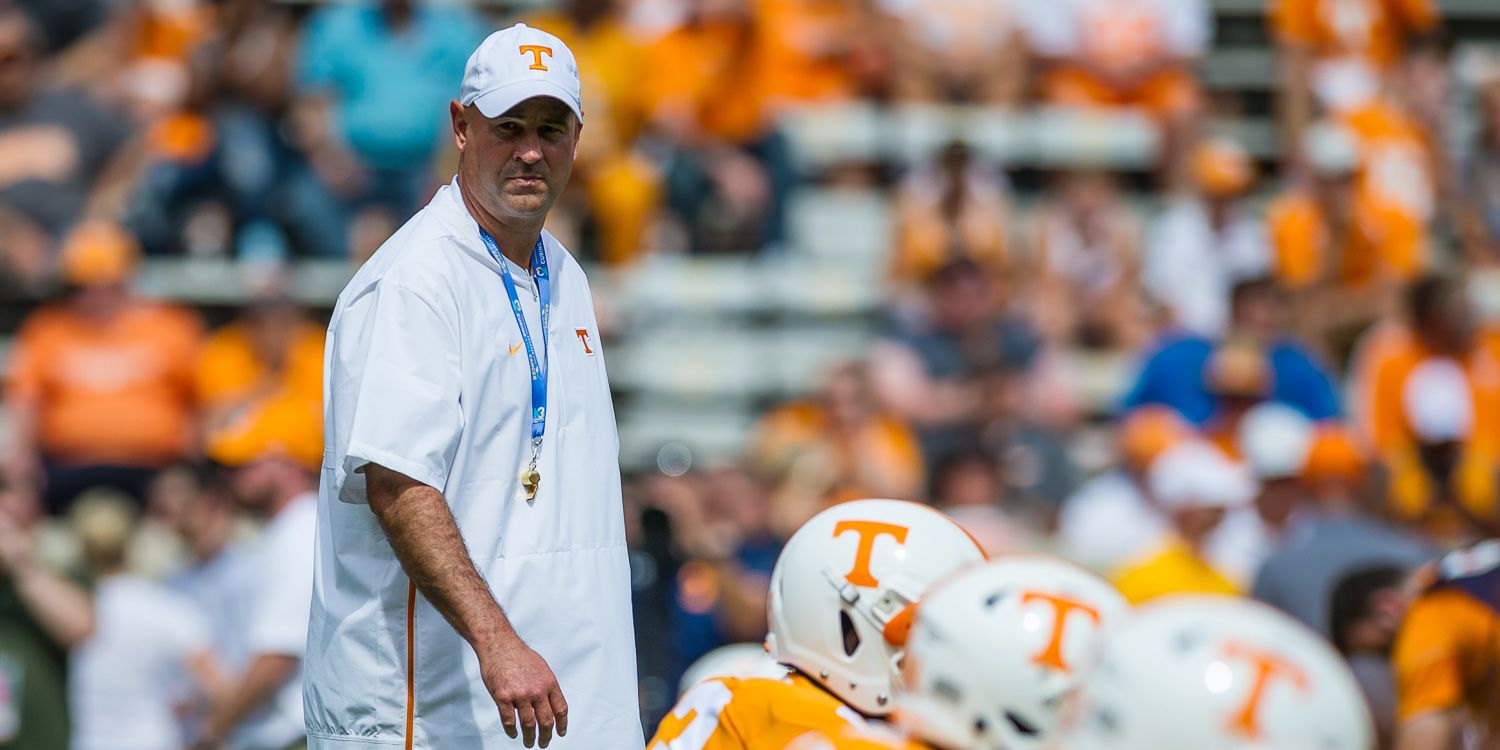
For Jeremy Pruitt, who earned plenty of confidence as a defensive coordinator, one of the most important issues in his first year is getting his team to believe: not just in him, but in themselves. That will be a tougher task in the next few weeks. But tomorrow night – surrounded by champions past, and inspired by the pain and knowledge of what should have been the last four years – the Vols can take a big step forward, in confidence and result.

This is a big one; it always will be. But after years of finding a way to lose, a new coach can inspire confidence by getting his team to play with it.

#DontLetUp
 

Gators, Guarantano, and the Run-Pass Ratio

It seems fair to say Tennessee isn’t asking Jarrett Guarantano to do too much so far. He only attempted 25 passes despite trailing all day against West Virginia. And the Vols didn’t seek to step on the gas to create additional separation from UTEP on the scoreboard, thus Guarantano attempted only 16 passes. His 54 attempts through three weeks rank 11th in the SEC, ahead of only the starters from Alabama, Georgia, and Mississippi State, whose assistance hasn’t been required much beyond halftime.

But in those 54 attempts, however restrained the offense may or may not have been…Guarantano has been pretty good.

He’s hit on 39 of them, for a 72.2% completion percentage. That’s 10th nationally through three weeks. His 9.1 yards per attempt are tied for 22nd nationally. And the Vols are one of just 14 teams yet to throw an interception.

It’s one game against an FCS foe, one game against what may be the worst team in FBS, and one against a West Virginia team not known for its defense. But what he’s been asked to do, he’s done well.

How much more will the Vols ask of him this week?

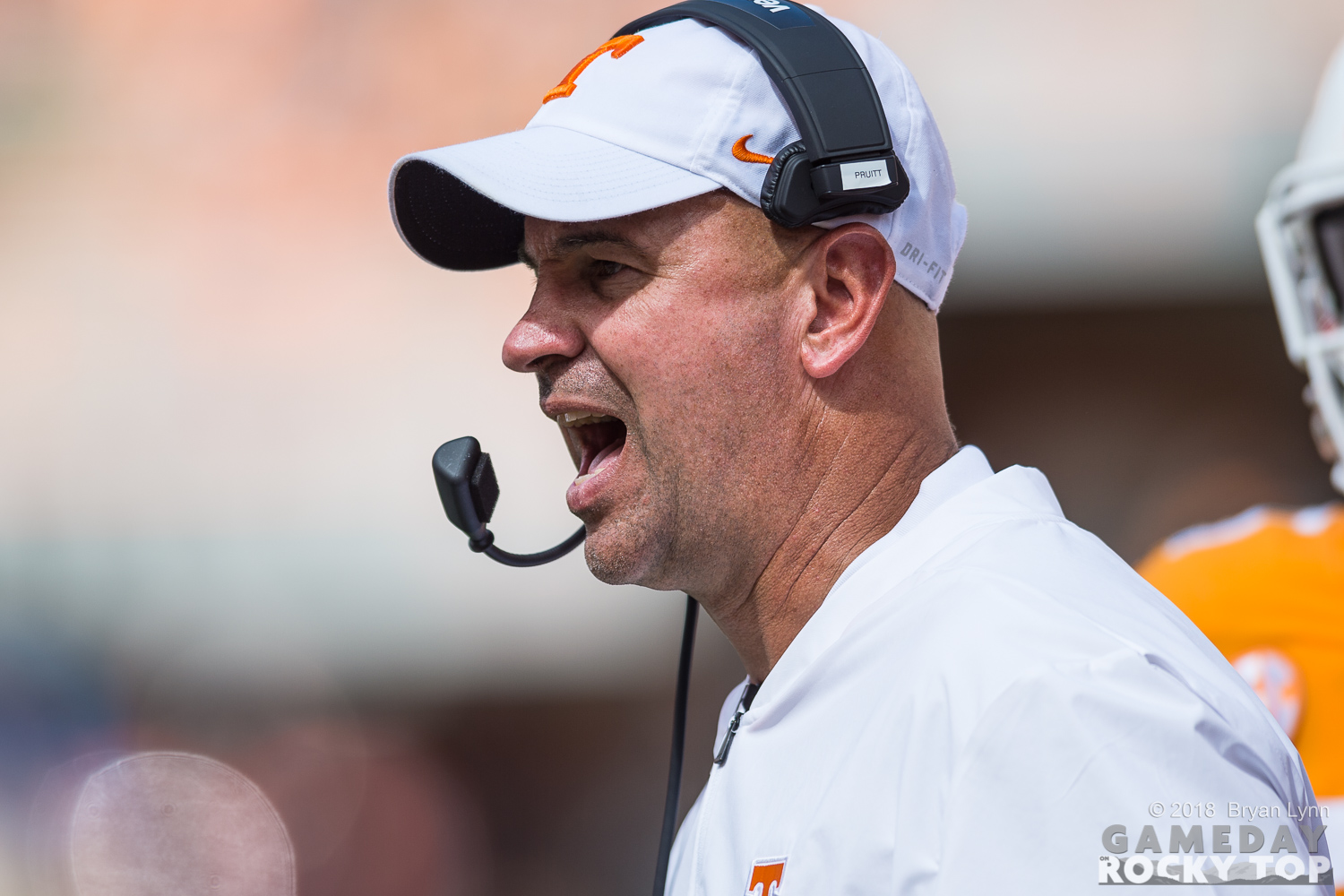
The coaches change, but the first rule of Tennessee-Florida remains: the team that runs the ball best has the best chance to win. The best chance doesn’t guarantee victory – the Vols have won the rushing battle three years in a row now – but it’s still the best philosophy. And it’s one Jeremy Pruitt should enjoy.

Tennessee has run the ball 132 times this year to Guarantano’s 54 passes (plus six for Keller Chryst). So far they’ve kept the ball on the ground 68.8% of the time. It sounds like a winning formula in this series…but the results have been mixed thus far. The Vols are clearly more explosive this year: after just 46 runs of 10+ yards and 13 of 20+ yards last season, Tennessee has 21 and six, respectively, in 2018.

But slow starts are both perception and reality. What do we make of this:

  • 1st Quarter: 28 carries, 35 yards, 1.6 ypc (129th nationally)
  • 1st Half: 69 carries, 237 yards, 3.4 ypc (97th nationally)
  • 2nd Half: 63 carries, 427 yards, 6.8 ypc (9th nationally)

(Stats from Sports Source Analytics)

Are the Vols simply wearing down lower-level competition as the game goes on? Ty Chandler’s 81-yard run in the third quarter certainly helps, and that first series against West Virginia certainly hurt the first quarter numbers. But Tennessee clearly has to get off to a better start.

And this is where the rubber will meet the road for Jeremy Pruitt and Tyson Helton: how long do you stay patient with the ground game against the Gators? How much more do you give Guarantano to do instead?

Of his 54 passes, I can’t remember many (if any) that were in danger of being intercepted. The Vols will have to take more chances. How this new staff manages risk will matter a lot; it’ll feel like even more to us watching after the way the previous staff often failed to manage it well. Tennessee is built on Maxim #1, and Jeremy Pruitt seems like a guy who likes coaching the team that makes the fewest mistakes. But it takes all seven maxims to beat the Gators. How the new coach plays for and makes the breaks will go a long way Saturday night.


The Unpredictable (Non-UGA) SEC East

Two weeks into the season, our top two thoughts about the SEC East remain unchanged:

  • Georgia is waaaaaaayyyyyyy better than everyone else; the Vols shouldn’t compare themselves to UGA right now.
  • There’s little separation between the rest of the division; the Vols may have finished last in 2017, but how they do against the non-UGA East is still a good barometer in 2018.

South Carolina was the most popular choice to come in second; they got dusted by Georgia at home, trailing 41-10 until a late touchdown trimmed the final margin to 24. And on the other end of the spectrum, Kentucky beat Florida – in Gainesville – for the first time in more than three decades.

There’s an anything-can-happen feel to the rest of the division behind the Dawgs. Case in point: look who’s leading the non-UGA pack in S&P+ through two weeks:

Team S&P+ FPI
Missouri 16 27
Vanderbilt 23 53
Kentucky 35 47
South Carolina 43 33
Florida 46 32
Tennessee 57 61

Wyoming-over-Missouri was a trendy preseason pick; the Tigers routed the Cowboys 40-13 and now face a suddenly 0-2 Purdue team this week. And if your reflex is still to pick against Vanderbilt no matter what, you paid dearly for it the first two weeks: 35-7 over MTSU, 41-10 over Nevada.

These numbers will be tested over the next two weeks. Vanderbilt is in South Bend Saturday afternoon, Missouri hosts Georgia next week. We’ll see how good those two are against top-level competition. But the anything-can-happen-ness among the rest of the division is still good news for a Tennessee team looking to move its way up the ladder.

Recruiting is still the long-term solution, and Vanderbilt, Kentucky, and Missouri are still not threats there. The Vols (11th) have the lead on South Carolina (16th) and Florida (18th) in the 247 Composite Rankings, but the Gators (53.3%) and Gamecocks (44.4%) now lead the Vols (40%) in blue chip ratio. Without the on-field results, it will be difficult for Jeremy Pruitt and staff to separate themselves from Muschamp and Mullen in recruiting.

That makes whatever separation can be earned on the field even more important. Thus Tennessee’s five most important games are all against the non-UGA SEC East, all of them some version of up for grabs. The Vols get one more tune-up this week, then the Gators, then three straight “brace yourself” opponents with a bye week thrown in for good measure. But whatever happens there or even against Florida, four of those most important games are in the last five down the stretch (plus Charlotte). What happens against those big rivals in the middle may feel like it carries more weight, but it may be what the Vols can do against their secondary rivals from the SEC East down the stretch that becomes the best sign of progress. For Tennessee to be successful, historically speaking, it has to separate itself from Kentucky, Vanderbilt, and South Carolina. The Vols can’t allow those secondary rivalries to become actual rivalries in the long-term.

In the short-term, though, we should be in for interesting outcomes when these six teams face each other.


Marquez Callaway and Number One Receivers

History suggested Tyson Helton would change the Vol passing attack, and we’ve seen it already in the first two games. Butch Jones’ offense targeted running backs more than any team in the SEC, essentially making the tailback the number three receiver. Not only has that changed dramatically in Helton’s offense – two catches for Tim Jordan, one for Jeremy Banks – a number one receiver has emerged in ways it never did in the last five years.

Marquez Callaway has 11 catches for 141 yards in the first two games. At this pace he’ll eclipse last season’s total – when he was the number one receiver in theory – by the end of the month (24 catches for 406 yards). And through the first two games, no other Vol has more than four receptions (Josh Palmer and Jordan Murphy).

We’ll see what happens with Jauan Jennings, the presumed top target going into last season and even this one by some. But so far, Callaway is the clear preference of Jarrett Guarantano. Sports Source Analytics has Callaway with seven catches for 115 yards (29th nationally) on first down, plus three for 15 and a pair of first downs on third down. The early returns show Callaway targeted early and often.

Callaway has 36.7% of Tennessee’s total receptions and 44% among wide receivers. We never saw percentages like those under Butch Jones:

Year Receiver #1 Catches Receiver #2 Catches
2017 Brandon Johnson 37 Marquez Callaway 24
2016 Josh Malone 50 Jauan Jennings 40
2015 Von Pearson 38 Josh Malone 31
2014 Pig Howard 54 Von Pearson 38
2013 Pig Howard 44 Marquez North 38

(Von Pearson played only 11 games in 2014)

You have to go back to the last two years under Derek Dooley to find true number one targets. Da’Rick Rogers easily stood out in 2011: 67 catches for 1,040 yards and nine touchdowns. The following year we remember Cordarrelle Patterson fondly, but many of his highlights were in the return game and on carries. Justin Hunter was easily the top target in the passing game with 73 catches for 1,083 yards to 46 for 778 for Patterson.

I’m not sure if this offense is built for Callaway to accumulate those kind of numbers. But he is clearly the number one option in an offense that’s going to receivers far more often than we’re used to. It’ll be interesting to see how his numbers change as defenses adjust to stop him, and if Guarantano can establish the same kind of rhythm with someone else. But through two games, Callaway is on track to be the kind of top target we haven’t seen in a long time.


Tennessee 59 ETSU 3 – Building Confidence One Play at a Time

When Derek Dooley was taking his first steps as Tennessee’s coach, the Vols faced an elite Oregon team in week two. Tennessee led 13-3 early and was still alive midway through the third quarter, down 20-13 but driving into Duck territory. Then Matt Simms was pick-sixed, and the floodgates opened: 21 additional fourth quarter points from Oregon turned a competitive game at halftime into a 35-point blowout.

Dooley noted Tennessee’s inability to handle adversity in the postgame: “I was real disappointed from then on (the pick six) with how we competed. You would have thought we were down 40 (instead of 14).” This became a recurring theme with Dooley’s teams: the head coach would (correctly) point out that they didn’t handle adversity well, while never making successful adjustments to help them do just that. The Vols folded against Florida two years later in much the same fashion, and Dooley was on the way out.

In his second full week on the job, Jeremy Pruitt noted Tennessee’s struggles when faced with adversity against West Virginia, specifically when getting denied thrice at the goal line in the second quarter as the offense was coming off the field on 4th-and-1 almost as a reflex. Even without being overly critical of the previous administration, it’s fair to say the Vols need to build confidence after a 4-8 season and a steep fall from the Top 10 in mid-October the year before. We all wanted to believe the new staff could make some of that happen right away; I’d imagine the players hoped for the same thing. Pruitt has the rings as a coordinator to sell that argument.

When it didn’t happen, and the Vols lost by 26 to West Virginia instead, players and fans alike had to reset their baseline. It was just one data point – and hey, maybe West Virginia will turn out to have as much in common with 2010 Oregon as possible – but it was the first impression, and it didn’t inspire as much confidence as we were wishing for.

Today was the second data point. And while you won’t be talking about what the Vols did against ETSU when the season is over, today was important in beginning to rebuild that confidence. How did the Vols do?

Defensively, very well. ETSU gained only 194 yards on 58 snaps (3.34 yards per play) and were just 2-of-15 on third down. The Vols grabbed a pair of interceptions, a particularly welcome sight for freshman Bryce Thompson after facing West Virginia the week before. Tennessee still struggled to get pressure on the quarterback, but gave hope that what we saw last week had plenty to do with the opponent. As I write, Will Grier is 20-of-25 for 292 yards and three touchdowns against Youngstown State.

Jarrett Guarantano was sharp again: 8-of-13 for 154 yards, hitting a couple of deep balls to Josh Palmer and Marquez Callaway. The latter followed up his 6-for-63 performance from last week with 5-for-78. Last year only two Vol receivers (Callaway and Brandon Johnson) finished the year with more than 200 yards; Callaway is off to another strong start and is fast establishing himself as Tennessee’s top target.

The running backs all had individual moments that popped. But the Vols weren’t as effective as you’d like against FCS competition: Tim Jordan (15-for-65) and Jeremy Banks (13-for-62) were okay, but the run blocking didn’t inspire the confidence we’re looking for.

The good news: UTEP is next, 0-12 last year and a 30-10 victim to FCS Northern Arizona last week. There’s more confidence to be built and more fine-tuning the Vols will need to face the Gators.

One early difference between Pruitt and Dooley (and Butch): the new guy admitted his own mistakes from last week, noting poor clock management at the end of the second quarter gave West Virginia a shot at three more points. Confidence is only, always earned. The new coach is doing it one play at a time too.


Tennessee Pays For The Program It Wants To Be

It’s not been a good news week, with the 26-point loss to West Virginia and the injury to Brandon Kennedy. But the most significant thing to happen in Tennessee’s athletic department in the last seven days was this:

Rick Barnes will be 70 if he serves the length of this contract through 2023-24. At some point between now and then, I’m sure there will be conversation on a timetable for retirement and if his successor should come from within the staff, etc. Phillip Fulmer will be 74 when Barnes’ deal is up, and may not be making those decisions anymore.

But Fulmer, Barnes, and everyone involved with this week’s decision took a big step for Tennessee basketball. And whenever whoever follows both of them, the program has a chance to be far better for it.

As Grant Ramey points out, Barnes was previously the 10th-highest paid coach in the SEC, 35th nationally. While bigger contracts must be earned, Barnes’ initial salary represented the tail end of a long period of bargain shopping for basketball coaches. While other programs like Florida have had more recent success, Tennessee can rightfully fancy itself as the second-most decorated basketball program in the SEC. But it cannot win that argument when paying its coach at a bottom-third rate.

It makes sense for Barnes to be the second-highest paid coach in the league behind John Calipari, given both his past at Texas and the work he did last season. Whoever takes the job next may not carry the same credentials or command the same rate. But since Doug Dickey hired Kevin O’Neill from Marquette and replaced him with Jerry Green from Oregon, Tennessee had shopped exclusively in the mid-major aisle: Buzz Peterson (Tulsa), Bruce Pearl (Wisconsin-Milwaukee), Cuonzo Martin (Missouri State), and Donnie Tyndall (Southern Miss). The Vols can thank good timing for Barnes being available when Tyndall was let go, or Dave Hart may have taken us down that path again.

Other big-name SEC programs have made mid-major hires like Mike White at Florida or Bryce Drew at Vanderbilt. Sometimes it’s the best play available. But the primary reason the SEC made so much progress the last few years is because of its coaches. Along with Barnes, Mike Anderson, Bruce Pearl, Tom Crean, Ben Howland, Cuonzo Martin, and Frank Martin were all previously employed by a power conference school. Kentucky obviously got the guy they wanted. Avery Johnson came from the NBA. And you can argue the current mid-major hires – Mike White, Will Wade, Bryce Drew, Kermit Davis, and Billy Kennedy – all had resumes relatively stronger than the guys Tennessee hired before Barnes. Obviously Bruce Pearl was dynamite here and Cuonzo Martin made the Sweet 16; both of those guys are back in the league and the tournament now. But the bar has been raised in the SEC. Tennessee giving Barnes and his staff this kind of money suggests they’ll seek to clear it well into the future.

Competence vs Excellence

Even in a 26-point loss, Tennessee’s performance against West Virginia felt like an improvement over what we saw at the end of last season, both in the stadium yesterday and in conversation today. This is, of course, what we want to believe; Jeremy Pruitt has the immediate benefit of things being blamed on Butch Jones if they go south.  But just how much better was Tennessee, relatively speaking, yesterday?

The Vols averaged 4.78 yards per play, almost identical to the 4.77 they averaged last season, which was the lowest total since 2008. But the returns were incredibly diminishing last year: Tennessee averaged 6.09 yards per play in the first three games, then just 4.28 in the last nine. Six times in those final nine games the Vols averaged less than 4.5 yards per play. Yesterday was progress, even if small.

It never helps when you’re faced with 4th-and-25 on your opening drive. Tennessee allowed just one sack, which was definitely progress. But the Vols still allowed a dozen tackles for loss, a bad start for a team that gave up 7.42 per game in 2017, 121st nationally. The good news: last year the Vols lost an average of 4.1 yards per TFL. Yesterday Tennessee lost just 2.6 yards per TFL, which is especially good considering we lost 10 on the first snap of the game and five more two plays later. The Vols still have issues getting a push at the line – see 1st-and-goal at the 1 – but most of their losses were of the non-catastrophic variety.

(This is the bar when you’re 4-8 with a new head coach: hey, it wasn’t a catastrophe!)

The Vols gained 14 yards in their first 15 snaps, then 287 in their last 48 (5.98 yards per play). Again, not great…but better. The Vols still lacked explosiveness – 13 plays of 10+ yards – but were slightly better than last season when they averaged 11 such plays per game (120th nationally). There are questions as to if the Vols can block well enough to create more opportunities downfield, but the offense still moved the ball in spite of that potential problem.

Tennessee’s offense was competent.

West Virginia’s was excellent.

The Mountaineers’ 8.97 yards per play is the most against a Tennessee defense since Marcus Mariota and Oregon unleashed 9.04 in Butch Jones’ third game five years ago. We hope that turns out to be a good comparison: the 2013 Vols rebounded to defend well enough to have a chance to win against Georgia, South Carolina, Vanderbilt, etc. That initial performance was both about a new scheme and a Heisman quarterback.

Was this one? That’s the biggest question to me going forward. Will Grier made a couple of throws yesterday that were among the best I’ve seen in person from a college quarterback. It helps when you’re facing very little pressure.

The guys on the back end are young, raw, and got the final exam on the first day of class. They’ll get better. The guys up front are seniors, and there are few options behind them to begin with. Tennessee will get more from Trevon Flowers and Bryce Thompson. But it has to get more from its defensive line and pass rush. The challenge may not be as great the rest of the season; that by itself might prevent another catastrophic performance in stopping the pass. But the Vols have to find a competent pass rush to help their freshmen defensive backs.

We’ll learn a lot when the Vols face the Gators in three weeks, and because of Tennessee’s schedule and who follows Florida, it’s going to feel like an awful lot is on that game. This team is going to get better. Will they get better fast enough for Florida? Stay tuned.


Tennessee vs West Virginia Preview: How Many, How Much, A Few

Let’s go.

How many points will Tennessee have to score to win? In six years at West Virginia, Dana Holgorsen is 53-37. In those 37 losses, the Mountaineers still averaged 24.9 points per game. By comparison, Tennessee went 34-29 the last five years with Butch Jones at the helm. In those 29 losses the Vols averaged only 17.4 points.

You’re not beating West Virginia 14-10. Even a relatively strong performance from Jeremy Pruitt’s defense right out of the gate will probably still require Tennessee’s offense to score more points than it mustered in most of its games last season. After a strong opening against Georgia Tech and Indiana State, the Vols scored more than 24 points just once the rest of 2017 (26 at Kentucky).

Tennessee will need to do something well, then do it consistently on offense to outscore West Virginia. The most likely answer there, as you’d imagine with this match-up, is via the ground game.

How much can Tennessee rely on its ground game? Last year West Virginia was 1-4 when allowing 200+ yards on the ground. The Mountaineers were 99th nationally in yards per carry allowed last season, and were especially susceptible on first down: 5.18 yards per carry allowed, and 48 runs of 10+ yards surrendered (127th nationally). Big plays were readily available on the ground when the defense didn’t know what to expect. Last season West Virginia ranked 100th or worse in 10+ yard runs allowed, 20+ yard runs allowed, etc. all the way through 50+ yard runs allowed.

It’s incredibly important for Tennessee to stay on schedule in this game, not only to protect the quarterback, but to put West Virginia’s defense in positions it struggled to stop last year. This feeds directly into the Vols showing improvement in the things they were very worst at last season: creating big plays (123rd nationally in 20+ yard gains), but also tackles for loss allowed (121st) which leads to a poor third down conversion rate (120th). The Vols must go backward far less to create more 3rd-and-3’s and fewer 3rd-and-7’s. And they have to capitalize in the ground game with both consistency and explosiveness against West Virginia.

A few incompletions can make a huge difference. On the other side of the ball, I think the most telling stat on West Virginia is this: the Mountaineers were 0-6 when completing less than 60% of their passes last year, 7-0 when completing more. Some of the sub-60% numbers include Will Grier’s absence, who was 6-of-8 when he went down against Texas. But in the three losses when he played the whole game:

  • Virginia Tech: 31-of-53 (58.5%)
  • TCU: 25-of-45 (55.6%)
  • Oklahoma State: 20-of-42 (47.6%)

With the possible exception of Oklahoma State, Grier wasn’t bad by any means in these games. He averaged 7-8 yards per attempt against good defenses from Virginia Tech and TCU, with three touchdowns and only one pick in both games. Both teams only sacked him twice; Oklahoma State just once. But all three did enough to disrupt the passing game to win; VT and TCU won by identical 31-24 scores, while Oklahoma State won the 50-39 shootout they’re built for. The Vols under Pruitt are far more likely to follow the Hokie/Horned Frog model.

The path to victory won’t be easy, and there’s so much we simply don’t know about this Tennessee team. But there is indeed a path: find repeated success on the ground and make Grier just uncomfortable enough. Don’t expect to beat West Virginia 14-10, and I’m not sure the Vols are built to beat them 50-39. But opportunity, as they say, is now here. And I’m very excited to see what we’ve got.

Go Vols.


Every Season Tells a Story

For a few of us, the 2018 season kicked over the weekend (Duquesne at UMass baby!). For the rest of us, now it’s game week: everyone’s undefeated, and everyone can dream.

Tennessee’s dreams have been some combination of strange and brief for a long time now. Standing in the way this fall are a Top 20 opener, annual rivalries with the present-and-perhaps-future kings of college football, and the annoying habit of drawing one of the best teams from the SEC West that isn’t Alabama. All of this on the heels of the program’s first eight-loss season and, even more, the worst S&P+ rating of any SEC team when it made its most recent coaching change. Another dream might meet another quick death this fall. The potential for adding another year on that tab might make us wonder if it’s healthy to dream at all.

Along those lines, the last ten years have made me less attached to the head coach, though I’m not sure one can totally escape such attachments no matter where you fall on the spectrum from fan to fanatic. For me it’s one part self-preservation: Lane Kiffin, Derek Dooley, and Butch Jones were all exhausting to defend in their own ways.

But at the same time, what has given me the most comfort and confidence in the last nine months is the presence of Phillip Fulmer. He is, for sure, a coach I was incredibly attached to in all of our younger days. But it’s also because of something I remember most from when those days came to an end:

(from November 3, 2008 at SouthEastern Sports Blog)

Doug Matthews was on Sports Talk earlier today, and made this point: Nick Saban is a fantastic coach, but he’s not personally invested in the University of Alabama the way that Phillip Fulmer was and is invested in the University of Tennessee. Not even close.

Urban Meyer’s not. Neither is Les Miles or Mark Richt.

And the next man who comes in here won’t be either.

Meyer and Miles have won National Championships. And we absolutely hope whoever comes in here next will do the same.

But what we gave away today we won’t find again.

Butch Jones and Lane Kiffin were from somewhere else, Derek Dooley the son of Georgia royalty. Jeremy Pruitt is from the opposite of here.

But there remains no one more personally invested in Tennessee Football than the person who hired him.

There are never any guarantees; we already asked Fulmer to leave once. But as the Vols lost both games and trust in record numbers last fall, he was the only choice, and in all the right ways. I don’t know if or when the Vols will get back to winning like the 1990’s again. But I do find it easier to trust something good is possible with someone so personally invested back in the decision-making chair. That much of what we lost is found again. And it’s valuable, at least to me.

We do all this every year because we love the Vols. Even when they don’t win. But now it’s a little easier to have faith, or at least it feels a little more right. And Fulmer hired hope, an unproven risk/reward coach even though safe and easy options were on the board. The ultimate goal hasn’t changed for us, because it certainly hasn’t changed for him. And it’s one Pruitt knows quite well as an assistant coach.

All of that is down the road, but we can dream its dream. This is Week One. This week we don’t have to worry about how long we’ve been gone. This week everything is new, just as it feels the right kind of old.

And this week is about all of us pulling in the same direction, something we haven’t enjoyed for more than a few short weeks in a very long time. I don’t know how far Jeremy Pruitt and the 2018 Vols will go this fall. He’ll earn some level of trust along the way. But after a season when the rope slipped through our fingers faster than ever, then threatened to unravel entirely? Now we get a chance to pick it back up again, together in more than name only. This is the week to grab the rope. Set your feet. And by God pull.

It’s here.

This week, in Charlotte, in Knoxville, and wherever you listen…it’s football time in Tennessee.

2018 Gameday on Rocky Top Picks Contest

It’s back and better than ever: the 2018 Gameday on Rocky Top Picks Contest is now open. As always, we’re using our friends at Fun Office Pools: we pick 20 games each week (straight up) using confidence points, where you place 20 points on the outcome you’re most confident in, one point on the outcome you’re least confident in, etc. Weekly winners get a free Gameday on Rocky Top t-shirt; the regular season champ gets pride, plus a free Gameday on Rocky Top hoodie.

NEW THIS YEAR: the games are listed with the latest weekend kickoff first, which means if you forget to pick the Thursday night game it only costs you one point instead of 20. My apologies that it took us having a baby last fall to realize how ridiculous that punishment used to be.

If you’ve played in one of our pools before, you should’ve received an email with sign-up instructions. You can also click here to sign up! Any questions, fire away in the comments below.

Here’s our Week 1 slate!

Thursday, August 30

  • Northwestern at Purdue – 8:00 PM – ESPN

Friday, August 31

  • Army at Duke – 7:00 PM – ESPNU
  • Western Kentucky at #4 Wisconsin – 9:00 PM – ESPN
  • San Diego State at #13 Stanford – 9:00 PM – Fox Sports 1

Saturday, September 1

  • Florida Atlantic at #7 Oklahoma – 12:00 PM – FOX
  • Ole Miss vs Texas Tech (Houston) – 12:00 PM – ESPN
  • #23 Texas at Maryland – 12:00 PM – Fox Sports 1
  • Tennessee vs #17 West Virginia (Charlotte) – 3:30 PM – CBS
  • #6 Washington vs #9 Auburn (Atlanta) – 3:30 PM – ABC
  • Appalachian State at #10 Penn State – 3:30 PM – Big Ten Network
  • Central Michigan at Kentucky – 3:30 PM – ESPNU
  • Washington State at Wyoming – 3:30 PM – CBS Sports Network
  • #22 Boise State at Troy – 6:00 PM – ESPNEWS
  • Cincinnati at UCLA – 7:00 PM – ESPN
  • #14 Michigan at #12 Notre Dame – 7:30 PM – NBC
  • Middle Tennessee at Vanderbilt – 7:30 PM – SEC Network
  • #1 Alabama vs Louisville (Orlando) – 8:00 PM – ABC
  • BYU at Arizona – 10:45 PM – ESPN

Sunday, September 2

  • #8 Miami vs #25 LSU (Dallas) – 7:30 PM – ABC

Monday, September 3

  • #20 Virginia Tech at #19 Florida State – 8:00 PM – ESPN