Tennessee vs Georgia Tech Preview

Two big truths from Tennessee’s last outing against Louisiana: one, “Does this team have anyone who can guard Grant Williams?” is still the first question to ask. When the answer is no, you get Friday’s performance: 31 points and 7 rebounds made Williams #2 in the early KenPom Player of the Year standings. (Zion Williamson is third, for what it’s worth.)

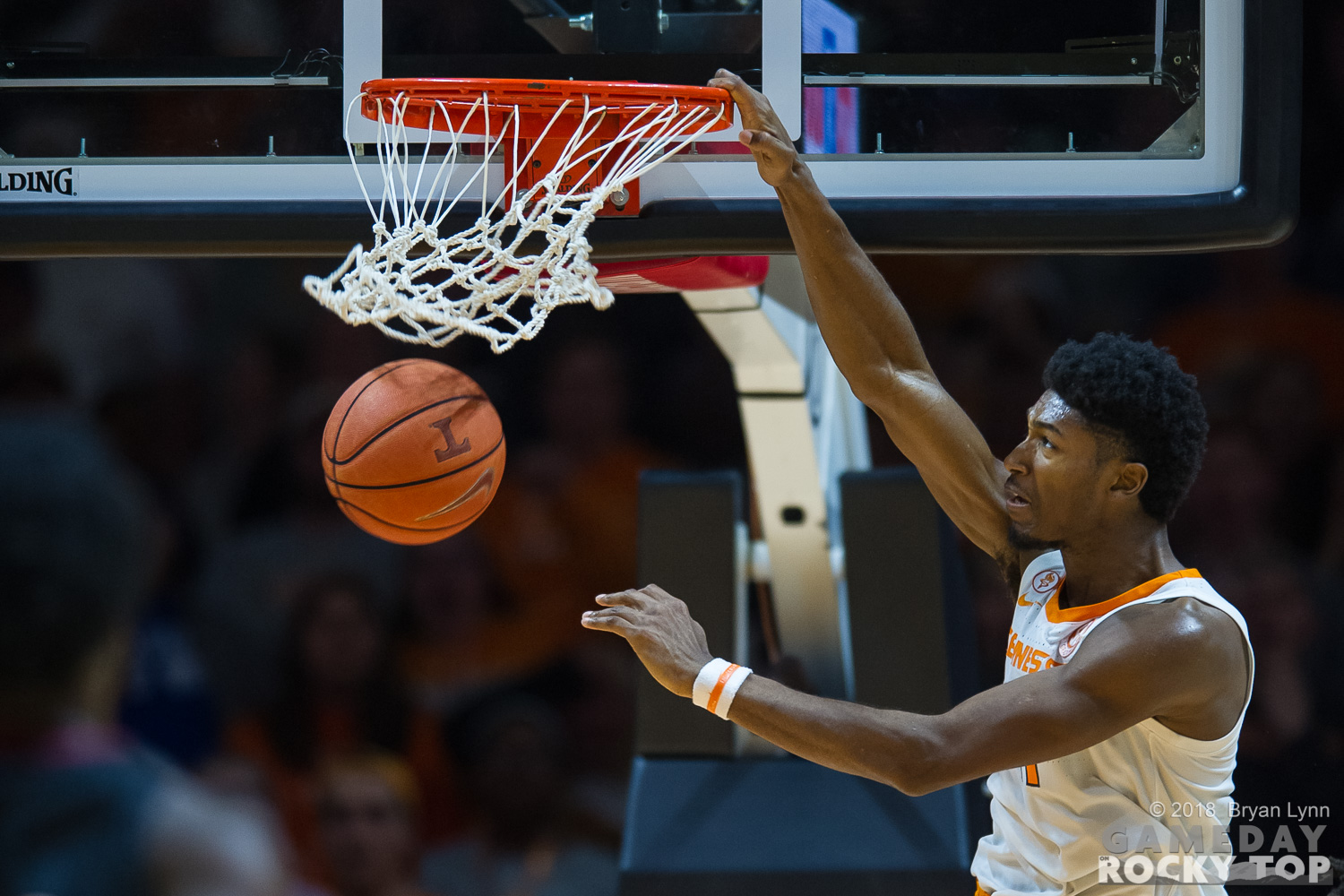
But we already knew about him. The bigger news: as we speculated in our season preview, the Vols gave some of the minutes that went to James Daniel last year to Yves Pons. Then they put the 6’6″ Pons on Louisiana’s point guard. And it worked.

Aside from all the excitement about what Pons’ athleticism can do on the offensive end, if he can give the Vols quality bench minutes while harassing the other team’s point guard? That levels up an already-great Tennessee defense. It’s early, but it was a very encouraging sign. We’ll get our chance to see more against major conference competition now: Georgia Tech, then Louisville, with #1 Kansas lurking.

First, Georgia Tech. A four-year series with the Yellow Jackets comes to an end tonight. Rick Barnes’ first team fell by two points in his second game, victimized by a 35/27/53 shooting line (FG/3P/FT%). One of the earliest signs of what could be under Barnes was the second game with the Yellow Jackets: after near misses against Wisconsin and Oregon in Maui, the Vols obliterated Georgia Tech 81-58 in Knoxville. Tennessee’s leading scorers that day were a freshman named Grant Williams and point guard Shembari Phillips, who eventually transferred to…Georgia Tech. He had to sit out last year, when the Vols won 77-70 in Atlanta behind 24 off the bench from Lamonte Turner. But he started GT’s season opener against Lamar, scoring 10 points with four assists and three steals in an 88-69 win.

Josh Pastner’s crew started ACC play 3-1 last year with wins over Miami and Notre Dame. They were still 11-11 (4-5) at the end of January. Then they lost seven straight, six by double digits. A first round exit in the ACC Tournament made them 13-19 (6-12) on the season, a disappointing end after an NIT runner-up finish the year before.

Josh Okogie is now a Minnesota Timberwolf, but the Yellow Jackets bring back guards Brandon Alston and Jose Alvarado to team with Phillips in the back court. Alvarado excelled in stealing the ball last season, finishing 131st nationally in steal percentage.

What to know about tonight’s match-up:

  • This was simply a bad shooting team last year. Georgia Tech finished 283rd in FG% and 325th in three point percentage (31.8%). Alvarado is their best returning shooter from the arc and he hit only 37%.
  • Last year Georgia Tech’s best basketball was about defending inside the arc. The Yellow Jackets surrendered just 45.4% from two, 24th nationally. They finished 23rd in blocked shots; 6’10” Sylvester Ogbonda looks to be the primary threat there, who played sparingly last year due to injuries. By contrast, teams splashed 37.9% from behind the arc against the Yellow Jackets last year, 320th nationally. The Vols are already good at creating open threes, but it could be an even easier task tonight.
  • A patient pace? Last year Georgia Tech was 277th in tempo, almost even with the Vols at 282nd. Tennessee looked plenty good against Louisiana, who loves to go up-tempo. The Yellow Jackets will be a good early test to see if the Vols want to go any faster this season against a team that won’t encourage them to do so. We know the Vols can win in a number of different ways. Let’s see if they prefer to speed Georgia Tech up just a bit.

It’s a late start: 9:00 PM ET on ESPN2. Last chance to catch the Vols before they’re in New York for Thanksgiving next week.
 

Sunday Stats: Vols & Guarantano Moving Up

Tennessee made the third-biggest move of the week in S&P+, up a dozen spots from 82nd to 70th overall (shout out to Minnesota’s 41-10 beat down of Purdue, leaping 23 spots). The bad news: Missouri is a Top 25 team in S&P+. The Tigers actually fell three spots after a narrow victory over Vanderbilt, but are 23rd in the S&P+ rankings and would be favored by about a touchdown on the Vols. The good news: Vanderbilt is now the worst team in the league by the same metric.

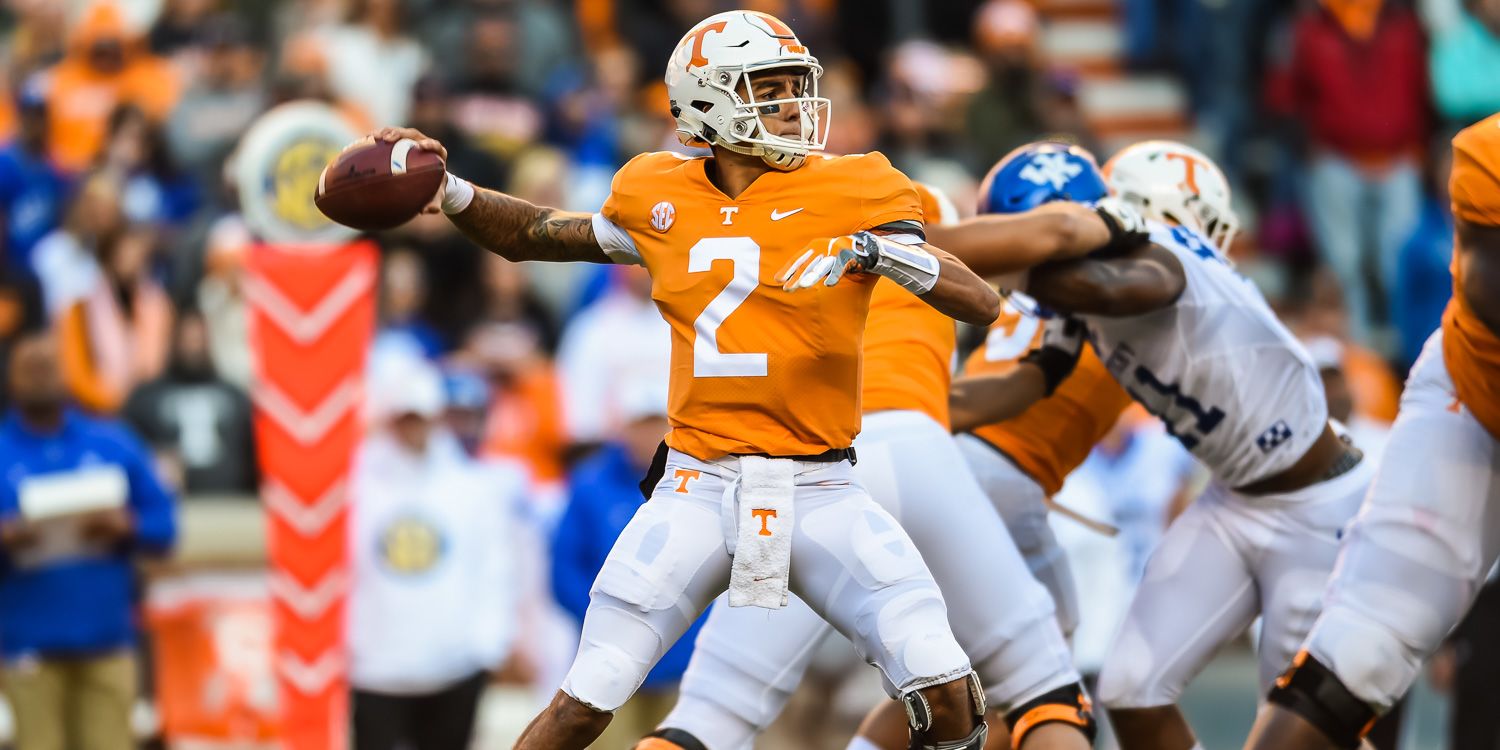
Jarrett Guarantano in national rankings (via Sports Source Analytics): 27th in completion percentage, 24th in yards per attempt, and one of only eight quarterbacks with 200+ passing attempts and two or fewer interceptions. They showed this on the Jumbotron yesterday and I didn’t believe it, but it’s true (via Sports Reference): Guarantano’s career completion percentage of 63.8% is currently the best in school history. Daryl Dickey completed 63% of his passes, Peyton Manning 62.5%. Guarantano is at 65.1% in 2018; no Vol quarterback has hit that mark since Erik Ainge in 2006 (67%).

Things we’re still bad at: the Vols are 126th nationally in tackles for loss allowed, surrendering 8.3 per game. This is still a worse pace than last year (7.42 per game), but also still an improvement in terms of how far we’re going backward. Last year the Vols lost an average of 4.1 yards per TFL. This year it’s only an average of three yards lost. More runs for -1, fewer total disasters, etc.

Tennessee continues to be far more explosive this season. Last year the Vols had 38 plays of 20+ yards and 18 plays of 30+ yards. This year, through ten games: 45 plays of 20+ yards, 24 plays of 30+ yards.

Guarantano only has a pair of interceptions, but the Vols have now lost ten fumbles (and put it on the ground an additional five times). The ten fumbles lost is good for 111th nationally.


Tennessee 24 Kentucky 7 – Almost Always, Almost Never

Tennessee used three turnovers and an unreal third-and-long performance to beat Auburn. And despite a 21-9 third quarter lead, the right team won in Columbia two weeks ago with the Gamecocks dominant in their comeback. We assumed this – third downs, turnovers, etc. – was Tennessee’s specific path to victory, and it would take more talent for the Vols to be the right team.

Today, against the #11 Kentucky Wildcats, Tennessee was the right team.

It’s felt weird all week, Kentucky being favored and (rightly) ranked so high. And so now, on the heels of Tennessee’s 24-7 victory, there’s a tendency to treat it like business as usual; the Vols haven’t lost to Kentucky, ranked or otherwise, in Knoxville since 1984.

Let’s be clear: this was not business as usual. Not just for Jeremy Pruitt, but for the Vols in recent memory.

Two second half fumbles made the score look more respectable. But Tennessee gained 412 yards in 60 snaps, 6.86 yards per play. Kentucky gained 262 yards in 73 plays, 3.59 yards per play. That difference of 3.27 yards per play is the best for any Vol squad against power five competition since Lane Kiffin’s 2009 Vols beat Georgia 45-19 with a difference of 3.49 yards per play.

That day felt like validation. Again, it’s hard for a Tennessee coach to earn validation by beating Kentucky in football. But those Dawgs were unranked, and these Cats just outside the Top 10. It feels a bit like Tennessee’s blowout of #12 Northwestern in the Outback Bowl at the end of the 2015 season: the name can carry more weight than the ranking, so much so we might fail to appreciation the level of domination.

Much of the validation we’re looking for – as much as is available this year – is one more win away. Butch Jones beat a South Carolina team that finished fourth nationally, but a failure to earn bowl eligibility made that memory fade. As we’ve mentioned before, those Gamecocks might have been the best team Jones beat in his entire tenure. But at Tennessee, 5-7 is never going to qualify as a memorable year.

For today to last, the Vols need to win one more. But for now…today was quite memorable indeed.

Jarrett Guarantano averaged 9.9 yards per attempt and tear-dropped several balls, including the end-of-half hail mary. For a team that couldn’t run all year? Ty Chandler and Tim Jordan combined for 152 yards on 31 carries, plus 59 more for Jordan Murphy on the reverse. Two school records were tied or broken today, as Darrell Taylor notched four sacks and Guarantano continues to just not throw interceptions. He’s got a shot at Peyton Manning’s single-season record of four picks.

Tennessee wasn’t lucky or gimmicky. They simply dominated Kentucky on both sides of the ball, the type of performance that raises the ceiling of everyone involved.

Jeremy Pruitt now has two ranked wins in ten games. Lane Kiffin got one in his only season, Derek Dooley infamously went oh-for-three-years, and Butch Jones got the Gamecocks in year one and Georgia in year three. It’s a big deal.

Pruitt also got a schedule that some might rank the toughest in the nation through this week. Kentucky is the sixth Tennessee foe to have spent time in the Top 15 this season. The next two won’t make that list, but the Vols still need one of them to earn bowl eligibility. Missouri will present in many ways the opposite challenge from today; if Vanderbilt beats Ole Miss next week the Vols and ‘Dores could face each other with only one going through to the postseason.

There’s work left to do. But today was some of the best work we’ve seen in this decade. We almost always beat Kentucky. But we almost never beat a ranked team – or anyone – like this.

Go Vols.


Tennessee vs Louisiana Preview

It’s a progressive opening run for Tennessee: after a D-II blowout win, the Vols will be tested up the ladder by Louisiana tonight (120th in KenPom), Georgia Tech (90th) on Tuesday, then Louisville (66th) in the preseason NIT with a chance to face #1 Kansas.

The Ragin’ Cajuns went 27-7 last year, easily winning the Sun Belt at 16-2 before a 71-68 loss in the conference tournament sent them to the NIT. They lost in the opening round to LSU 84-76, book-ending their season with losses to SEC teams with a 94-76 beat down from Ole Miss in the opener.

Their leading scorer graduated, but there are plenty of points left to go around: Louisiana dropped 121 on the University of the Virgin Islands in the opener, with six players in double figures. They scored 100+ six times last year, and they dominated the rest of the Sun Belt on the glass, leading the league in offensive and defensive rebounding percentage (via KenPom). Overall the Cajuns were sixth nationally in offensive rebounding percentage, but they also graduated Bryce Washington (6’6″ 255) who led those efforts.

Louisiana started a three-forward lineup that went 6’6″, 6’6″, and 6’8″ in the opener. None have the bulk of Washington, but they also didn’t need many offensive rebounds while shooting 14-of-24 from the arc. Last year these guys were just really good at taking advantage everywhere: 76.1% from the free throw line and 46.4% from the floor. Their defense also seemed to chase people away from the three point line, giving up the 52nd-fewest threes attempted on the season despite playing at such a fast pace and playing from in front so often in the Sun Belt.

Jakeenan Grant also excelled as a shot blocker, sending back 9.1% of the shots against him, 39th nationally. Point guard Marcus Stroman was 14th nationally in assist rate (10 assists in the season opener), 80th in steal rate, and fourth nationally in free throw rate. He clearly makes things go for the rest of their offense. 

This is an experienced team that’s used to winning and each other. It’ll be interesting to see what Tennessee elects to do with a team that wants to score a bunch of points in an efficient manner. They were 55th nationally in KenPom offense last season, and could continue to excel even without their best scorer and rebounder from last season.

It’s a good early test for the Vols as they continue to build toward New York City. 7:00 PM, SEC Network.


Rotation, Rotation, Rotation

It all starts tonight for the #6 Vols. That’s the highest preseason ranking in program history, and better than any preseason ranking in football since 2005. These are good days. Enjoy them.

Lenoir-Rhyne shouldn’t find much to enjoy tonight, the Division II alma mater of Rick Barnes. As such, we shouldn’t learn a whole lot about the Vols, at least not until Friday when the Rajun Cajuns (a 27-7 NIT squad last year) come calling. More on them later. For now, in the absence of specific details to watch for against a D-II squad, here’s something to keep an eye on as the season unfolds:

So, what will this look like?

Last year the Vols had two primary lineups: one with Kyle Alexander and two of Bone, Bowden, and Turner. And one without Alexander where all three guards played together with Schofield and Williams. Lineups with some combination of those six players made up 42.9% of Tennessee’s minutes down the stretch of the season last year according to KenPom’s data.

Derrick Walker’s minutes varied by the opponent last year: before getting 18 minutes in Alexander’s absence against Loyola-Chicago, Walker played 9-22 minutes four times and 2-6 minutes three times in the last seven games. John Fulkerson got lots of run early, then played only a single minute (when Grant Williams fouled out?) against Georgia around three DNPs in late February/early March. Then he played 7-15 minutes in the last four games of the year.

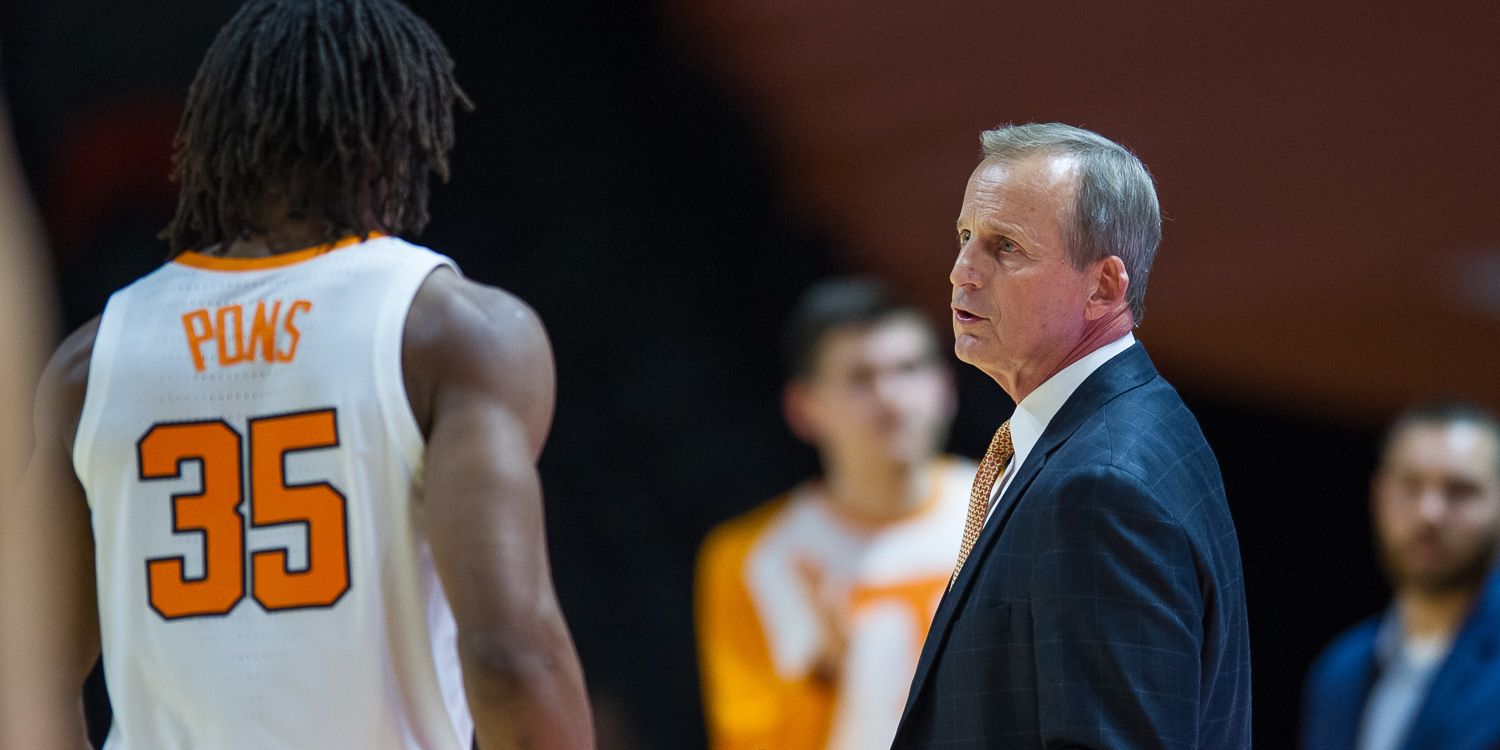
The winner of the preseason chatter award on this team seems to be Yves Pons, who saw no SEC action until late January, then became a four minutes per game guy, then averaged seven per game in the last four. There are guard minutes up for grabs with James Daniel’s graduation. Yves isn’t going to run the point, but could he guard one on the other end for a few minutes?

The tenth man, if you believe freshman DJ Burns is headed for a redshirt, should be Jalen Johnson. He gave the Vols nine minutes in the win over Texas A&M, but otherwise wasn’t relied on for more than a couple minutes here and there in non-blowouts. Will Barnes utilize Johnson as a true member of the rotation, or will he just earn the same spot minutes?

Tennessee can be the same team in crunch time, both the with-and-without Kyle Alexander versions, if they choose to be. But in the other 36ish minutes, how will Barnes tinker? After needing 31+ minutes from Armani Moore, Kevin Punter, and Robert Hubbs his first two years, last season Barnes had the luxury of not needing any more than 28 minutes from Williams and Schofield. If the Vols go 10-deep, how consistent will the rotations be? Is there room for a breakthrough from Pons or Walker with so much traffic ahead of them? And how long will it take for this team to find its groove?

It all starts tonight.

The Better and Worse of Tennessee’s Deliberate Offense

Not everything is the best or worst you’ve ever seen, though it may feel like it in the moment. Such was the case for portions of the day against Charlotte, when the Vols ran it 26 times for 20 yards against a Conference USA opponent and scored only a single offensive touchdown. It wasn’t good at 4.09 yards per play, Tennessee’s lowest output of the season. But per play, it was better than three games from last season, including both the obvious (Georgia and Alabama) and the similar (Southern Miss, 3.56 in victory). On the year Tennessee averages 5.35 yards per play, a significant improvement on the 4.77 from last year. The running game yesterday certainly didn’t fit the “competent, not excellent” theme the Vols have been building from after last year, but both the result and the other phases of the game were acceptable.

At the end of this year, when the offense’s total yards are held against them (currently 333 per game, 313 against power five competition), one thing to keep in mind: Tennessee is playing at a much slower pace than in most of the last ten years. The Vols ran just 47 plays yesterday, the second time this year (46 at Georgia) we’ve been under 50 offensive snaps.

Tennessee averages 62.2 plays per game. The Vols were actually a tick slower last year at 61 plays per game. But in time of possession, you can see a significant difference between 2017 and 2018:

Year Plays YPP TOP
2018 62.2 5.35 31:09
2017 61 4.77 28:14
2016 68.9 6.44 27:24
2015 76 5.56 30:32
2014 75.2 4.93 30:14
2013 67 5.27 28:49
2012 74.2 6.42 26:58
2011 66 5.04 30:45
2010 63.6 5.72 28:52
2009 67.5 5.69 30:24

(Stats via Sports Source Analytics)

Last year the Vols ran essentially the same number of plays, but took almost three fewer minutes off the clock at a difference of nearly half a yard less per snap. There are several key differences from last year: one is third down conversions, the lifeblood of Tennessee’s offense. The Vols are converting 41.13% in 2018, 50th nationally, and have picked up 37 first downs through the air on third down, 11th nationally. Last year Tennessee converted just 30.67% of their third downs overall, 120th nationally.

How else are the Vols staying on the field? Take away the Florida game, and how many turnovers do you remember?

For the record: two against UTEP, the late fumble against Georgia, and the sack-fumble of Guarantano early in the Alabama game. Six against the Gators still stings, but the Vols have turned it over just four times in the other eight games. Last year, by contrast, the Vols had 18 turnovers in 12 games.

The narrative of Tennessee’s season will essentially be written by what they do in the next three games, and whether they can find two wins to get bowl eligible. But there’s enough data to this point to begin to establish Tennessee’s identity. The Vols continue to run on first down, even though they’re not very good at it (4.05 yards per carry, 101st nationally). Tennessee’s 69 passing attempts on first down rank 119th nationally, despite playing from behind so often in four of the five losses.

Part of me still believes the Vols are running it so often on first down to protect their defense: keep the clock moving, limit opportunities, etc. Tennessee is also snapping it deeper into the play clock than at any point under Butch Jones.

The real question here is how we’ll see the Vols open things up not just in the next three weeks, but next season when, in theory, all of the skill players could return along with Guarantano. Maybe the most surprising number of all: Guarantano’s 8.1 yards per attempt are on par with the best numbers of the post-Fulmer era (8.3 for Dobbs in 2016 and Tyler Bray’s last five games in 2010, 8.0 for Bray in 2011 and 2012). The Vols appear more than capable in the passing game, but remain deliberate in their commitment to the ground game, even when it’s not working well. Again, I have to believe this is in part to protect their defense.

So what now? The offensive staff put together a different, effective gameplan at South Carolina. Needing two wins in three games to get home, will we see more passing attempts? Will that lead to opposing offenses taking advantage of more shots against Tennessee’s defense? Tennessee’s plan beat Auburn and gave itself a chance against South Carolina. Is there anything left up the offense’s sleeve?


What Can Tennessee Do Better?

One of the greatest indicators of health for last year’s basketball team was the absence of any real blueprint for success. From our post on the eve of the NCAA Tournament:

  • The Vols are 19-3 when shooting at least 33.3% from three. But they also beat Florida, Texas A&M, and won at Rupp Arena shooting less than that.
  • The Vols are 17-0 when holding their opponent under 40% from the floor. But they also beat Kentucky twice when the Cats shot above that.
  • The Vols are 14-0 when assisting on at least 64% of their made shots. But they beat Purdue and Kentucky when assisting on less than half of their makes.
  • Grant Williams has scored 20+ eight times, but the Vols lost two of those games. Meanwhile one of their best performances of the year was at Mississippi State, when he had eight.
  • Admiral Schofield has scored 20+ seven times, but only two of those came against tournament teams (Kentucky twice). Meanwhile the Vols beat nine-seed NC State in the Bahamas when Schofield had zero.
  • The Vols are 13-2 when Jordan Bowden scores double digits, but just annihilated Arkansas in the SEC Tournament when he had two points.

(All these stats come from the fine folks at Sports Reference)

After two years of needing big numbers from Kevin Punter or Robert Hubbs in seasons that went south when their health did, the 2018 Vols were far more than one-dimensional. They beat big-name opponents in multiple ways, and finished in the Top 50 nationally in a variety of stats: three-point shooting percentage, free throw shooting percentage, offensive rebounding, assist percentage, blocked shot percentage, field goal percentage defense, and three-point percentage defense.

The Vols are well-rounded and get almost everyone back. They’re defending SEC Champions with the highest preseason ranking in program history. Things look really good.

How can the Vols be even better?

Two-Point Field Goal Percentage

Last year only two tournament teams – not at-large teams, but the entire field of 68 – had a worse shooting percentage inside the arc than Tennessee: 16-seed Radford (shout out to my southwest Virginia neighbors), and 11-seed Syracuse who played in the First Four. The Vols made 47.3% of their shots from two, 278th nationally.

Kyle Alexander is tremendous at this, ranking 18th nationally on shooting percentage inside the arc at 67.9%. The rest of the Vols? Not so much.

The short version: the Vols don’t have a bunch of guys who finish well at the rim, or guards who create their own shot. The latter is probably by design in part: as you can see above, Tennessee excels at offensive rebounding, getting to the free throw line, and knocking them down. And the Vols’ exceptional ball movement – remember, Tennessee led the nation in assist percentage for much of the year and finished seventh – created plenty of open looks from three. It was an offense that finished 36th nationally in KenPom. It’s certainly not broken. But to get to a championship level, Tennessee needs to be more efficient from two.

Jordan Bowden was a better shooter from three (39.5%) than two (39.2%). Jordan Bone and Lamonte Turner were only slightly better. On the other end of the spectrum, one player to watch here is Derrick Walker. He’s the only player on the roster (with freshman DJ Burns looking at a possible redshirt) with the size and strength to get away with it, but he made 59.6% of his attempts from two. Will Tennessee run more of its offense through big men down low to get higher percentage looks? This is the other side of the coin of something else the Vols could do better:

Shoot More Threes…?

We looked at this at the end of the season back in March. The Vols shot 38% from three, 45th nationally. But only 35.7% of Tennessee’s shot attempts were threes, 220th nationally. If 65ish% of your attempts are twos, and you’re not a great two-point shooting team…should the Vols just jack it up more?

Tennessee’s three-point shooting last year was bolstered by so many players knocking them down. Bowden, Turner, Bone, and Schofield were all 38-40% shooters from three. The Vols do lose James Daniel, who hit 37.2%.

We know Tennessee can create good looks inside-out thanks to Williams and Schofield. Should the Vols take more of those looks? Or will the greatest room for improvement come from Alexander and Walker growing their scoring footprint in the paint, thus improving Tennessee’s percentage inside the arc?

Foul Less

Tennessee was 36th nationally in fouls last year, despite playing the 282nd fastest pace in college basketball. Some of this is the nature of the beast when you have undersized bigs and are aggressive defensively. And the Vols didn’t necessarily lose because of this alone, as teams shot 71% at the line against UT, an average 151st nationally.

But Grant Williams averaged 3.3 fouls per game, and fouled out six times. It was most costly in the loss at Arkansas, but the Vols also fell to Villanova, Missouri, and at Georgia when Williams was disqualified. They did beat Georgia Tech, and famously won the SEC by beating Georgia in the rematch after he fouled out. And when you run the numbers per minute, the Vols had lots of foul-happy reserves, led by Derrick Walker and Yves Pons. This isn’t just one player’s issue.

There’s clearly no need for a team that finished sixth in KenPom defensive efficiency to change its identity. But even fouling a little less, with guys like Williams playing fewer minutes with four fouls, can make a difference this season.

What Can KenPom Tell Us About Tennessee?

My web browser marks the changing seasons as well as anything. Right now my most visited sites include Sports Source Analytics and the hubs for my fantasy football team and our weekly pick ’em contest. But soon, they will give way to Basketball Reference, the Bracket Matrix, and of course, KenPom.com. A moment of silence for RPI Forecast, a longtime friend of the blog from back when we were trying to figure out if Cuonzo Martin’s first team could play their way in from a triple-digit RPI in December. The NCAA is moving on to something they call NET, which one can only hope will find an obsessive website of its own.

The move away from RPI is a nice step forward, but KenPom remains king of the advanced stats conversation. Last year the Vols were picked 13th in the SEC in the media poll. KenPom had the Vols sixth in his 2017-18 preseason ratings, and 43rd nationally.

This year’s preseason ratings have swung the other way, of course, with the Vols now the hunted. Tennessee is sixth in the AP poll, the program’s highest preseason rating ever. Tennessee is down at 11th in the initial 2018-19 KenPom ratings, but here the rating is more important than the ranking.

The Vols are at +21.14 (the number of points they’re expected to win by vs the average team in 100 possessions). Last year Tennessee finished at +22.27, the second-highest rating of the KenPom era (since 2002). The 2008 Vols finished at +22.17. Tennessee’s KenPom leader, as we like to point out from time to time, is actually Cuonzo Martin’s last team at +23.69. Like S&P+ in college football, it’s not a measure of your resume (and doesn’t value an end-of-game play more than the first possession; so the 2014 Vols aren’t punished for Antwan Space’s theatrics). It’s a measure of your efficiency on every possession; I always like to think of it as, “Which team would I least like to play?” Cuonzo’s Vols were bad at closing games (and finished 341st in KenPom’s luck ratings in 2014), but put more players in the NBA than any Tennessee team in my lifetime. Doing things like beating #1 seed Virginia by 35 and winning eight of nine before the Michigan loss by an average of 21 points is how you get that kind of rating.

This year the Vols are in a crowded field of teams, but I don’t know if I’d call it the second tier. In KenPom’s ratings, only one team is set apart in the preseason rankings: Kansas, also number one in the AP and Coaches’ polls. The Jayhawks are +29.27, nearly four points better than Duke at +25.44.

Think of it this way: for Tennessee, how many teams out there are simply better than us?

The Vols faced Villanova last November and battled for a half. But the Wildcats outscored Tennessee by 21 in the second half, winning by nine. And the proof was ultimately in the pudding: Nova won the title for the second time in three years, and amassed a +33.76 rating. Other than Kentucky’s almost-undefeated 2015 squad (+36.91), it was the best rating of any team in ten years.

Villanova was just better than us, and while anything can happen on any given night in a single elimination sport, there was no shame in losing to that Nova team. The early ratings suggest there’s only one such team this season: Kansas, who the Vols may get a shot at over Thanksgiving in New York City.

The usual suspects from Duke, North Carolina, and of course Kentucky are all ranked higher than Tennessee in KenPom. But their ratings are all within about three points of the Vols. With Rick Barnes you know you’ll get plenty of chances to find out what you’ve got: aside from a possible date with Kansas and the SEC opportunities, Gonzaga and West Virginia are rated ninth and tenth in KenPom as well. You won’t have to wonder about Tennessee, but it’s not just the good feelings from last year that suggest the Vols should have every chance to win against everyone, only a little less true against Kansas.

What’s more, last year SB Nation’s Villanvoa blog looked at the KenPom profiles of national champions. With one outlier – 2014 UConn, who won it all as a #7 seed – every national champion has finished in the Top 20 of both KenPom offense and defense. That list in the 2018-19 preseason ratings: Kansas, Duke, North Carolina, Virginia, Villanova, Kentucky, Syracuse, Gonzaga, and Tennessee.

There’s a lot to be excited about. And the numbers back up the idea that the Vols were far more than a feel-good story last year. If healthy, Tennessee shouldn’t find themselves at a disadvantage against almost anyone. And, along with plenty of other marquee opportunities this year, they might get to find out about the almost in just a few weeks.

On Becoming the Right Team

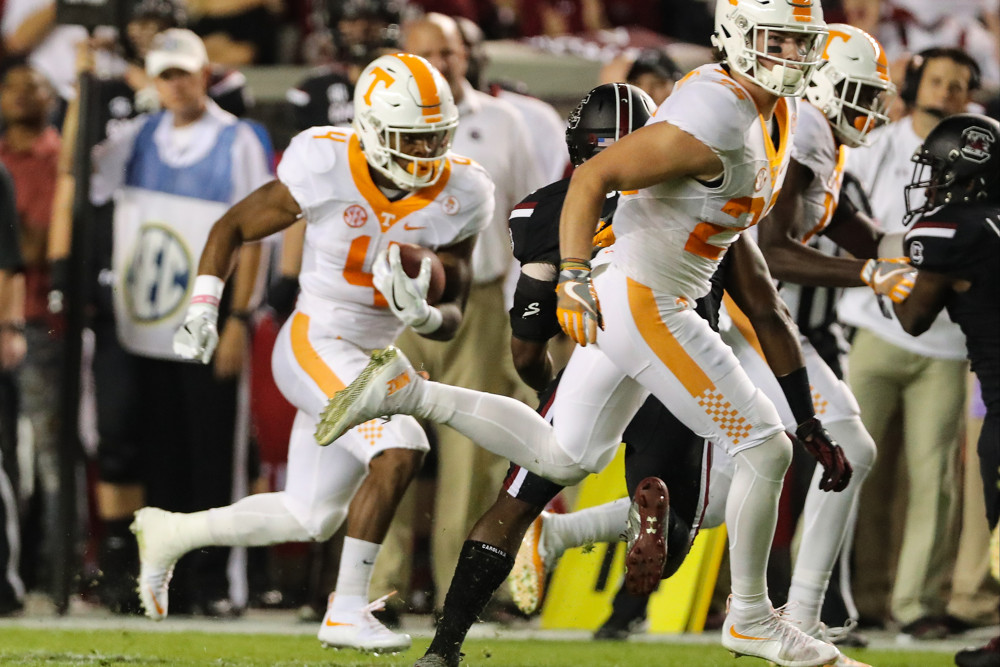
We almost got to hit the fast forward button last night. Tennessee’s touchdown to open the third quarter wasn’t the grind of its first two, which combined to take nearly 12 minutes off the clock in 21 plays. This one was poetry: nine plays, 75 yards, and almost all of them looked like they caught South Carolina off guard. The result was a 21-9 lead with 10 minutes to play in the third quarter. The Gamecocks, 3-3 on the year, looked wobbly. Pruitt’s Vols looked ready to ascend toward bowl eligibility.

And then, the game Vegas thought we’d see showed up.

South Carolina’s next three drives covered 198 yards in 20 plays. You can do the math there on the per-play average. Tennessee’s next three covered 109 yards in 35 plays. That math isn’t as much fun.

The end result – a three-point win for South Carolina – makes sense when you look at total yards: a 376-to-351 advantage for the Gamecocks smells of a close win. But per play, South Carolina (6.71) was far superior to Tennessee (4.81).

We saw some of Tennessee’s script for victory in creating a turnover and not being loose with the ball themselves. But South Carolina, as they have done all year, made it their business to take away big plays. The Gamecocks are now ninth nationally in 20+ yard plays allowed, sixth in 30+ yard plays allowed. And when Tennessee can’t connect on those downfield shots, you get an offense that looks like the one we saw last night: overly reliant on long drives sustained by a third down conversion percentage that seems, well, unsustainable.

Tennessee has converted 33 first downs on third down passes this year (stats via Sports Source Analytics). That’s 10th nationally among teams playing fewer than nine games so far. Jarrett Guarantano was remarkable, for the most part, on third down again last night, even when it had to look different from the downfield throws. Credit Tyson Helton and Tennessee’s offense staff for drawing up a plan that still worked without them. But the more you have to live on third down, the more it will eventually kill you.

South Carolina, meanwhile, lived much more reasonably: big plays taking advantage of a vulnerable Vol secondary, but also 224 yards on 40 carries, which represented 71.4% of their offensive snaps. It’s been there all year, just covered up by turnovers against Florida, an actual win at Auburn, and the quality of opponent from Georgia and Alabama. But Tennessee’s struggles to stop the run might be the quality that most stands in the way of the Vols and bowl eligibility. The Vols are 99th nationally in yards per carry allowed. In S&P+, the offense earns high marks for what it has been able to do, 35th nationally. But the defense ranks 104th, and it’s been down there for a while.

There are no easy answers, and no quick ones either with most of the snaps on the defensive line set to graduate. The Vols have been trying to overcome it in their own way on offense: methodical drives that create few opportunities for turnovers, peppered with enough risks down the field (and enough talent at wide receiver) to keep ’em honest. But when those risks don’t pay off, as was the case last night, Tennessee needs an otherworldly percentage on third downs to sustain drives.

So the numbers say the right team won last night, which also means credit the Vols for almost winning anyway. Nine penalties certainly didn’t help. But I don’t know if the Vols can be the right team the rest of the way home here, which means they’ll need that familiar formula: win the turnover battle, limit the snaps for the other side, convert a bunch of third downs, make those splash plays count.

The good news: Missouri and Vanderbilt have not been good at all in stopping explosive plays. After what will surely be another ranked win opportunity when Kentucky visits in two weeks, the Tigers and Commodores could end up being the best match-ups the Vol offense has seen on the Power 5 level all year. Tennessee’s 4.24 yards per carry last night were UT’s most against a Power 5 opponent since John Kelly ran wild on the Gators last September.

Tennessee is still making progress, which is great. But right now, even against their secondary rivals in the SEC East, it feels like the Vols have a very specific formula for victory, without many variables. The Vols may not be the right team until Pruitt and his staff bring more talent in. But last night they gave themselves a chance to win anyway. Let’s see if they can do it again.


Every Time We Go To Columbia…

Tennessee and South Carolina have been annual rivals for 26 years now. But after Carolina’s initial upset in 1992 – the final nail in Johnny Majors’ coffin – the rivalry lacked much importance during a 12-game Tennessee winning streak. That changed when Steve Spurrier arrived in 2005, beating the Vols in Knoxville. Since then, every Tennessee-South Carolina game in Columbia has become a landmark moment for the Vols in one way or another. It’s in part due to Carolina’s rise under Spurrier. But it’s also just an interesting twist of fate that the Vols have come to Columbia so often at their own crossroads. As Tennessee heads to South Carolina again this weekend, here’s a look back at the last six trips to Williams-Brice Stadium:

2006: The Last November as a Title Contender

On October 28, 2006, the #8 Vols earned a little payback for Spurrier’s win in Knoxville the year before. With College Gameday on hand, Tennessee beat South Carolina 31-24 under the lights in Columbia, turning back a 17-14 Carolina lead at the start of the fourth quarter with a 13-play, 80-yard drive. The win sent the Vols to November at 7-1, the only blemish a one-point loss to eventual BCS Champion Florida. But a late game injury would sideline Erik Ainge the following week, when the Vols fell to #13 LSU 28-24. Tennessee hasn’t been in the title conversation in November since then.

2008: Fulmer Forced Out

Already reeling at 3-5, Tennessee was no better at South Carolina. A 27-6 victory for the Gamecocks included just 207 yards from the Clawfense, and days later Fulmer was officially stepping down. He would finish out the season, though the Vols would fall to Wyoming the next week.

2010: Tyler Bray Emerges

The Vols and #20 South Carolina were tied at halftime, but a strip-sack fumble by Matt Simms was returned for a touchdown on the second play of the third quarter. That prompted Derek Dooley to hand the keys to true freshman Tyler Bray. His first pass was a pick six. But it got way better from there: Bray finished 9-of-15 for 159 yards and two touchdowns, helping the Vols rally to tie the game with 13 minutes to play. South Carolina won out behind Marcus Lattimore and Alshon Jeffery, but the Vols found their quarterback. Bray would lead Tennessee to a 4-0 run in November for bowl eligibility, taking several Tennessee freshman records along the way.

2012: Derek Dooley’s Last Chance

At #13 South Carolina, with Dooley’s Vols 3-4 and the head coach still looking for his first ranked win, Tennessee almost made it happen. Rallying back from three different 14-point deficits, Tennessee pulled within three at 38-35 with 8:35 to play, the intercepted Connor Shaw on 4th-and-4 at the UT 30 with 4:46 to go. Tyler Bray got the Vols in the red zone with less than two minutes to go when Jadeveon Clowney – silent all day up to this point – scored a sack/fumble, recovered by the Gamecocks. Dooley wouldn’t officially be fired for another few weeks, but the last of us left the ship on this day in Columbia.

2014: Josh Dobbs Emerges

Perhaps the least-tainted happy memory of the Butch Jones era. A week after entering the Alabama game and raising plenty of eyebrows, Josh Dobbs earned the first start of his sophomore season and never looked back. On the day: 301 yards passing and 166 yards rushing, a new school record for rushing yards by a quarterback. Five total touchdowns, including two in the last five minutes to turn back a 42-28 hole and get the game to overtime. Sacks on first and second down by Curt Maggitt and Derek Barnett led to a missed 58-yard field goal to win it for the Vols. Though the ultimate end for Butch Jones wasn’t what we wanted, this game remains the beginning of the real hope for something more. From November 1, 2014 to October 1, 2016 the Vols went 18-5 with wins over four ranked teams, those five losses by Jones’ now-infamous 25 points. Then we lost to Texas A&M in double overtime and got smoked by Alabama. And then…

2016: The End of the Beginning of the End for Butch Jones

Still alive in the SEC East race and in total control of their own destiny for the New Year’s Six, having survived a gauntlet of four straight ranked teams plus the Battle of Bristol, and coming off a bye week…the Vols lost to South Carolina 24-21 as a 14.5-point favorite. Dobbs, so spectacular two years earlier against the Gamecocks, was 12-of-26 for 161 yards passing and just 27 yards rushing. This was Jalen Hurd’s final game in a Tennessee uniform. And for Jones, it ended any association with that 18-5 run: 4-4 in their last eight in 2016, then 4-8 in 2017.