Tennessee at Memphis Preview

In a year when the Vols weren’t ranked third and didn’t just beat number one, this would still be a weekend for celebration. In this year, reflecting on the return of the Tennessee-Memphis rivalry is a joy on multiple levels.

The Vols and Tigers met annually from 1988-89 through 2001-02. Only six of those games featured a ranked Tennessee or Memphis squad: three for each side, and never in the same year. One of those came in December 1992, when #8 Memphis led by Penny Hardaway came to Knoxville and lost 70-59 to Allan Houston’s Vols. 

Memphis won the next three, then Kevin O’Neill and Jerry Green put together a five-game winning streak. Buzz Peterson’s first team lost by two to John Calipari’s first team, and then Calipari helped keep the rivalry paused.

It made me smile to read The Athletic’s oral history of the 2008 1 vs 2 Vols/Tigers clash:


“We went to their practice and Calipari expressed how much he did not like Tennessee in so many words. He was like, This is not a game. This is a war.”

Doc Evans, brother of Tyreke Evans

When it stopped, Buzz Peterson was trying to reload from Jerry Green’s four straight NCAA Tournament runs. Calipari was trying to rebuild his own image after sanctions at UMass and a failed three-year stint with the New Jersey Nets. Memphis hadn’t been to the NCAA Tournament in six years.

One part recruiting, one part football, one part Calipari – who would later champion playing anyone, anywhere, anytime, but clearly never wanted Tennessee home-and-home. By the time it returned in January 2006, Bruce Pearl was at Tennessee and Memphis was ranked fourth under Calipari. Pearl was a couple weeks away from the win over Florida that truly sparked that first-year run, and Memphis won at home 88-79 with Pearl raising Dane Bradshaw’s hand at the scorer’s table late in the game. But by the time it rolled back around the following year, the Vols were ready, and Chris Lofton put on what remains the single best individual performance from a Tennessee player in my post-Ernie/Bernie lifetime.

From there we got 1 vs 2, the first of three straight road wins in the series. Calipari went to Kentucky, then the Tigers went 3-0 against Cuonzo Martin the first two years, including a double overtime classic in Maui.

And then it was gone again. But now it’s back, for at least the next three years.

Calipari’s argument was, in part, that Tennessee benefited from playing Memphis far more than Memphis from playing Tennessee. If that was ever true while the two teams were playing, it was only in Pearl’s first year. The Vols were the Tigers’ equal on the floor afterward, and when Calipari left and Memphis bounced from a depleted Conference USA to the American? Now the opportunity has shifted hard to the Tigers.

Under Rick Barnes the Vols recruit nationally and successfully. Under Penny Hardaway, the spark is back on the banks of the Mississippi in ways Josh Pastner could never duplicate and Tubby Smith threatened to extinguish entirely. The Tigers haven’t made the NCAA or NIT since 2014. But Hardaway is doing work on the recruiting trail, including 7’0″ Memphis East five-star James Wiseman. 

Maybe my favorite part: while Pearl’s Tennessee teams quickly became the equal to Calipari’s Memphis teams, Barnes’ Tennessee teams have done the same with Calipari’s at Kentucky. Rick Barnes is 4-3 against the Cats at UT: his Vols are undefeated against Kentucky in Knoxville, beat the Cats in Rupp last season, won the SEC title and are currently ranked #3 to Kentucky’s #19. 

I’m grateful for Calipari the way Memphis fans should be grateful for Pearl: those two personalities gave that rivalry that little extra something. But this new chapter is exciting as well, with Barnes proving the Vols can be a stable force on the national scene, and Hardaway putting the Tigers back on the path to joining them. Fighting and blaming aside (on both sides), Tennessee and Memphis should play each other every year, no matter who thinks who gets the greater benefit. Both programs should be good enough to sustain it, and the rivalry deserves it.

This time around? Memphis is 5-4 and 118th in KenPom, but properly tested against the tier above them. Their best win is your choice of Yale in 2OT (99th KenPom) or South Dakota State (77th). But they also have a nine-point losses to LSU and an 11-point loss to #11 Texas Tech, who they led by nine at halftime before getting blown out in the second half.

The Tigers live by forcing turnovers (25th in turnover percentage) and getting offensive rebounds (33rd). 5’9″ freshman Tyler Harris is getting some early hype, knocking down 39.5% from three. But Hardaway is also getting the most out of his upperclassmen: 6’8″ senior Kyvon Davenport and 6’6″ senior Raynere Thornton are the forces on the glass, and Memphis can go small and aggressive on defense in a hurry.

The ascension in Knoxville, the hope in Memphis, and the rivalry itself should make for all kinds of fun tomorrow. High noon, ESPN. Welcome back, Memphis. I’m sure we’ll both keep pretending the other side missed it more than we did.

Go Vols.
Ranking the Gonzaga Win & Admiral Schofield’s Performance

Let’s rank yesterday even though it’s way too early to do so without the context of the entire season!

There are two clear-cut games at the top of my list. The Sweet 16 win over Ohio State will stand until the Vols make it to the Final Four; bonus points there from the 2007 Sweet 16 loss to the Buckeyes, properly avenged. And 1 vs 2 with Memphis in 2008 is fairly unassailable for the rest of all of our lives: the rivalry, Calipari, an undefeated Memphis and the Vols ascending to number one is once-in-a-lifetime stuff.

But after those two, it kind of depends on what you prefer. There’s a separate list of best Kentucky wins – last year at Rupp, Lofton at Rupp, beating them on the last day of the regular season to win the SEC East in Knoxville in 1999 (my personal favorite). There are wins on the way up, like 2006 vs Florida, that carry a “I can’t believe we’re doing this” quality. And that’s really how to best describe the last win over number one, when the Vols beat Kansas in 2010 after four players were suspended or dismissed just ten days earlier. 

Yesterday was not, “I can’t believe we’re doing this.” That felt like an Elite Eight game (or maybe a Final Four game, who knows!). It was two legitimate title contenders trading blows for 40 minutes; the 2008 Memphis game is the only comparison there. If that’s more your style – and hopefully it becomes more our style going forward – then I think you can make a case for that game as high as #3 on your list.

For me personally, I’m going 2010 Ohio State, 2008 Memphis, 1999 Kentucky, then yesterday, followed by 2010 Kansas and 2006 Florida. The rest of the season will determine how high or low it ultimately lands. Either way, it’s in pretty good company.

Perhaps even more impressive: let’s rank Admiral Schofield’s performance

The best individual performance I’ve seen from a Tennessee player is Chris Lofton vs Memphis in December 2006. People forget it because that shot over Durant was 17 days later, but in that game Lofton had 35 on only 8-of-24 shooting (plus 12-of-13 at the line). Against #17 Memphis, Lofton was 12-of-18, 6-of-11 from three, and scored 21 of his 34 points in the first half. It’s the best offensive performance – not just best three-point shooting – against a good team I’ve ever seen at Tennessee.

Yesterday, Schofield had 30 on #1 Gonzaga. He had 25 in the second half, and 11 in the last 3:18, including the game-winner.  

https://twitter.com/SeanFarnham/status/1071973319430176770

There have been some epic performances in school history. The iconic Ernie and Bernie games are both legion and before my time; the media guide highlights Ernie putting 43 on Kentucky in 1976, while Bernie had 40+ five different times. In my lifetime, Allan Houston had 43 in a 119-113 loss to LSU in Shaq’s freshman year. Ron Slay had 38, but the quality of opponent (New Mexico) will keep him a little further down the list. More recently we’ve seen Grant Williams with 37 at Vanderbilt and Kevin Punter with 36 vs #24 South Carolina.  

I think it’s at least safe to say that Schofield’s performance yesterday was the best we’ve seen since Lofton. In the aforementioned Lofton-at-Rupp game in 2006, he had 31 on 7-of-10 from the arc, Tennessee’s first win in Lexington in seven years. I’d still put the Lofton-vs-Memphis performance at number one, and probably Lofton-at-Rupp number two. But Schofield yesterday might be number three in the post-Allan Houston era. He was a volume shooter all day, but the late flurry helped him finish at 12-of-22 and 6-of-10 from the arc. Gonzaga wasn’t known for their defense, but that was still the number one team in the nation. Again, pretty good list to be on. 

#7 Tennessee 76 #1 Gonzaga 73: Sir, Yes Sir

Tennessee took 72 shots to Gonzaga’s 59, pulled down 16 offensive rebounds and only turned it over seven times. The Zags countered by getting to the free throw line: 19 attempts to Tennessee’s 10, though either team shooting it better could’ve won today with the Vols at 60% and Gonzaga at 63%. If you were a casual fan just watching two Top 10 teams, you got your money’s worth: Hachimura and Clarke each had 21 for Gonzaga, while Schofield – we’ll get to him in a minute – had 30 and Grant Williams added 16-12-7.

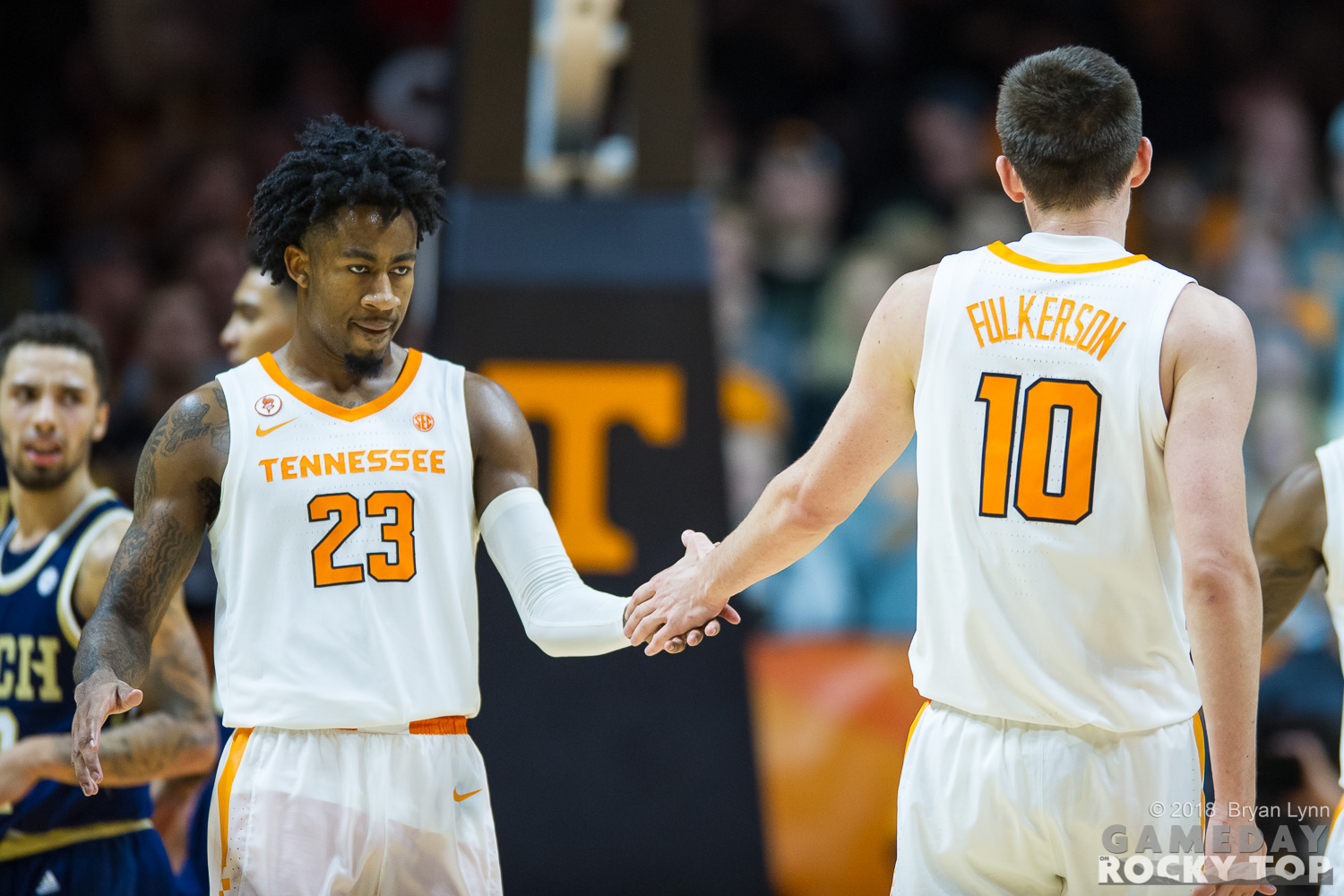
The box score at ESPN lists only six blocked shots in this game – four for the Vols, two for Gonzaga – but it felt like thrice as many. We knew going in these were two of the best shot-blocking teams in the nation, and boy did it live up to it. Brandon Clarke had one of the best blocks I’ve ever seen in my life on Yves Pons; Tennessee has a player like Pons who will try to dunk with no regard for his own life for the first time in forever. But the Vols answered with blocks that would have seemed spectacular had they taken place in any other game, but were just as critical. Two of them belonged to John Fulkerson, who played a bunch as the Vol bigs were saddled with foul trouble in the first half.

The threat of those blocks definitely affected Tennessee, especially after offensive rebounds. Jordan Bone was 2-for-13, Kyle Alexander had only two points, and Schofield took 22 shots.

But he made them count.

Gonzaga led by nine with 6:15 to play. The Vols stayed alive behind Jordan Bowden and Jordan Bone: a Bowden three, a Bone fast break layup, and another Bowden three cut it to three less than 90 seconds later. Grant Williams scored to get it back to three with 3:38 to play. 

Schofield would bury a three to tie it on the next possession, but the story shifted back to Grant Williams, who fouled out with 2:49 to play. Williams missed the overtime against #2 Kansas in Brooklyn, and the Vols failed to get a stop in the extra session without him, ultimately falling to the Jayhawks. 

Not this time.

After Williams fouled out, the Zags sank three free throws. But they went 0-for-4 from the floor. Meanwhile, the Vols went to Schofield:

  • Three to tie it at 68 at 3:18
  • Jumper to pull within one at 2:19
  • Banked three for the lead at 1:20
  • NBA three for the lead for good with 24 seconds left
https://twitter.com/marchmadness/status/1071892970083966976

With Gonzaga looking for answers, Jordan Bowden did a fantastic job covering Zach Norvell and denying him the ball. Norvell and Schofield had been jawing for most of the second half (what kind of crazy person talks to Schofield, I have no idea). The Admiral got the last laugh.

Gonzaga had not scored less than 81 points this year. They left with 73 and a loss today. Tennessee beat the number one team in the nation for the first time since 2010, and you’d be hard pressed to find a win like this in the eight years since. 

A game like this in December is really about March, where last year the Vols won the SEC. But a win like this in December allows us to take a look at the ceiling and nod. Yep, it’ll hold.

Go Vols.

Tennessee vs Gonzaga Preview

Gonzaga will be the third KenPom Top 50 opponent the Vols have faced in their first eight games. But we’re only scheduled to face three others between mid-December and mid-February. Tennessee’s SEC schedule is back-loaded this year: both dates with Kentucky fall in the last seven games, and the regular season ends with Mississippi State and Auburn. Other than those three conference foes, the only current KenPom Top 50 teams left on the schedule are Florida (January 12 & February 9) and West Virginia (January 26).

If Tennessee is thinking about a one seed and wants to get there via something other than a run at an undefeated season in SEC play, this would be a good win to get. When it’s the team with #1 next to their name on the other side, you typically don’t need additional motivation. But the Vols, having already flirted with #2 Kansas, have earned the right to think about more than just beating the top team for a day.

To do that? Defense better travel.

Gonzaga is number one in KenPom’s offensive ratings. They hung 91 on Arizona, 89 on Duke, and 103 on Creighton. The Bulldogs shoot 38.8% from three and 61.2% from two. The latter is second-best in the country, and the two combine to give Gonzaga the nation’s fourth best effective field goal percentage. They’re also 13th in turnover percentage, giving the ball away on just 14.7% of possessions.

The Vols have experience facing such a great offense: last year KenPom’s top two offenses belonged to Villanova and Purdue. For Gonzaga, Rui Hachimura gets top billing here – leading scorer, hit the game-winner against Washington on Wednesday – but KenPom loves what Brandon Clarke, Zach Norvell, and Josh Perkins are doing behind him.

Hachimura is more of a volume scorer and gets to the line. If you want raw efficiency, Brandon Clarke is 62-of-86 (72.1%) on the year, 14th nationally in effective field goal percentage and 25th in offensive rebounding percentage. Throw in 6’11” Filip Petrusev off the bench, and the Vols will have their hands full on the defensive interior. It’s easy to spend too much time on Hachimura and simply get beat by Clarke instead.

Luckily, the Vols will bring Grant Williams, Admiral Schofield, and Kyle Alexander to the party. These match-ups when Gonzaga has the ball should be so much fun to watch. Unlike going against Kansas or North Carolina the last two years, the Vols and Gonzaga are built much more in each other’s image: lineups full of upperclassmen, guys who play well together, and multiple ways to beat you.

If the Vols can work Gonzaga to a draw inside, you still have to defend Norvell and Perkins in the back court. Norvell is the designated three-point shooter, launching 8.7 per game and hitting 38.5%. Perkins is the senior point guard, 33rd nationally in assist rate and also plenty capable from three (38.9% on four attempts per game) and a 90% free throw shooter. There are no weak spots, and those four guys all run 26-32 minutes per game.

The good news: Tennessee is 12th nationally in defensive efficiency. The Vols are capable of defending well enough to win this thing.

Is Gonzaga? They beat Duke in part because R.J. Barrett went 9-of-25 and the Blue Devils didn’t defend well against Gonzaga’s ball screens. They bested Creighton by getting to the line 17 more times than their opponent. And their last-second win over Washington included Gonzaga shooting 19-of-19 at the line.

I expect Tennessee to offer a greater challenge on the defensive end than Washington, Creighton, and Duke-in-Maui (as opposed to Duke-in-March). And the Vols should also be just as capable, if not more so, of attacking on the offensive end. Gonzaga does not force turnovers, 295th nationally. Opportunities should be there for Tennessee to run its offense and take advantage, even if Lamonte Turner is still limited.

Perhaps the biggest question for this game: who wins the shot-blocking/foul-calling battle? Gonzaga is 48th in shot-blocking percentage and 41st in fewest shots blocked. The Vols are 23rd in shot-blocking percentage and fourth in the nation in fewest shots blocked, getting rejected on just 3.8% of attempts. Tennessee is slightly better at shot-blocking, Gonzaga slightly better at getting to the line. But the single best player at getting to the line in this game is still Grant Williams.

This one should be all kinds of fun. Kansas proved we’re at the point where we can take Tennessee quite seriously in beating the number one team in the nation. Let’s go do it.

Sunday, 3:00 PM in Phoenix, where great things involving number one teams have happened to this university before. Put some orange in your Advent wardrobe on Sunday morning.

Go Vols.


Three Questions for Anyone We Hire

Why was the offense so slow in 2018?

With Tyson Helton moving on as the head coach at Western Kentucky, it becomes a little easier to view his time in Knoxville objectively. We pointed to Tennessee’s pace of play throughout the season, and it’s especially jarring at the end: 716 total snaps was the lowest total in the post-Fulmer era, and last in the SEC by a huge margin (Mississippi State was 13th with 763 total snaps – stats via SportSource Analytics). This has to be taken into account when throwing around season totals: the Vols were thus last in the SEC in yards per game, as you’d expect with such few opportunities. But per play, the Vols were 12th at 5.46 ypp, just behind Auburn at 5.47 and ahead of LSU and Arkansas. That number isn’t anything to write home about, but neither is Tennessee’s decade…and in that context, the Vol offense was more productive per play than 2011, 2013, 2014, and last year’s atrocious 4.77. And something we always need to repeat, even though we’re used to it: the Vols played one of the nation’s most difficult schedules, #2 in S&P+. The going is never easy in Knoxville.

From game one, it was the theme in 2018: competence without excellence, better than last year though it would’ve been hard to be worse. In 2017 the Vols had so few snaps (732) in large part because they were that bad offensively. Larry Scott’s offense punted more often (5.9 per game to 5.5 this year), turned it over more (18 to 16), and was significantly worse on third down (30.67% to 38.22%). Last year the Vols ran so few plays because they had no other option. This year the Vols seemed to be going slow with more purpose. Will that be a theme going forward? How long will Jeremy Pruitt feel a need to protect his defense?

In Tennessee’s advanced statistical profile (via Bill Connelly) the Vols finished the regular season 30th in passing explosiveness and 23rd in third-and-long success rate. The offense finished 62nd in S&P+ – again, nothing to celebrate, but significantly better than the defense (96th) fared. That’s not a knock on Jeremy Pruitt; I think both numbers say more about Butch Jones than anyone. But I also think this trend will continue into 2019, regardless of who serves as offensive coordinator.

Will the offense be encouraged to lead the way in 2019?

If Tennessee’s biggest problems this fall were in the trenches – can’t block, can’t get pressure on the quarterback – the former seems to stand a much better chance of improving given the entire starting defensive line will graduate. Tennessee’s offensive line should benefit from a healthy Brandon Kennedy and an additional year of experience for some players, plus the arrival of five-star Wanya Morris and four-star Jackson Lampley. But right now, I’m not sure who the starters will be on the defensive line, let alone the backups, and the 2019 class currently holds no blue-chip commitments for that unit.

More than that, all of Tennessee’s offensive starters could/should return from a unit that was slow, but had its moments. In the right hands, the Vol offense could be potent in 2019; in anyone’s hands, they might still have to lead the way as Pruitt rebuilds the defensive line.

So whose hands those ultimately end up being is important, both for making the most of the returning experience next year, but also having the trust of the head coach. I don’t know how much the head coach’s fingerprints were on the Vols being so deliberate/slow this season. I do assume Pruitt needs someone he can trust more fully in the OC role; we’ve seen far too many well-regarded coordinators turn out to be a bad fit with the head coach, creating unfruitful compromises.

If it’s Hugh Freeze…

Along those lines, we might be a little too easily convinced Freeze is the best or only option. Aside from the obvious and the NCAA issues, both of which make me uncomfortable, Freeze could present more problems with both the floor and the ceiling.

Pruitt’s initial staff was built on pre-existing relationships; in some ways there’s a greater risk of failure in bringing in an outsider and hoping the fit is right. There’s a chance Freeze’s name ends up on a list with Bob Shoop: a great coach in a different setting, but if his vision clashes with that of the head coach (or if, when the going gets tough, Freeze – whose only coordinator gig was one year at Arkansas State – doesn’t respond well as the OC when he knows what it’s like to win big as the HC) it simply might not be a great fit.

And I don’t disagree, at all, that Pruitt needs to hire someone he can trust and put more of the offense in their hands; hopefully that’s part of a lesson he learned in his first year on the job. I’d simply imagine it’s a little harder to do that with someone you haven’t worked with in the past, and that Freeze isn’t the only one who can pull that off.

There’s also certainly a great chance of reward with Freeze, who worked wonders at Ole Miss…but if he’s everything some of us want him to be, how long is he in Knoxville? I get that you can’t hire scared, and it’s a good sign for your program when assistants are being promoted elsewhere. But for the Vols in the midst of a serious rebuild, with a defensive-minded head coach who needs a trustworthy, fruitful relationship with his offensive coordinator? I don’t see many scenarios where Freeze is a long-term answer. How much does it help Tennessee to have Hugh Freeze for one year? I’m not sure that’s what’s best for Tennessee right now, aside from the other red flags.

Regardless of your feelings on Freeze, it would be a different kind of red flag if Pruitt wanted to hire him and was turned down somewhere up the food chain. It might be a wise move for Tennessee administratively, but it’s never a good day at the office when the football coach at Tennessee is prevented from getting what he wants. I don’t know if that’s happening, or if it is how any of us would know for sure. But Pruitt would certainly know.

The Vols have everyone coming back on offense, including proven skill players and a quarterback with potential. Pruitt has a year under his belt that saw the offense play slow and, at times, perhaps limit itself. The offense will almost certainly lead the way in 2019. This is a good job with more than one good option out there. It’s an important hire that will require a lot of trust in a long-term rebuild. We’ll learn a lot by where Pruitt and the Vols ultimately turn. But the real answers are, as always, only available on Saturdays in the fall.

Getting Better in Big and Small Ways

Through the first six games, we haven’t seen anything from Rick Barnes’ Vols to suggest last year wasn’t the real thing. And despite the pain of an overtime loss to #2 Kansas, there are encouraging signs the Vols are going to be even better.

There’s this, first of all:

I remember watching his highlights on YouTube against the likes of the Lithuanian under-17 national team, and telling myself not to get too excited. I think it’s okay to get excited now.

Pons has gone from playing five minutes per game to fifteen. The best is yet to come – the Vols don’t need him to peak this season – but it’s exciting to think about what that best could look like.

It’s not just Pons who’s seeing increased minutes. Right now Tennessee is running Grant Williams, Admiral Schofield, and Jordan Bone roughly 32 minutes per game, plus 29 from Jordan Bowden and 28 from Kyle Alexander. Last year no one averaged more than 28.8 minutes per game. For all the early-season chatter about playing a 10-man rotation, the Vols are basically rolling eight deep right now with spot duty from Derrick Walker and Jalen Johnson.

The Vols are still really good at some of the important pieces of the puzzle from last year, including assist rate (68%, fifth nationally). Increased roles for Alexander and Pons show up on both ends of the floor in blocked shots: only 3.8% of Tennessee’s shots get blocked, seventh nationally. And the Vols are sending back 13.8% of the shots they face, 34th nationally. This is a big part of Tennessee’s defense, which continues to be their calling card: 54th nationally in effective FG% allowed, and opponents are shooting just 29.7% from the arc in the early going.

Maybe the best news of all: Tennessee isn’t shooting well from the arc either. And the Vols are still rolling.

31.8% from three is good for 228th nationally. A 9-of-21 performance against Louisiana is the only one to write home about; Jordan Bowden is off to a decent start at 38.1%, but Jordan Bone and Lamonte Turner are both shooting a cool 20%.

But so far, the Vols are dramatically better at scoring inside the arc.

It was their biggest weakness last year, shooting just 47.3% from two (278th nationally). This year: 56.7%, 38th nationally. Kyle Alexander was great at the rim last year (67.9%) and is off to a good start this year (64%). But look at the rest of the team:

2018 2019
Williams 0.497 0.618
Schofield 0.483 0.490
Turner 0.403 0.444
Bowden 0.392 0.500
Bone 0.396 0.526
Pons 0.455 1.000
Fulkerson 0.429 0.636

A healthier Fulkerson and an unleashed Pons are making a difference. Bowden’s numbers are nice to see, though he’s still most valuable to the Vols from behind the arc. But the biggest differences: Jordan Bone is finishing at the rim, and Grant Williams is finishing at the rim the first time instead of living via offensive rebounds. Williams is also starting to get the superstar whistle: he’s 15th nationally in fouls drawn per 40 minutes (via KenPom).

Overall, the Vols are 10th in KenPom and one of just eight squads with a Top 20 offense and defense in those rankings, a metric every national champion other than 2014 UConn has hit since 2002.

This becomes a weekend sport for a minute now: Texas A&M Corpus Christi (314th in KenPom) on Sunday, then the showdown with Gonzaga next Sunday, then a trip to Memphis to renew the rivalry on Saturday, December 15. There’s plenty of time to keep getting better before SEC play, where five teams are in the KenPom Top 30 and seven others are in the Top 80. But so far, any concerns that last year was a nice story the Vols would have a hard time duplicating have been replaced by better basketball, more athleticism, and a higher ceiling.


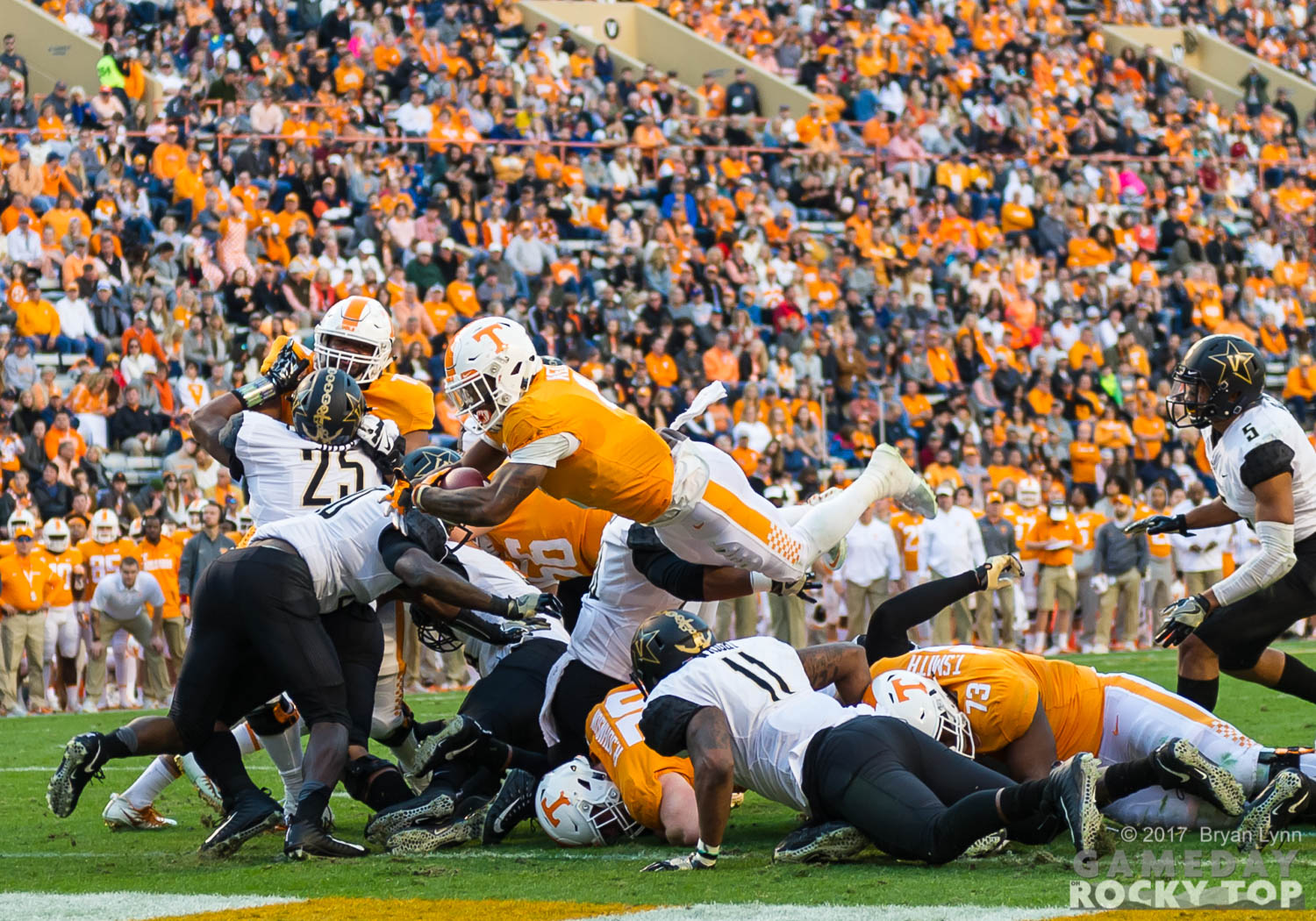
Tennessee vs Vanderbilt: The Measuring Stick

Tennessee is playing for bowl eligibility on Saturday, but also to even its record this decade. The Vols are 55-56 since 2010. A win would tie them with Ole Miss and Arkansas for the decade as the only SEC teams with a better winning percentage than the usual basement dwellers from Kentucky and Vanderbilt. Kentucky is obviously up this year, but still trails over the decade at 47-63. Vanderbilt sits at 49-62.

But head-to-head, the Vols and Dores have split the decade so far. And more often than not, what Tennessee has done against the Commodores has played a significant role in the success or failure of their season. It’s not the measuring stick we envisioned at the start of the decade. The Vols can take an important step in leveling up by getting past the Commodores tomorrow.

Here’s a look back at how the last eight meetings have defined Tennessee’s season:

2010: At 4-6, Tyler Bray made his third start and led the Vols to a 24-10 win in Nashville to keep bowl eligibility alive. The Vols beat Kentucky the following week for a successful end to Derek Dooley’s first regular season.

2011: This decade is full of wildly entertaining games in the moment that didn’t stand the test of time because the season was ultimately unsuccessful. One of the best examples: after Tyler Bray missed five games with a broken thumb, he led the 4-6 Vols to a 14-7 halftime lead over a 5-5 James Franklin squad. But a 100-yard pick six tied the score, then Vandy took the lead with 12 minutes to play. A 13-play drive was capped with a fourth-and-goal touchdown pass to Da’Rick Rogers, setting the stage for overtime. Eric Gordon pick-sixed Jordan Rodgers (after a lengthy review) for the win. It was a great step forward in Bray’s return, and positioned Dooley to earn bowl eligibility again…and then the Vols lost at Kentucky.

2012: Dooley’s final game as head coach was a 41-18 beat down from Franklin and the Commodores. His fate was likely already sealed and Tennessee fans were simply interested in moving on. But while losing to Vanderbilt is uncomfortably common now, this loss was the first in the series since 2005 and the second since 1982, and the margin was jarring.

2013: Butch Jones came to his first Vanderbilt game in the exact position Jeremy Pruitt finds himself in now. A Josh Dobbs you’d never recognize now went 11-of-19 for 53 yards, the Vols failed to convert a faked field goal up 10-7 with 12 minutes to play, and after a fourth-and-one stop was overturned, Patton Robinette capped a 12-play, 92-yard drive with a touchdown with 16 seconds to play. It cost the Vols bowl eligibility and dampened some of the good memories of a near miss vs Georgia and a win over #4 South Carolina.

2014: Back in the same boat at 5-6, this time the Vols made it work. An 11-play, 94-yard third quarter drive put Tennessee in front 17-10, and a late score from Dobbs pushed the margin to 24-10 before a Vanderbilt score in the final seconds made the final margin 24-17. The Vols earned bowl eligibility for the first time in three years, and dominated Iowa in Jacksonville.

2015: The only business-as-usual Tennessee-Vanderbilt game of the decade. The Vols won 53-28 over a 4-7 Vanderbilt team behind 331 rushing yards, carrying Tennessee to the Outback Bowl.

2016: The most costly of any of these losses. With a clear path to the New Year’s Six, Tennessee led 34-24 with four minutes to play in the third quarter. From there: Vanderbilt touchdown, Tennessee fumble, Vanderbilt touchdown, Tennessee missed field goal, Vanderbilt touchdown, Tennessee turnover on downs. An already contentious season for Butch Jones took a hard turn into disappointment, setting the stage for his exit the following season.

2017: Jones was out, but the Vols still had a chance to avoid the first 4-8 season in program history. It was not to be: despite a 14-7 lead and trailing only 21-17 with five minutes to play in the third quarter, the defense again surrendered three straight touchdowns down the stretch. Vanderbilt finished 5-7, the Vols 4-8.

Four wins, four losses. The 2011 win was lost in the disaster in Lexington the following week, but I’d say you can draw a straight line between relatively successful regular seasons in 2010, 2014, and 2015 and beating the Commodores. A regular season that might feel more successful than any since 2010 will turn on what the Vols do against Vanderbilt one more time tomorrow.


Tennessee vs Kansas: Here’s Our Chance

One year ago today, Tennessee beat #18 Purdue in the Battle 4 Atlantis. It was, at the time, an important win to get Tennessee a shot at Villanova and bolster their RPI for what we thought would be a run at the bubble.

One year later, #5 Tennessee will face #2 Kansas on Friday night.

There’s more, of course: #3 Gonzaga’s win over #1 Duke could propel the Bulldogs to the top of the polls, and they’ll face the Vols on December 9. They’ve got work to do between now and then, dates with Creighton and Washington. The Vols shouldn’t be threatened by Eastern Kentucky and Texas A&M Corpus Christi. There’s a chance Gonzaga and Tennessee could meet as #1 and #2.

All that’s down the road. The opportunity with Kansas is enough for one day.

The difference in Tennessee then and now was particularly striking against Louisville. The Vols, once the hunters, watched Louisville play that role against them really well for most of the game. Jeff Greer’s game story from The Athletic speaks of the Cardinals in language that fit Tennessee for years, and speaks of the Vols in terms we haven’t heard since Bruce Pearl’s days. Louisville was within one with less than nine minutes to play.

And then the Vols unleashed the kind of run a Top 5 team makes. A 14-0 run over the span of four minutes included only one point from Grant Williams, who finished with 24 total. Admiral Schofield did plenty of damage in that span though, finishing with 20 points. The Vols survived 11 Louisville threes, missed nine free throws, and still won by 11 while scoring 92 points. Through increasing degrees of difficulty, the Vols have ultimately handled Louisiana, Georgia Tech, and Louisville. Now it’s the boss level.

The Jayhawks beat Duke in the Elite Eight last year before falling to Villanova in the Final Four. Seven-footer Udoka Azubuike is back, currently 10th in the KenPom Player of the Year standings. Dedric Lawson, a 6’9″ Memphis transfer, is fourth.

Grant Williams is first.

The first question for any Vol opponent – “Does this team have anyone who can guard Grant Williams?” – should be an affirmative this time. Louisville had no answers, but I’d expect more from the Jayhawks. Azubuike sends back 12.8% of the shots he faces, and Lawson will bang in there as well. He was a volume scorer at Memphis, finishing in the top six among AAC players in his percentage of total team shots taken in both 2016 and 2017. That shouldn’t be as necessary at Kansas, but he’s averaging 16.3 points and 9.8 rebounds in the early going. Lagerald Vick leads the team in scoring with 20.8 points in 35.3 minutes, and is a scorching 18-of-29 from the arc so far this year.

Kansas has been giving up a really high percentage from the arc and winning anyway. Michigan State hit 12-of-23 (53.3%), and Marquette was 14-of-31 (45.2%). Neither was enough against the Jayhawks: the Spartans were undone by 18 turnovers, Marquette by only attempting five free throws. And on the other end, Kansas has shot well too: 10-of-23 (43.5%) against Michigan State, 5-of-10 (50%) last night, plus 12-of-19 (63.2%) against Vermont. And they don’t turn it over, with just 48 in four games despite playing a Top 50 pace.

The Jayhawks also take away almost any opportunity for an offensive rebound. In four games they’ve only surrendered 27 total offensive boards; that’s the eighth best percentage in the country. The Vols will need to be good on their first shot.

The good news: the Vols are once again one of the best teams in the nation in creating good shots via assist percentage. It’s currently at 70.1%, fourth in the nation, leading to the Vols shooting 51.7% from the floor, 18th nationally in the early going. In better news, the Vols are shooting 57.6% from two, 52nd nationally. Last year: 47.3%, 293rd nationally. It’s early. But shooting better from inside the arc was the most obvious place the Vols could improve from last year, and so far, so good.

They’ll need to be good against Kansas. Tennessee has lived on offensive rebounds in the past, but that may be a luxury they can’t afford against the Jayhawks. This could be an excellent test of how much Tennessee’s best basketball is worth; they should need every bit of it to win, but the prize for winning could be a shot at number one.

It’s the late shift: 9:00 PM ET, ESPN2. Go Vols.


Tennessee vs Louisville Preview

The one good thing about your rival being at the peak of their powers is the reward for beating them. And when your rival is operating at the peak of their powers with a head coach that’s especially fun to hate, bonus points.

Louisville is certainly not Tennessee’s rival – the Vols won the first six meetings from 1913-1922, and the Cardinals have won 12 of the other 13 since – but Rick Pitino used to be. He went 14-3 against the Vols at Kentucky, winning the last nine in a row by an average of 25 points. Those nine games were my middle and high school days, and those blowouts gave me a significant amount of disdain for Pitino. But then he left for my beloved Boston Celtics; it was an odd feeling but, hey, the way he dominated at UK, surely he’ll bring championships back to Boston, right?

Nope: 36-46, 19-31 in the shortened 1999 season, 35-47, then fired after a 12-22 start. Larry Bird wasn’t walking through that door, but half the guys who played at Kentucky were.

Pitino went to Louisville, which had a four-year home-and-home agreement with Buzz Peterson’s Vols. And…one-point loss, three-point loss, three-point loss, blow out. Three years later the most successful Tennessee team in program history went to the Sweet 16, ran into Louisville as a three-seed…and lost by 19.

All of that to say this: no individual has done more damage with less return to more teams that I care about than Rick Pitino. And I’m mad he’s not on the sideline to get beat tonight.

Instead it’s Chris Mack, a great coach who made four Sweet 16’s and an Elite Eight in nine years at Xavier, plus won the Big East outright over Villanova last year. It’s been a minute since we’ve seen Louisville on the national stage for something other than Pitino and drama: after going Final Four, National Champs, Sweet 16, Elite Eight from 2012-15, the Cardinals were ineligible in 2016, got bounced in the second round in 2017, and fell to the NIT during their tumultuous 2018.

A 9-9 finish in the ACC is still nothing to sneeze at; the Cardinals finished 38th in KenPom but graduated their starting point guard and lost three others early to the NBA. They’ve played a lot of no one in their 3-0 start – Nicholls State, Southern, and Vermont – but do jump out at you statistically in a couple of ways.

The Cardinals are fifth nationally in effective field goal percentage and first in the country in free throw rate. In the opener against Nicholls, Louisville went 42-of-55 (!!!!!!) at the line. Nicholls went 12-of-16. In a 50-point win over Southern, they were 31-of-39. Against Vermont, 26-of-33. The Cardinals are 27th nationally in free throws attempted and 21 of the teams ahead of them have played at least five games; Louisville has played three.

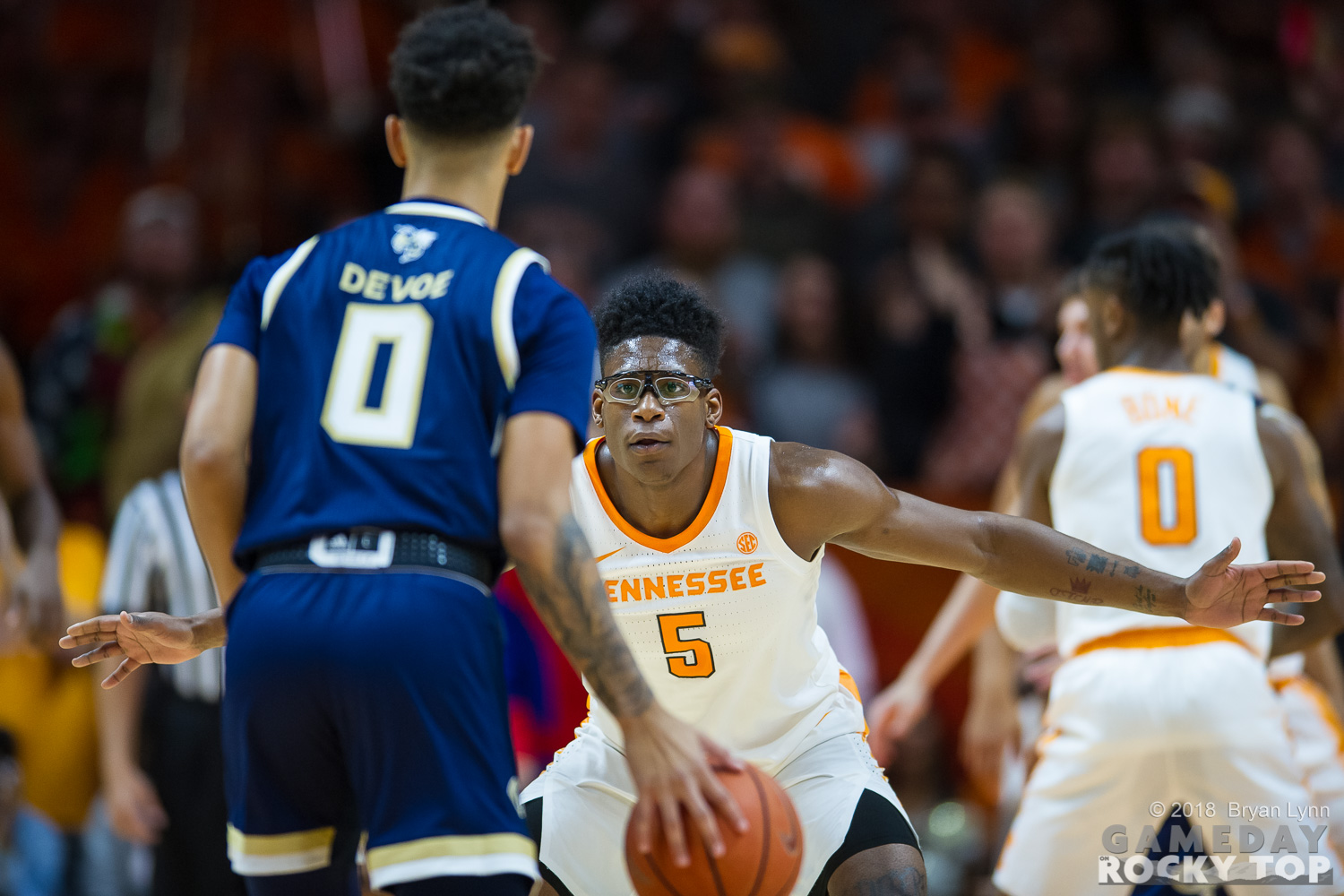
So yeah, these dudes get to the line. Jordan Nwora (6’7″) averages 18-6, V.J. King (6’6″) averages 11-4, and Akoy Agau (6’8″) averages 7-7. Throw in 6’11” Malik Williams, and you’ve got plenty of length to go around in the rotation, plus a really hot shooting guard in Darius Perry. It looks like a Pitino team. The good news: Tennessee, so far, has been much better at defending without fouling this year. Their 50 personal fouls on the season rank 327th in the nation.

The good guys have been playing their starting five a bunch of minutes early: between 28.6 for Kyle Alexander and 33.7 for Admiral Schofield. Fulkerson and Pons have been the go-to’s off the bench, but it’ll be interesting to see how Lamonte Turner factors into the equation in his first game back.

Of course, Kansas is out there waiting. There’s a scenario here where the Vols could sweep the week and find themselves ranked second in the nation next week, behind the winner of Duke and, I’m assuming, Gonzaga in Maui. The Vols are currently ranked fifth and could/should get a shot at the #2 Jayhawks on Friday. Virginia is at #4, but their Battle 4 Atlantis field isn’t as strong this year, with only #25 Wisconsin ranked in the rest of the bracket.

That’s all getting ahead of ourselves, but when you’re ranked this high that’s what Thanksgiving basketball is all about: let’s see what we’ve got against the best of the best and file it away for March. The Vols are certainly playing to win the SEC again, but also to get as far up the bracket as possible. A shot at Kansas lets you take your temperature; beating the Jayhawks allows you to stay in the top-line national conversation.

But to get there, we’ll have to go through Louisville first. 5:00 PM ET, ESPN2. Happy Thanksgiving.


Pace and Space and Total Plays

Two years ago Tennessee beat Missouri 63-37, part of a sterling November performance for Josh Dobbs and the Vol offense. Tennessee led the nation in yards per play that month (stats via SportSource Analytics), averaging 8.96 per snap against Tennessee Tech, Kentucky, Missouri, and Vanderbilt. The next-closest team in November was Colorado State at 8.51. It was incredibly impressive.

But against Missouri, some of the post-game press went to what the Tigers did against the Vol defense: 740 yards! 420 on the ground! Oh the humanity!

It was a huge day for the Tigers…mostly because they ran 110 plays.

Mizzou’s 6.73 yards per play that day certainly didn’t represent a great effort by Bob Shoop’s unit. But Texas A&M, Alabama, Kentucky, and Vanderbilt were all more successful per-play against the Vol defense. They just didn’t snap it 110 times while giving up 63 points in just 67 plays on the other end.

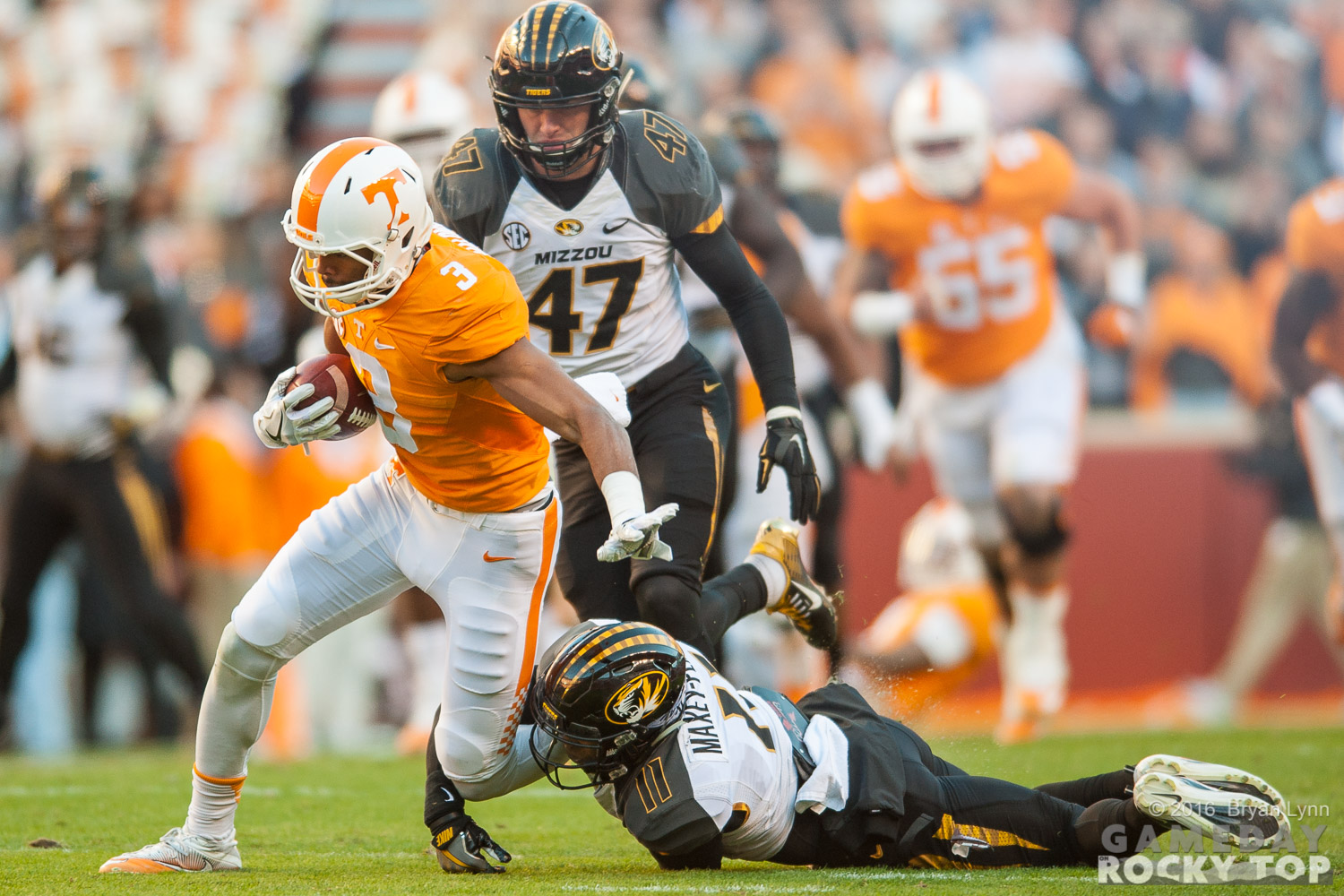
Much has changed for Tennessee since then, but not a whole lot for Missouri. Derek Dooley now calls the plays, but the Tigers still love to get up and go. And this is the biggest difference between these two teams: Missouri has run 776 plays, eighth nationally among teams playing 10 games or fewer so far, and the fastest pace in the SEC. Tennessee has run 620 plays, fourth-slowest nationally among teams playing 10 games or more, and dead last in the SEC. Missouri essentially averages two whole drives more than Tennessee per game.

Missouri isn’t so much explosive as they are relentless. In their advanced statistical profile from Bill Connelly, the Tiger offense ranks only 98th in explosiveness but 16th in efficiency. For a team running more plays than almost anyone else, the Tigers are only fifth in the SEC in gains of 10+ yards on the year. Here they have a clear advantage on the Vols, who rank 12th in the league. But when you start increasing the denomination, the gap narrows quickly.

MIZ UT
10+ 148 122
20+ 54 45
30+ 28 24
40+ 18 12
50+ 7 7

With the Tigers averaging 15+ snaps a game more than Tennessee, you would expect these differences to be greater. But Missouri hasn’t been beating people with sheer explosiveness. It’s instead an efficient, relentless offense that’s been good at creating more chances and making the most of them.

Tennessee, on the other hand, is more explosive than we give it credit for because it runs so few plays. We looked at this in-depth after the Charlotte win – Tennessee’s pace of 62 plays per game is still the second-slowest of the post-Fulmer era, bested only by last year at 61 because the offense struggled so much it couldn’t stay on the field. This team is much more deliberate about its pace, averaging 31:02 in time of possession, nearly three minutes more than last season. No doubt the Vols will look to do that again on Saturday, seeking to limit Missouri’s chances. This is exactly what Kentucky did, holding the Tigers to 62 plays. Only two of Kentucky’s five punts in that game came via three-and-outs. The Cats weren’t overly efficient – 3-of-14 on third down, 0-for-3 on fourth down – but they did a good enough job keeping the chains moving to limit Missouri’s chances.

For Tennessee’s offense, the formula for success here is a familiar one: make it count on third down, and sprinkle in enough big plays. I’m not as worried about Missouri decimating Tennessee’s defense over the top as I am about the Tigers simply eating it up one play at a time. When the Vols did well against Kentucky’s offense last week, they did well on first down and put the Cats in situations they didn’t want to be in. There are fewer situations the Tigers don’t want to be in. But I think this will be less about explosive plays allowed, and more about limiting Missouri’s overall chances by way of Tennessee’s own efficiency.