The Idiot Optimist’s Guide to the 2018 Season

Did you know the Vols are 500-to-1 to win the national championship? That’s life-changing money, boys!

Listen, I’ve already got the basketball Vols at 25-to-1 to win it all. Those winnings are set aside to get right with the debt collectors and the Lord, so it’s all limousine ridin’ and jet flyin’ with the rest. My wife had already been telling me I should pay less attention to Butch Jones and more to Rick Barnes long before last fall went right down the drain. And when Admiral dunked that ball at Rupp Arena, I asked her right then and there if we could name our first child Private First Class. She did not go for that, but she’s got an SEC Championship t-shirt in the closet, by God. And you’d better clear out some room for the Pruitt collection.

I mean, with Phillip at the helm, it don’t much matter who the coach is. Only took us a decade to figure that one out. And whenever CPF (ADPF?) decides to retire to Wyoming with a fistful of championships, we can simplify the search process. If you want to involve the common man and the common fan, you don’t have to schedule an on-campus riot to do it. Just get one of us a spot on the search committee. Then have the prospective new AD start down their list of hypothetical coaching candidates. If our first response is, “Who’s that?”, “(Fulmerized) no!”, or “…wait, what?”, you don’t hire that person. Something that simple could’ve saved us from Derek Dooley, Butch Jones, and Greg Schiano.

But we don’t need saving anymore. Fulmer’s bringing championships to the entire athletic department. You do know the only reason we didn’t win the NCAA Tournament is because we got beat by God, right? But only by one point! If Sister Jean’s reward is a Final Four appearance for a mid-major, I know we’re due at least six national championships. She turned 99 this week, and I hope that lady has lots of time left on this earth. But I hope she also knows that in heaven, it’s John Ward and Bill Anderson on the call.

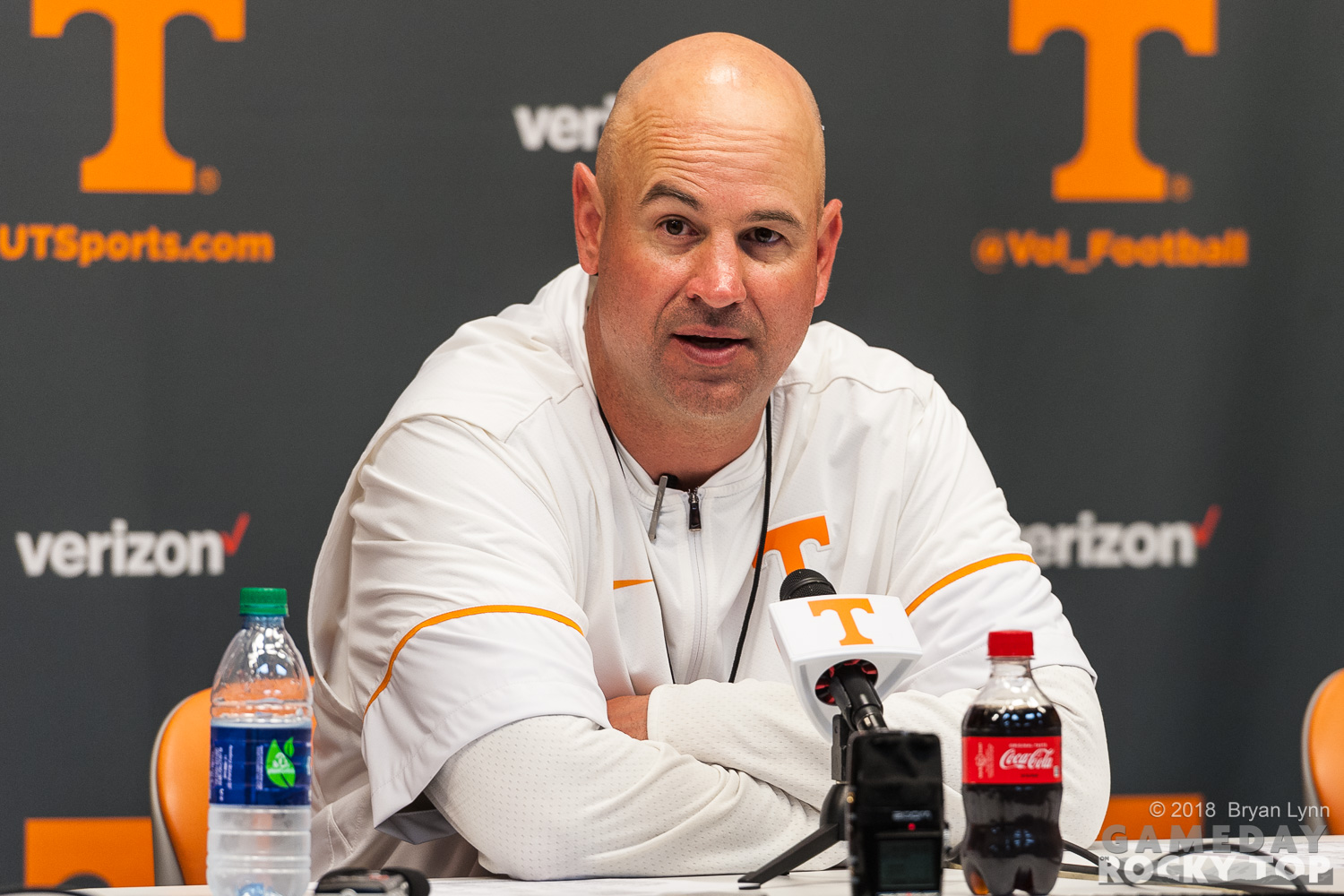
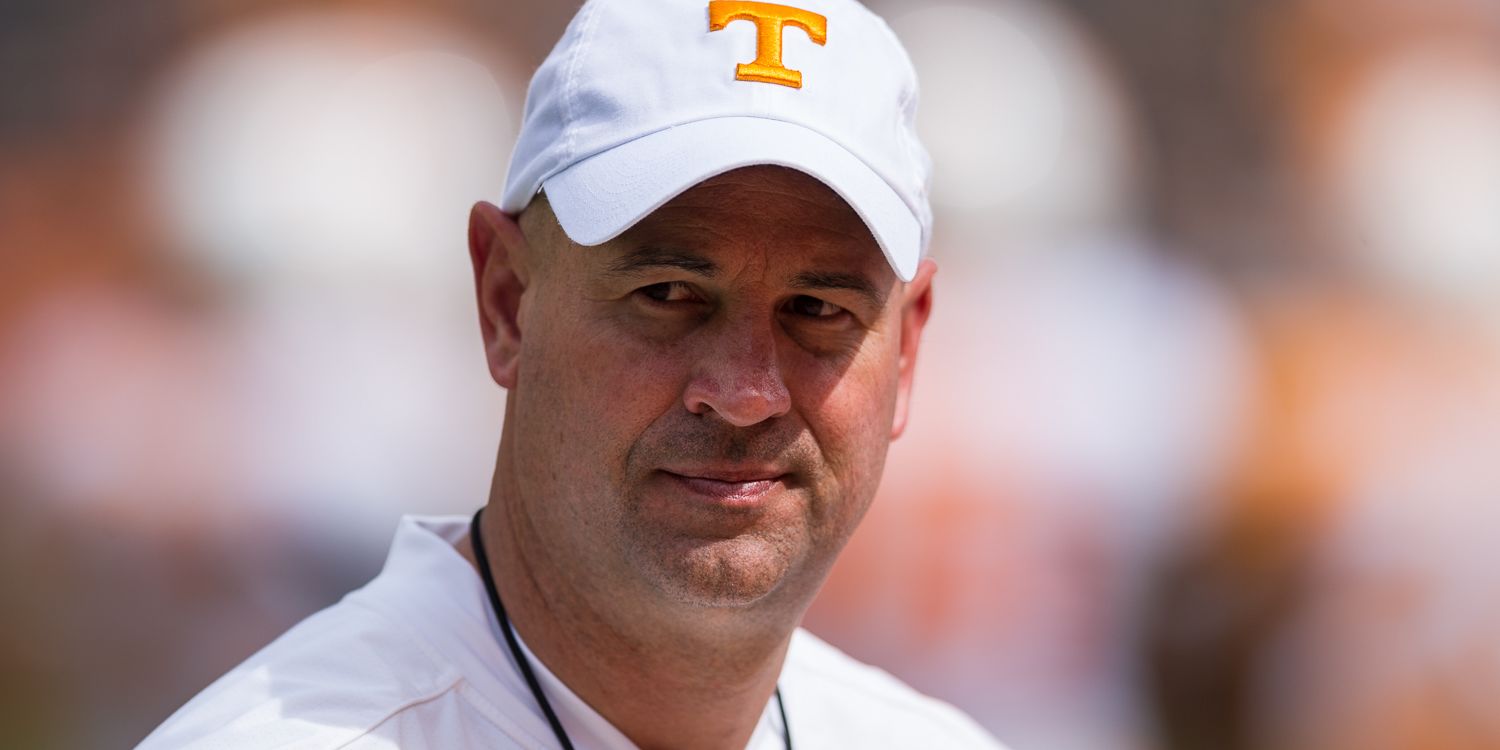
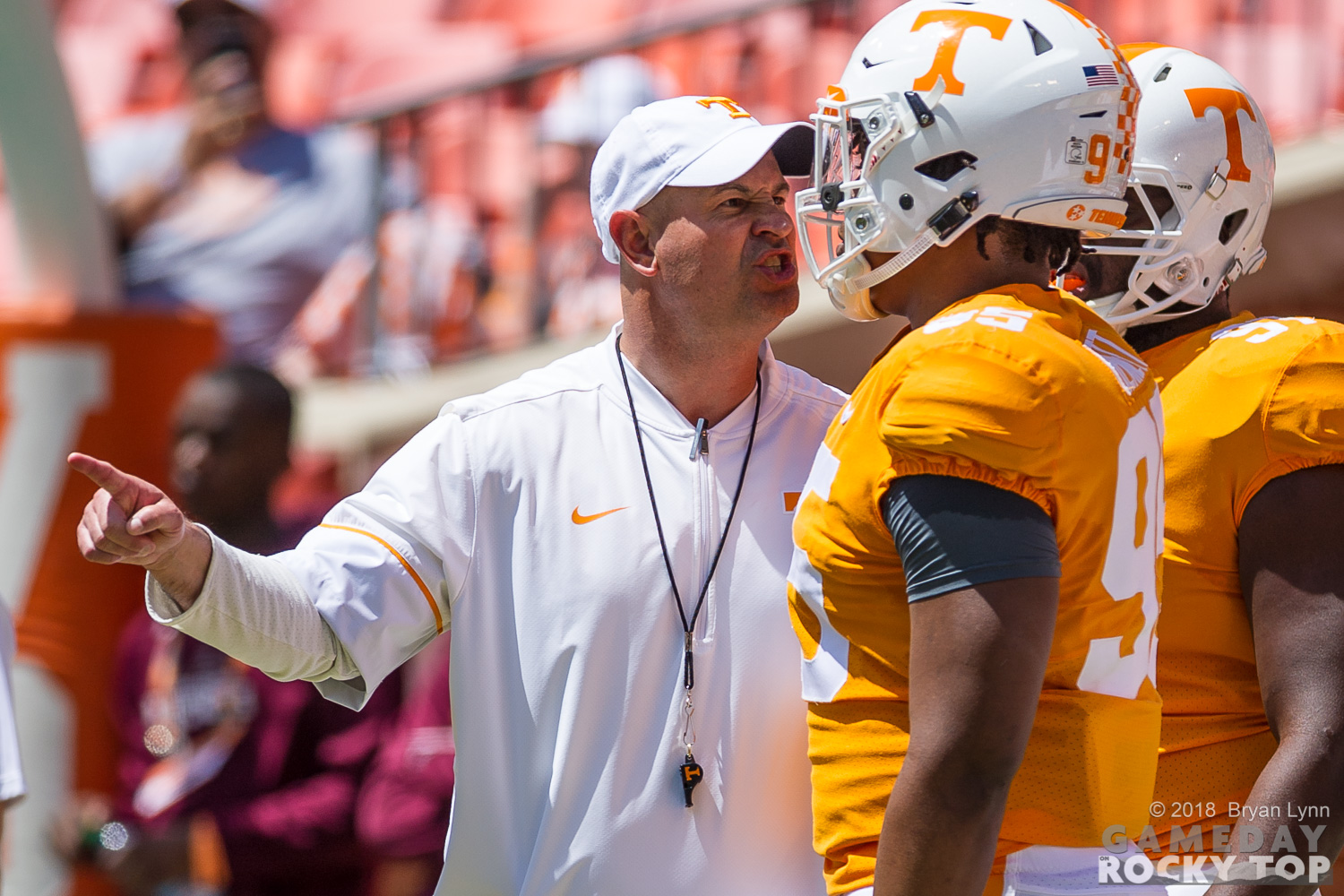
Look man, Jeremy Pruitt got the Tennessee job, got out there ‘cruitin’, then held Clemson’s offense to 2.69 yards per play in his spare time. Remember how excited you were when we signed Kyle Phillips, Shy Tuttle, Jonathan Kongbo, Darrin Kirkland, Nigel Warrior…I mean, basically our entire defense? Now think about them in this guy’s hands. What’s the record for fewest first downs in a season? Wait, is it the Clawfense?

Then on offense, nevermind who’s playing quarterback, this year they’ll have actual coaching! Imagine that! And Florida State fans still believe they’d’ve won the title in ’98 if Chris Weinke was healthy, but he’s not even good enough to coach our QBs! But really, here’s all the coaching they need: get the ball to the guy who wore Gator-skin boots to the postgame, then caught a hail mary, then told the truth about our previous administration IN LANGUAGE THE INTERIM COACH COULD UNDERSTAND. Get the ball to Jauan, and Weinke won’t have the only Heisman on the property. It doesn’t even matter that we could start all four-and-five-stars on the offensive line. One of them is Trey Smith, and he’s been waiting all year to hit somebody. Good luck, West Virginia.

And look, I fully respect a man who refuses to acknowledge the reality of the situation atop his head. I’m a Holgo man. West Virginians are our Appalachian brethren. But the Mountaineers are Diet Tennessee: looks the same, tastes kinda the same but mostly worse, zero national championships.

Then we get Randy Sanders’s ETSU program, who will change their mascot to the screen pass by the end of the year if they haven’t already. But I think they could take UTEP, who went 0-12 last year but only lost 11 of them by at least 14 points.

When I close my eyes and dream, I see the four game winning streak we should be on against the Gators. Instead, we lost once because we wet the bed in the red zone, once because we gave up a 4th-and-17, and once on a hail mary. And that’s just the Cliffs Notes. But one in a row is better than none in a row. Do you know the last Tennessee coach to beat the Gators on his very first try? Phillip By God Fulmer. And never you mind that new coach in Gainesville, the same truth still applies: they ain’t no good. Vols by 30, unless we decide to win 20-17 in overtime as a tribute. And don’t worry, that means we can pay tribute to 1998 against Georgia by keeping them out of the end zone altogether. But I do appreciate the Dawgs helping us move along with our coaching search last fall.

Then it’s Auburn, who beat Alabama last year because the Tide had 1st-and-10 inside the Auburn 40 on their last three drives and scored zero points. That’s not Jeremy’s fault! Sounds like a Saban problem to me. I’m sure their new intern can solve that one. If you don’t think the Pruitt-for-Butch trade makes Tennessee over Alabama the lock of the century, I don’t know what to tell you. How many life championships are Bama fans claiming by now? I can’t keep giving out these winners for free!

We’ve owed Will Muschamp a punch in the face for like six years now, and finally have the coaching staff that will encourage that sort of behavior, metaphorically speaking, instead of being satisfied that we’re close enough to put our hands on them but let’s see what happens in the fourth quarter. Then we play the 49ers, which might’ve been a good game back in the 80’s but I’m not sold on the Garoppolo kid yet. He does have the advantage of moving as far away as physically possible from Tom Brady, but we’ll have to wait and see.

Kentucky? Wait til basketball season. Missouri? I’ve been hoping we’d schedule the Cowboys for years, this is a much easier way to get a piece of Derek Dooley. Vanderbilt? Swept them in basketball too! It don’t matter who we see in Atlanta since we’ll’ve already beaten the two best teams in the division. But in the playoff, I’m pulling for Ohio State, Florida Atlantic, and of course, Wake Forest. Since we’re guaranteed a shot at Butch Jones and Derek Dooley already, I figure we can just go ahead and cleanse our palate altogether.

15-0, National Champions, boys. Then we’re going after that single-season college basketball wins record, which is currently held by three John Calipari teams (or two teams and an asterisk). Get your tattoos now, boys. And don’t tell my wife I already did.

Hey look, only took me nine years to learn about GIFs!
via GIPHY


Ranking Season Openers on the Anticipation/Anxiety Scale

September 1 will be Tennessee’s 13th season opener against a ranked non-conference foe (thanks, as always, to the folks behind Tennessee’s media guide). Fun fact: five of those were against UCLA, from the first one in 1967 through Peyton Manning’s debut in 1994. The Vols are 5-4-3 in those games overall, most recently splitting a pair with California in 2006-07.

But when you’ve struggled like the Vols in the last decade, you don’t need a ranked opener to raise the stakes. Tennessee has had plenty of tense first tests in the last few years, many of them made so by uncertainty surrounding the head coach. Jeremy Pruitt will get the best kind of uncertainty – new coach, first game – against West Virginia. It’s the first impression, but it’s also a Top 20 opponent some are projecting far higher than that.

How will the first game set the tone for Jeremy Pruitt and 2018? How does it compare to some of the other season openers in recent memory in terms of anticipation and anxiety going in?

Level 1: The Sure Thing

  • 2004 UNLV, 1999 & 2002 Wyoming, FCS Opponents

Lane Kiffin, Derek Dooley, and Butch Jones all opened their UT coaching careers with FCS opponents. In FBS/Division 1-A, you have to go back to the special jersey night game against UNLV to find a sure-thing opponent that actually played itself out that way. UAB the following year certainly felt like one going in.

Level 2: The Pseudo-Sure Thing

  • 2016 Appalachian State, 2015 Bowling Green, 2008 UCLA, 2007 California

A successful season, or at least a successful finish in the prior year, often creates overconfidence in the season opener. With Butch Jones it was capable mid-majors who were overlooked in part because of massive Week 2 opportunities in Oklahoma and Bristol. Phillip Fulmer’s last two teams opened on the road with Pac-12 opponents, one the Vols torched the year before and one the Clawfense was expected to torch. The lesson: never overlook a team with a pulse in week one.

Level 3: I Have No Idea

  • 2000 Southern Miss, 1998 Syracuse, 1994 UCLA

You have to go back almost two decades, but all three of these were some form of rebuild/reload against ranked opponents, two of them on the road. The ’94 Vols were replacing their starting tailback, both wide receivers, and the Heisman runner-up at quarterback. The ’98 Vols were replacing the next Heisman runner-up, along with several key defensive pieces. And in 2000, most of the pieces from that championship run were gone. It was a testament to the strength of Tennessee’s program that the Vols went 2-1 in these games, all of them close. Tennessee’s performance in these openers didn’t necessarily color the entire season (other than Jerry Colquitt’s injury in ’94), but did create a first impression that was ultimately reliable. West Virginia probably goes in this tier: the game shouldn’t be confused for a toss-up with the Vols at +9.5, but we know so little about Tennessee in the midst of starting over I feel like there’s more to learn here than just the outcome.

Level 4: I’m Nervous

  • 2017 Georgia Tech, 2014 Utah State, 2003 Fresno State

Disappointing season the year before + opponent you feel like you should beat but not blow out + additional anxiety you know will come if you lose = these openers, the rare kind that can create more anxiety than anticipation. The Vols were solid against Fresno in ’03, surprisingly good against Chuckie Keeton and Utah State in ’14, and we all remember the full spectrum of emotions that came with the Butch Jones experience last year. The stakes for losing a game like this are so high it creates a, “Why did we schedule these guys?” mentality, even though those decisions are made far before we know what kind of anxiety/anticipation we’ll be feeling leading up to kickoff.

Level 5: Everything is on the line!

  • 2012 NC State, 2006 California

The ol’ let’s make decisions about the future of the program opener, when a disastrous season the year before and a capable opponent in the first game create a tense situation. The Vols went 2-0 in these games, though one was a false positive. Looking at things this way gives me additional appreciation for what the Vols did to Cal in 2006. It’s the fantasy we’d like to come true every time we play a significant opponent in the season opener; fortunately the West Virginia game doesn’t carry the same burden of the fate of the program at stake.

It’s only the first impression, but it will be a meaningful one for Jeremy Pruitt and this Tennessee team. Where does it rank for you in terms of anticipation and anxiety?


Confidence in Year One: 2013 vs 2018

A good question came out of this week’s return of the Gameday on Rocky Top Podcast: when did you have the bigger wait-and-see mentality, right now or five years ago?

It’s no sin to say you need to see it to believe it with Jeremy Pruitt; after the last ten years, we all might need a little sight to go with our faith. But how does that compare to the way we felt on the eve of Butch Jones’ first season?

Neither being Tennessee’s first choice, Jones and Pruitt also inherited more years of disappointment than their infamous predecessors in the last ten years. The additional years of disappointment under Jones might make us more wait-and-see with Pruitt by default; the Vols have now been down for ten years instead of five. Butch Jones also had the benefit of a more-celebrated group of commitments earlier in his tenure. Some of this was via name and location: early recruiting wins on guys like Jalen Hurd and Todd Kelly Jr. dramatically changed the conversation on Jones, giving one the impression that he could turn this program around with talent like that in the fold. Pruitt’s early set of commitments during his first fall camp is still impressive, but Jackson Lampley is the only in-state/legacy blue chipper on board at the moment; the new staff’s highest-rated commits are from Georgia and North Carolina.

However – and due, of course, to Jones’ recruiting – it feels like Tennessee easily has more talent on the roster right now than in 2013. Five years ago we knew the Vols had a sensational offensive line, but little else. Ultimately in that season three of Tennessee’s five leading receivers – Marquez North, Jason Croom, Josh Smith – were freshmen, and after injury freshman Josh Dobbs took over at quarterback. Cam Sutton and Malik Foreman were day one starters in the secondary, Corey Vereen was a factor on the defensive line…you get the idea. The talent that left after 2012 and some of the recruiting failures at the end of Dooley’s tenure left the cupboard far more bare than it seems right now.

Of course, the guys in the cupboard right now just went 4-8 last year and lost five times by 17+ points.

When you hire someone with six years of experience as a head coach, you know more going in. Butch Jones had done a good job on the mid-major level, and most of the initial questions with him were how he would recruit at the level Tennessee needed. We thought Jones could get us to at least nine wins, and he did…it just turned out that was also his ceiling. With Pruitt, the basement is deeper – he’s never done it, maybe he’s just a great coordinator but a lousy head coach – but the ceiling also seemed higher on day one. We applauded Phillip Fulmer when Pruitt was the choice for not playing it safe with Les Miles or easy with Tee Martin, but going with someone with more risk/reward.

So going into this first year, I find myself a little less wait-and-see with Pruitt than I was with Jones, even if I’m still significantly more wait-and-see than at any other point in my three decades of fandom. Dooley wasn’t a great hire and we knew it at the time, but anyone would’ve galvanized us after Kiffin, and in 2010 the Vols were only three years removed from a division title. For at least the year one prospects, I’m slightly more optimistic right now than I was five years ago.

You can see it a little bit from Vegas too. Right now the Vols are 9.5-point underdogs in a neutral site game against #20 West Virginia. In Jones’ first year, the Vols were 28-point underdogs at #2 Oregon. There’s plenty of room between #2 and #20, but +28 is the second-biggest underdog the Vols have been in the last five years (and maybe ever); Alabama was +36 last year (and covered). This time five years ago I was just worried about trying to beat Western Kentucky.

There’s not a right or wrong answer here, but there’s enough good happening with Pruitt and just enough good Jones did in recruiting to make me slightly less wait-and-see right now than I was five years ago. It’s starting over, but it might not be from scratch. We’ll see.


10 Questions for 2018: What Will We Learn About Jeremy Pruitt?

We learned quite a bit about Derek Dooley and, even in one year, Lane Kiffin. But I’m not sure we learned a whole lot from them. Kiffin wasn’t here long enough for that, and even three years for a hire like Dooley tends to play out in a predictable pattern: this probably won’t work –> yep, this isn’t working –> okay, let’s move on. Even as some of us spent lots of time arguing injuries and inheritance meant we needed most of that third year to make an informed decision, the final verdict on Dooley was the same as the quick one.

But with Butch Jones, we had five years. You don’t stick around five years at a place without a tangible hope that it might work. And along the way, you get a chance to learn not only about the head coach, but from them.

It’s easy for many to simplify the final verdict about Butch Jones as some form of lol nope; there are plenty of intern jokes out there. I’m far more interested in what we learned from Butch Jones:  what did the last five years teach us as Tennessee fans?

And how will that impact what we’re getting ready to learn from and about Jeremy Pruitt?

#1: What Will We Learn About Jeremy Pruitt?

When you grow up with the late Majors and Fulmer teams, you learn that Tennessee wins except, for frustrating lengths of time, against Alabama or Florida. When “scoreboard!” is your friend, you value it. A lot.

The last ten years have forced us to look beyond something so simple; the Vols are 62-63 since 2008. With Jones specifically, the scoreboard was just favorable enough, just long enough to allow us to hold on to the idea of something more. The Vols were almost bowl eligible in 2013, almost beat Florida in 2014, almost did far more in 2015, and still almost made the Sugar Bowl in 2016. Almost.

Playing the almost game long enough makes you step back and look at the bigger picture. In this year’s Gameday on Rocky Top preseason magazine, we took a closer look at Butch Jones in close games: 24 of his 55 contests against FBS foes were decided by one possession, and 15 of those were decided on the final play. Those are extraordinary numbers, and even when you win your fair share of them – Jones was 8-11 in one-possession games and 5-6 on the final play before things went south last season, finishing at 10-14 by one-possession and 6-9 on the last snap – too many close games will drive your fan base crazy.

I feel like this is what I learned, more than anything else, from Butch Jones: every play matters. Not so you can make more of them in the fourth quarter to earn an unsustainable winning percentage in close games. But so you can avoid, as much as realistically possible, playing close games altogether.

Don’t Waste Opportunities

In Butch’s first year, with Justin Worley and an all-star offensive line, the Vols were 37th nationally in tackles for loss allowed per game (stats from Sports Source Analytics). The next four years, including two with championship-caliber teams, the Vols were 125th, 108th, 53rd, and 121st. The offense went backwards an awful lot. Wasted plays behind the line of scrimmage became far too normal. Along with infamously freezing in crucial situations – 2014 Florida, 2015 Oklahoma, 2017 Florida – play-for-play, the offense failed to take advantage as much as it should have.

Butch Jones could have won a couple more close games and still been the coach here, or lost a couple more and been fired in 2015. But in the final analysis, it was an inability to take appropriate advantage on every play that cost Jones and his teams.

The temptation will be to measure Jeremy Pruitt by simply the wins and losses: six wins is a job well done, five not so much. But one thing I learned from watching Butch Jones the last five years is how much every play is worth. It’s why I find myself gravitating to things like S&P+ (and KenPom) more and more.

Don’t Waste Memories

This sport is about the outcomes, and the moments they create. Memories remain college football’s most valuable asset, for fans and for a coach seeking to earn another year. We wrote in the aftermath of the Georgia loss last year that Jones’ inability to create memories that lasted hurt him more than anything. His best wins are dragged down by the eventual disappointment of the seasons they came in.

Jeremy Pruitt will have the opportunity to make memories this fall. If one of those six wins is the Gators, we’re going to have a good time. Those memories feel like they get made in dramatic fourth quarter finishes. But the best way to truly make them is to focus on the ol’ process: being as efficient as possible on every snap.

What Will Progress Look Like?

We’ll measure Pruitt by the wins and the memories, but coming off last season there is plenty of progress to be made play-for-play. And especially now, how close the Vols are coming can be a great indicator.

Consider this: in Tennessee’s golden age from 1989-2001, the Vols lost five games by 17 points (three possessions) or more: Alabama in 1989, Florida in 1991, 1994, and 1995, and Nebraska in 1997. All five of those teams were in the Top 10, three in the Top 5.

Then the Vols jarringly lost four times by 17+ points in 2002, but at least all four of those teams were in the Top 20. In the next four years Tennessee lost one game each season by that margin, three to Top 10 teams and to #11 Arkansas in 2006.

In 2007, the Vols lost to #5 Florida and unranked Alabama by 17+. In 2008 it was #4 Florida, #2 Alabama, and unranked South Carolina, and Fulmer was out.

Kiffin had two such losses (unranked Ole Miss and #12 Virginia Tech). Dooley had nine in three years, though six of them came to teams in the Top 10. And Butch Jones had a dozen in five years. The first nine were against Top 10 teams – the schedule wasn’t kind, no doubt – but at the end of last season, the Vols were trounced by Missouri, #20 LSU, and Vanderbilt.

So after only five three-possession losses in 13 years, an aberration in 2002, then one-per-year through 2006, the Vols have lost by 17+ points 28 times in the last 11 years. Seven of those came to unranked teams.

Just being competitive won’t make a whole lot of memories. But in 2018, it would absolutely be progress.

Every play matters. And I think this coaching staff, with its pedigree from the top down, will do a better job understanding that, and calling the game accordingly.

There will be a bunch of little things we learn about Pruitt this fall, and an even longer list he’ll learn himself. It’ll take more time than this season to figure out what Jeremy Pruitt’s teams will teach us as fans. But we learned from Butch Jones’ teams that almost is especially painful and being satisfied with close games and the mysterious “we have a chance to win” is a treadmill in disguise. Every season is relative, telling its own story. But every play matters. I look forward to seeing how much Jeremy Pruitt can make them matter, this fall and beyond.

10 Questions for 2018

10. Which backups on the defensive line will be starters in 2019?

09. Can special teams make the difference in a coach’s first year?

08. What do we know about Tyson Helton’s offense from his time at USC?

07. Who’s the third/fourth wide receiver in an offense that will actually throw them the ball?

06. What about team chemistry with a first-time coach and a hodgepodge of players?

05. How much ground can the Vols gain in year one on the non-UGA SEC East?

04. Could the offensive line actually be a strength now?

03. Who wins the QB battle, and how will Pruitt manage it throughout the year?

02. Could two freshmen start at corner?


10 Questions for 2018: Cornerback

Practice starts today. The quarterbacks will be the lead story, and the offensive line is moving from weakness to strength. My biggest on-the-field concern for 2018 is at corner.

It’s the one place where playing a true freshman seems like the option with the highest ceiling. And while it’s exciting to see a player like Alontae Taylor in his first action as a Volunteer, the lack of experienced options could create major problems for Tennessee this fall.

#2: Cornerback

Last year Tennessee was 126th nationally in rushing yards allowed per game and third in passing yards allowed per game. But neither number foreshadows much in 2018. Phil Steele picked Tennessee to have the most improved run defense this season; the Vols have the personnel up front, if healthy, to be significantly better there. But the Vols were third in passing yards allowed last season because they played Georgia Tech in the opener, then played from behind the rest of the year.

The Vols saw only 279 pass attempts last fall. Only Air Force saw fewer (243) among teams playing 12 games. Tennessee was okay in completion percentage (55.2%) and yards per attempt allowed (7.0), but again, not many teams had to go deep to beat the Vols. Georgia was 7-of-17 for 84 yards and rolled 41-0. Tennessee had just 3.08 passes defended (intercepted or broken up) per game, 117th nationally. Just five interceptions last season was the lowest season total at UT in at least the last 10 years.

And then the Vols graduated Justin Martin, Emmanuel Moseley, the little-used Shaq Wiggins, and saw Rashaan Gaulden turn pro.

The good news in the secondary is at safety, where the talent has been disproportionately skewed for several seasons. Nigel Warrior might be Tennessee’s best defender (and I wouldn’t be surprised if Pruitt finds ways to move him around, just as Monte Kiffin did with Eric Berry, to maximize his usefulness and protect some of the younger guys back there). Todd Kelly Jr. is Tennessee’s veteran presence, the longest-tenured starter. He knows a thing or two about contributing as a freshman after 33 tackles and three interceptions in 2014. Micah Abernathy has recorded 150 tackles in the last two years. Even Maleik Gray was Tennessee’s third-highest rated recruit in 2017 at safety, and Theo Jackson saw limited action last fall.

But at corner, the options are far more unproven. Shawn Shamburger led returning options with 19 tackles last season. Marquill Osborne and Baylen Buchanan had nine between them. Osborne in particular is a name fans hope can flip the switch via the new coaching staff. Cheyenne Labruzza is another option among returning players, but position-switch options like Tyler Byrd and Carlin Fils-aime didn’t generate much noise in the spring.

So the new faces – specifically Alontae Taylor and Bryce Thompson – will get their chances early and often. They were two of Pruitt’s three highest rated recruits. And we’ve seen previous Vol coaches throw new pieces into the fire in year one secondaries, most notably Cam Sutton in 2013 and Janzen Jackson in 2009.

There are options, young and old, and with Pruitt’s background you have to feel like he can get more out of the pieces to make a better whole.

The bad news: Tennessee opens with West Virginia.

10 Questions for 2018

10. Which backups on the defensive line will be starters in 2019?

09. Can special teams make the difference in a coach’s first year?

08. What do we know about Tyson Helton’s offense from his time at USC?

07. Who’s the third/fourth wide receiver in an offense that will actually throw them the ball?

06. What about team chemistry with a first-time coach and a hodgepodge of players?

05. How much ground can the Vols gain in year one on the non-UGA SEC East?

04. Could the offensive line actually be a strength now?

03. Who wins the QB battle, and how will Pruitt manage it throughout the year?


10 Questions for 2018: First-Time Coach with a QB Competition

It was Tennessee’s turn in Bill Connelly’s 130-team previews yesterday, and it included this terrifying statistic:

You still need a quarterback who a) does his part and b) stays upright. Sophomore Jarrett Guarantano took an incredible 26 sacks on just 165 pass attempts…

We thought the line would be question number one with this team, but thanks to good health and a couple of nice pickups by Pruitt and company, it might even be an asset this season. That brings us back to the QB.

#3: First-Time Coach with a QB Competition

Guarantano’s season totals weren’t terrible: 61.9% completion rate, 7.2 yards per attempt. If we’re leaning into optimism – August is just around the corner, after all – there’s some hope that the play-calling will be an obvious benefit, because in several instances last fall they didn’t let Guarantano do much of anything downfield:

  • Georgia: 6-of-7, 16 yards
  • South Carolina: 11-of-18, 133 yards, most of which came on the final drive
  • Alabama: 9-of-16, 44 yards

There’s a bit of chicken-egg here, because one reason they didn’t do more downfield was the sack rate. If he’s taking a sack on 16% of his dropbacks, you have to limit the dropbacks. You can give Guarantano the benefit of the doubt, because Butch Jones was overly conservative by default and the offensive line was a mess by the time Guarantano took over. But he’s still got to get rid of the ball sooner. Again, statistically there were some bright spots. He was 18-of-23 for 242 yards at Kentucky.

Likewise, Keller Chryst had some bright spots at Stanford. In 2016 he was 19-of-26 for 258 yards and three touchdowns in a 52-27 win at Oregon. But his completion percentage and yards per attempt suffered last season, finishing worse than Guarantano on both counts at 54.2% and 6.7 yards per attempt.

Whatever will separate one from the other isn’t in the past, but the present: a critical fall camp begins this weekend. But for a first-time coach, the burden isn’t just in picking the starter for week one. It’s handling the decision over the course of a potentially-rocky season.

What can Pruitt learn from the last three Vol coaches in their first season, all of whom dealt with some version of a quarterback controversy?

Lane Kiffin: Sticking with your guy

Most of us assumed it would not be Jonathan Crompton. How could it be, after a 2008 season including a 51.5% completion rate, negative TD/INT ratio, only 5.3 yards per attempt and stat lines like 8-of-23 at Auburn and 11-of-27 against Wyoming? That all of it happened in the season that got Fulmer fired made it even worse.

But then it was Crompton, who dominated then-FCS Western Kentucky in Kiffin’s opener before going 13-of-26 for 93 yards (3.6 ypa) and three picks in a 19-15 loss to UCLA. He added two more interceptions in Gainesville, then was 20-of-43 in a loss to Auburn that dropped the Vols to 2-3.

And then, as if from nowhere, brilliance.

From our 2009 Georgia postgame at Rocky Top Talk:

At halftime, I told my friend next to me in Z11 that I didn’t want to see Crompton’s numbers.  There was a Raiders of the Lost Ark feel about it – “Shut your eyes!  Don’t look at it!” – because what #8 did in the first half was so totally unnatural, I feared that seeing 12 of 15 for 205 yards and 3 TDs and then having my brain try to comprehend it might, in fact, make my face melt off.

Two weeks later he was 21-of-36 for 265 against the vaunted Crimson Tide. Against Memphis that year he went 21-of-27 for 331 and five touchdowns.

Kiffin stuck with his guns and his guy, and ended up being right on the money. Crompton’s transformation was remarkable, and that game against Georgia is still one of the most surprising things I’ve ever see at Neyland Stadium. There was no stud freshman option at the time; Kiffin stayed with Crompton over Nick Stephens. It’s easier to stay the course, at least into mid-October, when that’s the case. The stud freshman case study would come the following year:

Derek Dooley: Knowing when to make the change

Tyler Bray got some spot duty early, but Matt Simms was Tennessee’s starter in the first eight games of the 2010 season. For the year he completed 57.9% of his passes at 7.5 yards per attempt, only eight touchdowns but only five interceptions. And he was also playing behind a ton of freshmen on the offensive line, which was one reason to keep the wiry Bray safe on the sidelines.

Tennessee was 2-5 at South Carolina in their eventual SEC East title year. And Simms was, statistically, having a good day: 10-of-13 for 153 yards and a touchdown. But a 10-10 game at halftime quickly turned when Simms was sacked and fumbled on the second play of the third quarter, giving South Carolina a short field and a 17-10 lead.

And Dooley chose this moment to make the change.

I was in the stands that day, and furious at the time. Simms was playing well, the Vols had a chance to win…and Bray promptly threw a pick six two plays later. An easy November stretch of Memphis, Ole Miss, Kentucky, and Vanderbilt was on deck; the Vols could’ve made the change the following Saturday.

But Bray became the story before the game was over. Two teardrops to Denarius Moore and a touchdown to Gerald Jones tied the game with 13 minutes to play. Though the Vols would ultimately fall, that initial change – 9-of-15 for 159 yards – set the tone for a record-setting November. Bray averaged 308.5 yards per game, 9.3 yards per attempt, and threw a dozen touchdowns as the Vols won four straight to get bowl eligible. The hype was real.

We don’t credit Dooley for much, and the 2010 coaching staff still wears the scars of the LSU finish. But this season was his best coaching job, and riding Simms through the teeth of the schedule was the right move. I think the move to Bray came at the right time, and there was no turning back.

Butch Jones: Don’t change for the sake of change

Plenty of words have been spilled, and too many by me, over the Justin Worley/Josh Dobbs conversation. But in 2013, with Dobbs and Riley Ferguson rightfully headed for redshirts, Jones had a decision to make between Worley and Nathan Peterman.

Worley was the choice in the first three games, two wins and a blowout loss at Oregon. Worley completed 61.4% of his passes for 6.5 yards per attempt; not great, but nothing was going to beat Oregon anyway. At Florida the following week, Jones put the ball in the hands of Nathan Peterman.

It did not go well, as you might remember: 4-of-11 for five yards and two interceptions. I’m not sure if Worley was going to beat Florida anyway (the Gators won 31-17), but this was the wrong kind of change.

For Jeremy Pruitt, there is no stud freshman on the roster right now. Keller Chryst can only represent the present, and if Guarantano can’t win the job over the next month there will be plenty of questions about his ability to win the job next season. With a quarterback battle, there are always more questions than who’s getting their name in the starting lineup. How Pruitt handles the entire situation will be one of the biggest tests of his first year.

10 Questions for 2018

10. Which backups on the defensive line will be starters in 2019?

09. Can special teams make the difference in a coach’s first year?

08. What do we know about Tyson Helton’s offense from his time at USC?

07. Who’s the third/fourth wide receiver in an offense that will actually throw them the ball?

06. What about team chemistry with a first-time coach and a hodgepodge of players?

05. How much ground can the Vols gain in year one on the non-UGA SEC East?

04. Could the offensive line actually be a strength now?


10 Questions for 2018: The Offensive Line

I don’t know what you think the lowest moment of the last ten years is; maybe it’s the loss to Kentucky in 2011, maybe getting blown out by Georgia last year, or maybe it’s just everything from the South Carolina game in 2016 onward. But I’m a firm believer that the scariest moment was the hours between John Currie’s dismissal and Phillip Fulmer’s hire on December 1.

The book on Fulmer as athletic director will be written over the next few years; there are no guarantees. But in that moment, the Vols seemed more vulnerable than they’d been in my entire lifetime. The short-term was already sacrificed with the Schiano fiasco, but the long-term was on the table with no athletic director, no guarantees the powers that be would bring in the right one, and no promising candidates who would want to walk into that kind of situation as Tennessee’s next head coach.

And at some point in those hours on December 1, I remember thinking, “…and we can’t block anyone next year anyway.”

10 Questions for 2018 #4: The Offensive Line

Consider how much better things have gotten since then, not only with Fulmer and (hopefully) Pruitt, but the line. That this isn’t question number one is a very good sign.

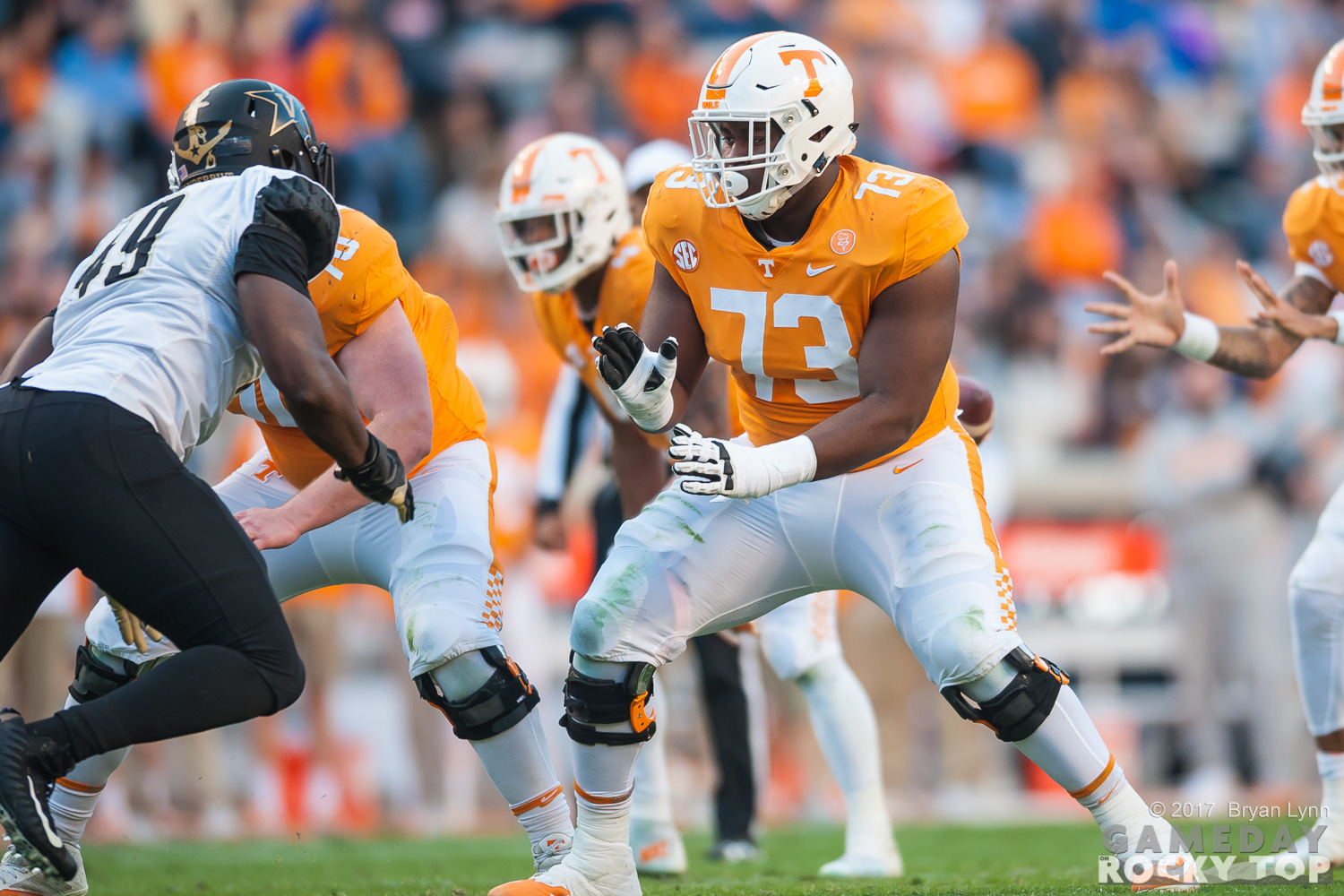
Jeremy Pruitt inherited a line including Drew Richmond, Trey Smith, Marcus Tatum, Ryan Johnson, Riley Locklear, and redshirt freshman K’Rojhn Calbert. Devante Brooks had just been converted from tight end. That’s seven scholarship players. Jack Jones was out, Venzell Boulware transferred, and Chance Hall and Nathan Niehaus seemed unlikely to return. Even before we assumed we wouldn’t get Cade Mays, this was big trouble. When we did a first draft 2018 depth chart in the midst of the coaching search, we had to leave center blank.

But Jeremy Pruitt did three critical things to shore up the line: signed four-star Jerome Carvin, picked up junior college transfer Jahmir Johnson, and landed Alabama transfer Brandon Kennedy.

The Vols still didn’t get Mays, then had several months of waiting to hear Trey Smith could go again. I’m still not sure when or at what percentage we’ll see Chance Hall. But there’s at least some optimism available now when it was impossible to find back in December.

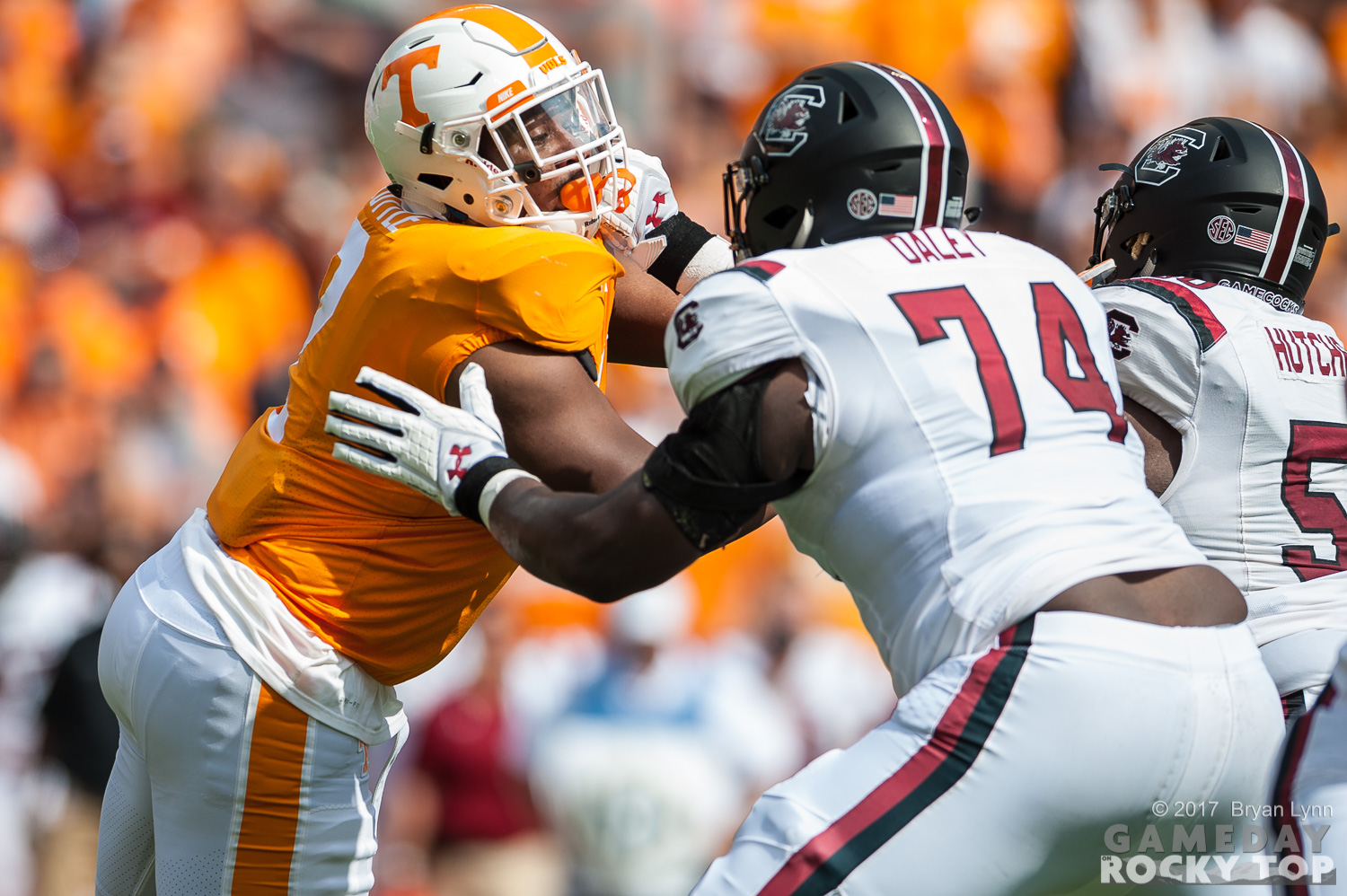
The Vols could start a five-star and three four-stars in this group. Again, leaning heavily on recruiting rankings and hoping this staff flips the switch on a player like Drew Richmond is what we’re all guilty of with a first-year coach. But there’s now hope the Vols could not only fill out the line, but it could be an asset.

Last season Tennessee was 114th nationally in sacks allowed, 121st in TFLs allowed, and 115th in yards per carry. The sacks number (2.92 per game) was only the worst since 2014 (3.31) when Justin Worley was ultimately lost for the year. The Vols also allowed 3.15 per game in the 2010 “we can’t play Tyler Bray because he might die back there” season with freshmen everywhere on the line. Sacks allowed have varied wildly in this decade between styles of play and freshmen being forced to step in. That shouldn’t have to be the case this season; guys like Ollie Lane and Taylor Antonutti will be available, but can rightfully wait before they’re asked to be a first-team option if the Vols stay relatively healthy.

The tackles for loss were a concern throughout Butch Jones’ tenure; Southern Cal struggled a bit in that department last season as well, but were 11th nationally in that stat in 2016. Hopefully the system and the play-calling will help there. As for running the football, 3.41 yards per carry last season was the program’s worst number since 2011 (2.76). But those two totals, along with Ole Miss’s 3.36 ypc in 2011, are the worst three rushing performances in the SEC this decade. There’s bad, and then there’s a kind of historically bad you simply cannot afford to be in this league.

So yes, there’s lots of room to grow. But that growth now has names and faces and even backups, and the majority of the starters should at least carry the recruiting rankings Pruitt’s staff will want to become the norm. The Vols don’t have to start freshmen, and the previous staff did at least recruit the position as opposed to what they were left by Derek Dooley. Last season was as bad as it’s been on the line, and things looked especially perilous during the transition. But looking forward, there’s more reason for optimism, especially with offensive line coach Will Friend having an influence on not just this unit but the offense as a whole. That this line has a better prognosis than at least a couple we’ve inherited this decade is a good sign. If they stay healthy, they might even become a strength.

10 Questions for 2018

10. Which backups on the defensive line will be starters in 2019?

09. Can special teams make the difference in a coach’s first year?

08. What do we know about Tyson Helton’s offense from his time at USC?

07. Who’s the third/fourth wide receiver in an offense that will actually throw them the ball?

06. What about team chemistry with a first-time coach and a hodgepodge of players?

05. How much ground can the Vols gain in year one on the non-UGA SEC East?


It’s Almost Always Florida

Jesse Simonton’s piece at VolQuest this week produced a familiar answer to a fun late-July question. What’s Tennessee’s most important game?

It’s Florida. It’s almost always Florida.

There are quotes Tennessee fans will like in Jesse’s piece, offering some behind-the-scenes insight on how Jeremy Pruitt’s staff seems to understand the importance of Vols/Gators around here. And while Florida has been a consistent answer to that question since the divisional format began in 1992, why the game is so important has shifted over the years from Tennessee’s perspective.

It’s easier to think of seasons when Florida didn’t feel like the most important game in late-July. It’s also fun to look at the impact of the Florida game at the end of each year. Here are a few thoughts on the pre-and-post-season answers to Tennessee’s most important game since the Vols and Gators have been together in the SEC East:

1992-95: The Bama Streak

Even though the Vols and Crimson Tide aren’t in the same division, Alabama still felt like the most important game of the year until the Vols broke what became a 10-year streak. It took that, in 1995, to really turn the attention of Tennessee fans fully toward Gainesville, where by then Florida had picked up a three-year run of its own over Tennessee. Looking back, only the first of these years in 1992 wasn’t also defined by what the Vols did against Alabama in the end. Phillip Fulmer’s takeover made the Florida game the most meaningful at the end of the ’92 season, both the best memory from that year and the one that most assisted Fulmer in becoming Tennessee’s next head coach. 1993’s longest-lasting memory is the tie against the Crimson Tide, a near-miss at the goal line the longest from 1994, and that jubilant night in Birmingham still sings 23 years later from 1995.

1996-2001: Tennessee/Florida as a National Rivalry

With the exception of a rebuild in 2000, in every one of these years you knew there were national championship implications on the line when Tennessee and Florida met. And only once, when the Vols lost to Florida in 1997 but still made the SEC Championship Game, did the outcome fail to define Tennessee’s season. These six match-ups were #2 vs #4, #2 vs #4, #2 vs #6, #2 vs #4, #6 vs #11 in 2000, then #2 vs #5. That’s all you need to know.

2002-03: A Brief Intermission for Miami

Having drained The Swamp and watched Steve Spurrier leave for the NFL, the Vols were free to dream a little bigger heading into the 2002 season. The defending champs from Miami would visit Neyland Stadium that November, and with the Vols in the preseason top five it felt like the biggest bulls-eye coming in. Of course, the 2002 season didn’t go as planned, starting with a rainy day against Florida that ended up being the longest-lasting memory from that year. The following season Florida was back in its rightful place atop the most important list at the start of the year, but a surprise upset in the return match with the Hurricanes (and a three-way tie in the SEC East) made the win at Miami the season’s most memorable.

2004-09: Change on the Horizon

With Ron Zook at Florida, Georgia took advantage. Florida won the BCS title in 2006, but it was their only SEC East crown from 2001-07. Tennessee and Georgia split the other six, making the Dawgs the most important game on the front end in 2004 and 2005, plus Georgia’s preseason #1 turn in 2008. It lived up to that standard in 2004, as the Vols stunned #3 Georgia in Athens en route to the division crown. And while it may not have felt like the most important game coming in, wins over Georgia in 2007 and 2009 were the best memories from those years. During this span the Vols also had critical early-season non-conference games that mattered a great deal in perception: California in 2006, and UCLA for Lane Kiffin in 2009.

2010-17: You’re not really back until you…

Beat Florida. During the Derek Dooley and Butch Jones tenures, only once was Florida not the most important game of the year coming in: 2013, in Jones’ first year, with Vanderbilt on the rise under James Franklin and the Vols having lost to Kentucky in 2011 and Vanderbilt in 2012. After the Dooley era, beating the Gators felt like too big of an ask for Jones in year one, the most sober we’ve been as a fan base (and maybe even more sober than we are right now). I’d listen to an argument for 2015, that more people were invested in that Oklahoma game in Neyland than Florida in The Swamp coming into the year, but I’m not sure I’m buying it. For Dooley, only in the end was the Florida game truly the most important: his first team turned it over to Tyler Bray at South Carolina and seemed to turn a corner; his second team threw all that right in the fire at Kentucky, which should never ever be your most impactful game of the year. Butch Jones got more positive out of beating South Carolina in 2013 than losing to Vanderbilt, but Florida has been the most painful memory in each of the last four years. Three losses that absolutely should not have been, and one spectacular win that couldn’t stand the test of time by season’s end.

By my count, Florida has felt like the most important game coming into the year in 15 of the last 22 seasons since the Vols broke the Bama streak. And it has been the game with the longest-lasting impact on Tennessee’s year 11 times in those 22 years, including five of the last six. It’s a far cry from what we saw in the late 90’s, but the stakes still feel quite real. They’re all important for Jeremy Pruitt, including West Virginia. But the answer is almost always Florida. It’s Pruitt’s job to raise those stakes even higher.


10 Questions for 2018: Vols vs The Non-UGA SEC East

Tennessee takes the stage in Atlanta today, and the media will unveil their picks for the 2018 SEC standings before the week is out. Georgia should be the overwhelming favorite in the SEC East coming off a near-miss in the national championship game and the number one recruiting class of 2018. How the rest of the division shakes out will be of interest to Tennessee, and not just this season.

This is an era Tennessee fans of my age (36) and younger are unaccustomed to. Georgia hasn’t won the SEC in consecutive years since the Herschel Walker days in the early 1980’s. The Dawgs have two sets of back-to-back division titles (2002-03 and 2011-12), but both times the second year came via a tiebreaker. Tennessee fans who grew up familiar with Georgia playing third fiddle have never seen a Bulldog program consistently on top the way they’ll have a chance to be in 2017, 2018, and beyond.

And the gap between one and two is substantial. Their traditional contemporaries at Florida and Tennessee changed coaches. Missouri seems due for an up year on the field, but is yet to level up in recruiting. Kentucky and Vanderbilt have yet to shed their reputations under their current administrations. Will South Carolina be the #2 pick in this year’s SEC East?

That idea may also seem foreign to those of us holding on tightly to Tennessee’s glory days in the 1990’s. But the truth is it’s not just South Carolina, but the vast majority of the SEC that’s been better than Tennessee the last ten years:

SEC Overall Records 2008-2017

Team Wins Losses Pct.
Alabama 125 14 .899
LSU 95 34 .736
Georgia 95 39 .709
Florida 86 43 .667
Auburn 83 48 .634
South Carolina 81 49 .623
Missouri 80 50 .615
Texas A&M 77 52 .597
Mississippi State 74 54 .578
Ole Miss 69 57 .548
Arkansas 67 59 .523
Tennessee 62 63 .496
Kentucky 53 72 .424
Vanderbilt 53 72 .424

(data from the always-helpful stassen.com)

This is the Tennessee recruits know: not Kentucky and Vanderbilt, but not on par with the rest of the league either.

And this is where Jeremy Pruitt’s first comparison must fall: not to Georgia, and certainly not to Alabama. But what are his Vols doing against the rest of the SEC East?

#5: The Vols vs The Non-UGA SEC East

At the old site we did an annual off-season piece ranking the importance of each game for the upcoming season. It was equal parts fun and futility, because it’s impossible to know how good or bad Derek Dooley’s offense will actually be when Missouri comes rolling into Knoxville on November 17. But in general, I think we can say this for 2018: the five most important games will be the ones against the non-Georgia SEC East.

West Virginia will be the first impression and would be fun to steal, but Pruitt’s first real measuring stick will be how this rebuild is going compared to the one in Gainesville, how quickly it can catch what’s happening in both Columbias, and how well it can avoid another loss to Kentucky or Vanderbilt.

A little more than a month ago we looked at Pruitt’s relative recruiting success compared to the non-UGA East in blue-chip ratio. Tennessee’s has fallen, for the moment, below the 50% threshold needed to be in the national championship hunt. But the Vols are still out-performing the rest of the non-UGA division. Six of Tennessee’s 14 commitments for 2019 are four-or-five-stars, 42.3%. South Carolina sits at 6-of-16 (37.5%), Florida at 4-of-11 (36.3%), while Kentucky, Missouri, and Vanderbilt are yet to nab a four-or-five-star.

That’s good news for climbing the ladder in the future. In the present?

Here’s how the non-UGA SEC East projects in ESPN’s FPI, Bill Connelly’s S&P+, and Phil Steele’s Power Poll:

Team FPI S&P+ Steele
Florida 21 32 23
Missouri 29 30 28
South Carolina 28 35 24
Tennessee 54 79 70
Kentucky 60 64 75
Vanderbilt 76 75 85

As you can see, the preseason expectation for Tennessee is basically what the last ten years have been: better than Kentucky and Vanderbilt, but in a lower tier than Missouri, South Carolina, and Florida’s restart.

We’ve got this as only the fifth most important question for Pruitt’s first year. But it will rise quickly as time goes on. Derek Dooley had the Vols competitive for four quarters with the entire division in 2012 until he was a dead man walking, but couldn’t take advantage. Butch Jones should have won the SEC East in 2015 and 2016, but too many close games led to too many close losses before the bottom fell out. Now Georgia is the biggest threat within the division since Urban Meyer and Tim Tebow a decade ago.

The early returns in recruiting suggest Pruitt will bring in the necessary talent to get the Vols back in the conversation. How much progress will we see on the field in those five games this fall?


10 Questions for 2018

10. Which backups on the defensive line will be starters in 2019?

09. Can special teams make the difference in a coach’s first year?

08. What do we know about Tyson Helton’s offense from his time at USC?

07. Who’s the third/fourth wide receiver in an offense that will actually throw them the ball?

06. What about team chemistry with a first-time coach and a hodgepodge of players?


10 Questions for 2018: New Coach, New Chemistry

We tend to overestimate the importance of a previous coach’s weakness. Butch Jones got elite talent to Knoxville, but struggled to keep it there. Potential difference makers from Preston Williams to Venzell Boulware left the program before their time was up, and actual difference makers like Jalen Hurd did the same. You can call it chemistry or culture or whatever you like, but it’s a significant percentage of the reason Jones isn’t here anymore.

How significant will this issue be for Jeremy Pruitt, a first-time head coach?

#6: New Coach, New Chemistry

So far, it’s been a non-issue. Darrin Kirkland Jr. flirted with the idea of transferring but ultimately stayed. Rashaan Gaulden, John Kelly, and Kahlil McKenzie all went pro earlier than hoped, the latter two going only in the sixth round. But we’ve avoided the rash of transfers a new coach often deals with.

One significant difference between Jones and Pruitt: the current coach is thoroughly familiar with recruiting, coaching, and developing four-and-five-star talent. There’s no other option at Florida State, Georgia, and Alabama. Butch Jones was successful at Central Michigan and Cincinnati, but his only experience at a power five school before coming to Knoxville was two years as the receivers coach at West Virginia.

Again, we’re probably overestimating the importance of chemistry just because Jones struggled with it. But though the Vols have avoided the transfer bug, chemistry can become an issue in another way for first-year coaches.

As you’re probably aware, Nick Saban lost to Louisiana-Monroe in year one. Kirby Smart lost to Vanderbilt. Dabo Swinney lost to a 2-10 Maryland squad. It happens.

But it usually doesn’t happen out of the gate. Swinney lost to Maryland on October 3, Smart to Vanderbilt on October 15, Saban to ULM on November 17.

(Of note: if you think Lane Kiffin’s worst loss at Tennessee wasn’t the Ole Miss debacle, but the UCLA game – and I’m in this camp – that happened in week two. So this isn’t a hard and fast rule.)

When you have players who were recruited on the promise of championships, and especially players who almost got a taste of one like Alabama in 2005, Georgia in 2014, and Tennessee in 2016? They can lose interest much faster in a rebuilding year, especially if they’re seniors.

The good news on that front: the Vols only have 12 seniors, and only seven of them (Todd Kelly Jr., Micah Abernathy, Shy Tuttle, Jonathan Kongbo, Kyle Phillips, Chance Hall, Paul Bain) have been meaningful contributors. There shouldn’t be a whole lot of guys who lose interest, because most of them can be back in 2019.

The (potential) bad news: there aren’t a whole lot of guys in any one category.

You’ve got those seven seniors, plus guys like Kirkland and Jauan Jennings who know what it’s like to play in and win big games. You’ve got the major contributors from last year looking for redemption like Guarantano, Ty Chandler, Marquez Callaway, etc. You’ve got high profile recruits who haven’t gotten their chance yet like Maleik Gray and Jordan Murphy. You’ve got Pruitt’s signees. And then you’ve got a whole bunch of graduate transfers, including potential starters at quarterback and running back.

That’s a lot of ingredients in the soup bowl. We’re all wondering if it’s any good. But it’s also worth wondering if it’ll turn five or six weeks in.

The scenario some pundits play out for this team is a 2-6ish start with a chance to get bowl eligible in November via Charlotte, Kentucky, Missouri, and Vanderbilt. It’s what Derek Dooley was able to accomplish in 2010 (against a worse version of Vanderbilt and a lifeless Ole Miss team), in part by turning the team over to the future with Tyler Bray. If Jeremy Pruitt’s first year ends up in a similar ditch, he may have to make a similar call to get it back out and bowl eligible.

Chemistry is tricky business, and there are some things you just can’t learn until you’re the head coach. I don’t know if this is the sixth-most-important question this year or the tenth or the first. But it’s in there somewhere. And when the Vols lose a couple of games – hopefully later than sooner – how Pruitt gets his hodgepodge of players to respond as a team will be important.

10 Questions for 2018

10. Which backups on the defensive line will be starters in 2019?

09. Can special teams make the difference in a coach’s first year?

08. What do we know about Tyson Helton’s offense from his time at USC?

07. Who’s the third/fourth wide receiver in an offense that will actually throw them the ball?