Our 10 Most Rewatchable Beat Downs

Last week we shared our picks for the most rewatchable Tennessee games of the last 30 years. They lean toward the dramatic, with plenty of offense from both sides.

But maybe you love seeing Tennessee’s defense do its thing? Or maybe, in these strange days, you’re in the mood for pure dominance?

Here are our picks for Tennessee’s most rewatchable beatdowns:

10. 1989: Tennessee 24 UCLA 6

The birth of the “Decade” of Dominance. The Vols started 0-6 in 1988, then won their last five games, a story told in full on the latest Host of Volunteers podcast. The 1989 Vols barely beat Colorado State in the opener. And then they went to #6 UCLA in a west coast night game, and rolled. A filthy coming out party for the CobbWebb – you’ll see all kinds of triple option fun in this game with those two and Sterling Henton.

9. 1990: Tennessee 40 Mississippi State 7

After an 11-1 SEC Championship season in 1989, Chuck Webb blew his knee out in the second game of the 1990 season. Enter Tony Thompson, who ran for 248 yards at Mississippi State in his first start. Bonus points for the fumblerooski in this one.

8. 1997: Tennessee 38 Georgia 13

There are lots of great Peyton Manning choices for this list, but none of them combine such a great rushing performance against a quality opponent. Georgia was undefeated and ranked 13th. The Vols made a change at running back, and this became the “Give the Ball to Jamal” game: 343 yards through the air for Manning, 232 on the ground for Jamal Lewis, and one of the best beatdowns of a good team in the last 30 years.

7. 1993: Tennessee 55 South Carolina 3

The Steve Tanneyhill revenge tour. After the long-haired South Carolina quarterback led an upset the previous year – the Gamecocks’ first in the SEC, which also cost Johnny Majors his job – he came to Knoxville for round two. If you’d like to see why SP+ rates the ’93 Vols as the decade’s best, this blowout is a great example. Also rewatchable: the 1995 edition, where a senior Tanneyhill drove the Gamecocks to the one yard line on the opening drive. He was helicoptered on a goal line hit, couldn’t get in on second or third down, and the Vols blocked the field goal and ran it back for a touchdown to kick off a 56-21 beat down.

6. 2001: Tennessee 45 Michigan 17

Heartbroken after losing to LSU in the SEC Championship Game, this was a terrific epilogue on the 2001 season. The first and only meeting between these two programs, and the first after the Manning/Woodson Heisman drama four years earlier. And yep, it’s a beatdown. Jason Witten outrunning their secondary is the most memorable highlight, but far from the only one.

5. 2007: Tennessee 35 Georgia 14

One of the clearest crossroad games of the last 30 years: lose, and Fulmer’s job is in serious trouble. Win, and you’re in first place in the SEC East. And Tennessee outright dominated a team that would finish the year ranked second in the nation.

4. 2006: Tennessee 35 California 18

One of the most joyfully surprising evenings I’ve ever seen at Neyland. I think it’s how equally surprising the struggles of 2005 were, that made you doubt if the Vols could bounce back for the first time in 15+ years. And then they bounced back with a vengeance in this one. My favorite blowout that didn’t involve our biggest rivals.

3. 1992: Tennessee 31 Florida 14

The downpour. Heath Shuler and the Vols won a thrilling 34-31 contest at Georgia the week before in Phillip Fulmer’s interim stint. This one, in front of the rain-soaked masses in Knoxville, was even more surprising and brilliant.

2. 1990: Tennessee 45 Florida 3

If you want to skip to the second half, it’s cool. The Vols led 7-3 at the break, and Dale Carter probably should’ve let the second half kickoff bounce out of bounds. He did not. And the Vols never looked back. Easily the best single half of football of my lifetime in Steve Spurrier’s first trip to Knoxville as the Gator coach. Florida was ranked ninth. The Vols won by 42.

1. 1995: Tennessee 41 Alabama 14

Other than everything that happened in 1998, this is the best of the Phillip Fulmer era. No wins over the Tide since 1985. Peyton Manning and Joey Kent on play number one. Streaks are made to be broken; this one was obliterated.

What did we miss?
Our 10 Most Rewatchable Tennessee Games

When I’m stressed, spent, or any other word you might use to describe what these days are taking from us, I find myself going back to happier childhood memories. I’ve been playing back through the Super Nintendo Legend of Zelda: A Link to the Past on my Switch for the past 10 days or so, and I’m almost sad that I’m coming close to the end. It was surreal to turn on ESPN Sunday night and find WrestleMania 30; we taught our son the Yes! movement a little too close to bedtime, as it turned out.

And if you’re reading this site, chances are you’ve tried to fill some of these hours with Tennessee highlights. The problem with highlights, however, is they only burn seconds, and you can blow through what feels like everything you know in a short amount of time.

In watching those old WrestleMania matches, and in talking to some of my friends on what they’ve been going back and watching, I started thinking of some of our old “best of” lists. We’ve spilled plenty of word count on bests and favorites and all that over the years. But what’s most helpful right now is rewatchability: what games am I most likely to sit down and watch all of, with the least temptation to fast forward?

As always with me, you get 1989-present, both as a nice starting point in Tennessee’s history and about as far back as my own memories go. Shout out to those who uploaded these onto YouTube long ago, so that they’re here like old friends today. Click each game to go to the broadcast.

With rewatchability, you value the whole thing. I often use 1998 Florida as the example: one of the most memorable and important wins in Tennessee football history…but not an overly great football game play-for-play. Today’s list focuses on excitement, and is thus a little heavy on offense. I tried to think of these games in terms of the most plays of consequences, fewest three-and-outs, etc. We’ll come back in a few days with a list of Tennessee’s most satisfying beatdowns, if you’re in the mood for something a little less dramatic. And I also leaned into some games that haven’t been in as heavy a rotation; I adore the 1997 win over Auburn in the SEC Championship Game, but they replay that all the time. I think the top four games on this list are unassailable; if I watched them today I’d still be interested in watching them again tomorrow. The rest are the games I think are most rewatchable for March of 2020, including for younger fans, representing some of the greatest hits of the last two decades.

Play-for-play, for the most exciting ways to spend 60+ minutes of gametime and 2-3 hours watching Tennessee football, these are my picks:

10. 2006: Tennessee 31 Air Force 30

This game carries the weight of Inky Johnson’s injury, someone whose positivity we could all use more of right about now. A week after blowing past #9 California, Tennessee needed all of David Cutcliffe’s high-powered offense against the Falcons and the triple-option. Total punts in this game: two. Total punts by Tennessee in this game: zero.

9. 2001: Tennessee 38 Kentucky 35

Two weeks before the December showdown at Florida, the #6 Vols fell behind 21-0 against Jared Lorenzen in Lexington. I was at this game, and it was terrifying; much less so when you know the outcome.

8. 2016: Tennessee 38 Florida 28

Four years later, this one still carries a tinge of grief for what this team didn’t ultimately become, which is why I have it lower than the next one on our list among games from the last decade. Still, there are so many meaningful plays in this game, even having memorized them all in the last few years.

7. 2014: Tennessee 45 South Carolina 42 (OT)

Hello, Josh Dobbs. The most rewatchable game of the 2010’s. All the things we wanted to believe about Dobbs that night really came true. An incredible football game even before the complete insanity of the last five minutes, and the performance of Tennessee’s pass rush in overtime. And the last word against Steve Spurrier.

6. 2006: Tennessee 51 Georgia 33

Another feather in the 2006 cap. If you’re too young, you might wonder what an 18-point win is doing in this group instead of being on the beat-down list. Just watch. Antonio Wardlow gets the cover of Sports Illustrated, and this might be the most complete fourth quarter in the history of Tennessee football.

5. 2007: Tennessee 52 Kentucky 50 (4OT)

All the other multi-overtime games at Tennessee really lack a compelling story for most of regulation. Not this one. And don’t forget, this was a really good Kentucky team: beat #1 LSU, ranked in the Top 10 two different times that year. No Tennessee win in the last 13 years has mattered more than this one.

4. 1991: Tennessee 35 Notre Dame 34

The Miracle at South Bend, and the best road unis the Vols have ever worn. If you’ve never watched this game from start to finish – including the entire first half just to appreciate how bad it was in digging a 31-7 hole – now’s the time.

3. 2004: Tennessee 30 Florida 28

The best play-for-play game I’ve ever seen at Neyland Stadium. Ainge and Schaeffer, Chris Leak, a 12-play 80-yard UT touchdown drive featuring all runs, a bananas touchdown pass from Ainge to Bret Smith, and the ballad of James Wilhoit. All in front of what will probably always be the largest crowd in Neyland Stadium history.

2. 2001: Tennessee 34 Florida 32

The best play-for-play game I’ve ever seen period. The stakes, the rivalry, everything on the line and winning anyway. It’s hard to believe this game turns 20 years old next fall.

1. 1998: Tennessee 28 Arkansas 24

I think those two Florida games are slightly better play-for-play. But they don’t carry the feel-goods of 1998, which will always push this one over the top.

On Getting the Last Word

We often talk of the similarities in Tennessee’s historical football and basketball DNA when it comes to our biggest rivals: no one has beaten Alabama football or Kentucky basketball more than the Vols. In nearly 30 years of divisional play, the Vols fell into a similar pattern with Florida in football: always within reach, grasped just enough to make you believe it can happen each time. (Apparently that’s true at Rupp Arena now too.)

I think I’ve always leaned into this idea because it somewhat mirrors the dynamic between Alcoa and Maryville in football. And those of us who double as Braves fans know much of the “good enough to believe you can win every year” DNA. You don’t win every year, of course. Being close means being invested, and being invested means losing hurts. But the payoffs, when they come, are incredible. And they happen just enough to make you believe it can happen again this time.

But there’s one other, much more enjoyable trait of being a Tennessee Vol: we tend to get the last word against our greatest villains.

Bear Bryant won 11 in a row against Tennessee from 1971-1981. The Vols broke that streak in Knoxville in 1982 with a 35-28 victory, in what became Bryant’s final season.

Steve Spurrier caused more pain for Tennessee football than any individual in my lifetime. But the Vols sent him out of The Swamp with a loss, 34-32 in December 2001, the greatest individual football game one of my teams has ever played in. Thirteen years later, Josh Dobbs rallied the Vols from down 14 with less than five minutes to play to win 45-42 in overtime, the last time Tennessee faced him at South Carolina.

Peyton Manning is our favorite hero, and his story was always best defined by its villains, including Spurrier. But the longest of those relationships belong to Tom Brady. And, in 2015, Manning got the last word in the AFC Championship Game.

So my first thought yesterday, even before trying to picture Brady in one of those creamsicle uniforms? If your Venn diagram, like mine, includes the Titans as well?

I’m sure Alabama and Florida and New England fans enjoyed all those wins; I know how little I enjoyed the losses.

But getting the last word? I enjoy that very much.

Absence

I wore orange to work today, even though I figured they wouldn’t really play basketball at 1:00 PM ET in Nashville. Since moving back to Virginia I’ve acquired more brand-free orange so as to be somewhat less obnoxious to my neighbors here in Hokieland. It’s convenient, since both of the schools of record in the commonwealth have orange in their scheme anyway.

I wore orange to work today because we played today, or we were supposed to, and that’s what we do. It didn’t matter that the Vols are 17-14 and not 27-4 as they were this week a year ago. That distinction feels like it matters a whole lot right now – the cancellation of the NCAA Tournament isn’t robbing us of a real chance to make our first Final Four this year – but we’re also figuring out, and fast, how much we’re actually going to miss a hypothetical NIT run.

It’s never really about the winning. I’ve written about Tennessee for 14 years now, a period in which the football team has 94 wins and 83 losses. That’s tied with Western Michigan for the nation’s 59th best winning percentage in that span. And yet, we keep putting fingers to keyboard to talk about the Vols because that’s what we do. I’m not far from 40, and I still have a stubborn, childlike, idiot optimism that says, “I know they’re probably not even going to play this thing, but Alabama’s on a slide, and we should have no fear of Kentucky now, and if we can get to Saturday…” And so by God, we wear orange to work today.

There’s a quote I like for sports about how they’re the most important unimportant thing we do. Now something that only happens a couple days a year in the summer – no games of record in America’s major sports the days before and after baseball’s all-star game – is getting ready to become our reality for at least weeks. They’re still playing golf at Sawgrass this weekend, at least for the moment. And if you can judge the severity of a hurricane by when the Waffle House closes? Vince McMahon and professional rasslin’ are without question the Waffle House of sports (entertainment). So there may still be a few unusual options, but no reason to wear your color of choice to work for a while.

We won’t miss sports because they matter, as much as we’ll miss them because so much else does. For these same 14 years, I’ve been a United Methodist pastor. There have been plenty of days when writing about the Vols seemed so unimportant. And some of those days I just haven’t. I’m not contractually obligated to create content – I get to do this because I want to – but if I was, I too might find it somewhere between odd and distasteful to write about who Tennessee’s backup tight end will be this fall. At least right now, while all of this is still unfolding and none of us are sure just how bad it’s going to be.

But at the same time, when it is that bad, there are moments when all I want to do is write about the backup tight end.

I think it cheapens both sports and life when we define them as only “escape”. Sports can absolutely serve that purpose; solitude is cozier when your bracket’s on the line. But sports also contain so much of what we value about the actually important things: relationships, loyalty, community, and a childlike hope. The winning and losing is more defined. But it’s never fully about the winning and losing. The experience itself is what keeps us coming back.

This time last year during Lent, our church took one consistent, meaningful, screen-free hour for 40 days (inspired by The Tech-Wise Family by Andy Crouch, a great book that might be an especially worthy read if you’re thinking of how to fill more hours in these next few weeks). My wife and I took 4-5 pm each day: no screens, no phones, etc. That meant a callback to the days of John Ward during the middle third of an epic Tennessee & Kentucky showdown in the SEC Tournament, letting the radio be our guide. A few days later it also meant a panicked hour of, “Alexa, what’s the score of the Tennessee game?” when Colgate made a run.

It was just an hour every day, but it was harder than I thought it would be. We are indeed creatures of habit. In our tradition, God creates with order from chaos, a story told in poetry. We’re made for rhythm. Maybe sports should never sit in the first chair. But they make the song better, even when you lose.

Important stuff is happening. But if you do it right, important stuff happens every day. I’d let those who are experiencing these cancellations on a personal level speak for themselves and call it what they like. From Dayton, to Rutgers, to those in the state tournament here in Virginia, now called off with titles split among the finalists. The NCAA cancelled all spring sports. That hurts for our suddenly prominent baseball team, who might’ve squeezed in a reason to wear orange to work in June. And it hurts for names we’ll never know or see who ran track or played tennis. They’ll have their own language. As fans, we’d be wrong to call any of this a tragedy while actual tragedy unfolds. But I think we’d be right to lament the loss, though temporary, of the place sports hold in the rhythm of our lives.

At my job we’re trying to figure out whether or not to have church on Sunday. But the real work is in trying to figure out how to get food to kids if school closes, and make sure our 90+ year old friends have what they need for today. And we’ll give ourselves to that work, because that’s what we do. I will miss coming home, at the end of a long day, and checking the NET ratings. I’m sure we’ll still find something hopeful and orange to talk about on this site.

Maybe that’s the thing about being creatures of habit, created in the image of a creator: we can always make something new. The song goes on. We can still find the rhythm.

At the end of this long day, I came home and played outside with my 2.5 year old son while my wife, about to enter her third trimester with our daughter, watched on. The cure for absence is presence, even if you have to be present a little more carefully right now. Presence makes you better at all the important stuff. And presence helps you appreciate all that’s good and right about sports in its proper place too.

At the end of this long day, the music still plays and we can still find the rhythm: my son picked up a basketball, and we took it from there.

Go Vols.

Any Run Would Be Remarkable: On Tennessee’s Workload

When you’re putting together dream scenarios for the Vols to run through Nashville and win the SEC Tournament, a few things might wake you from sleep. Tennessee hasn’t won four games in a row since starting the season 5-0. If you make it through Thursday, the league champion awaits on Friday (though that wasn’t a problem last week). And a young, thrown-together lineup will generally lack the consistency it takes to pull off this kind of feat, one the Vols haven’t accomplished since 1979.

But perhaps more than anything, how long this Tennessee team lasts is dependent on its stamina. These Vols aren’t just hastily formed, they’re operating at just about the only way they have a chance to succeed: playing their starters an insane amount of minutes.

It feels like John Fulkerson is the key piece of the puzzle here, but statistically that’s not true. Granted, he played 39 minutes in the win at Rupp. But Fulkerson, through some combination of fatigue and foul trouble, plays only 30.1 minutes per game.

The word “only”, as you’ll see, is relative. Let’s start with Jordan Bowden.

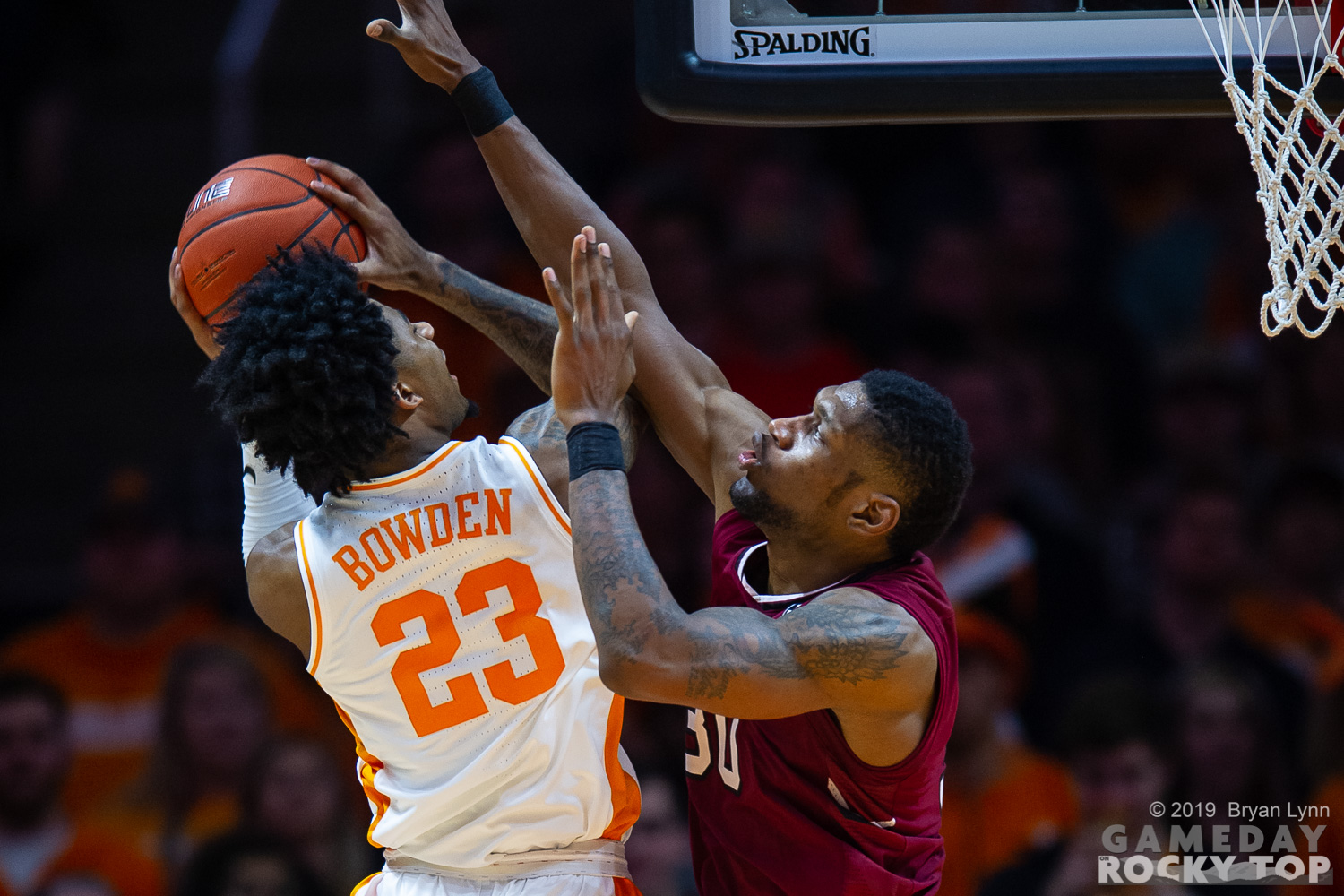
The Vol senior averages 34.4 minutes per game, well north of the 27.8 he put in last season. And it’s well north of anyone to play at Tennessee in the last 15 years (Pearl, Cuonzo, Tyndall, and Barnes) other than Josh Richardson:

PlayerSeasonMPG
Josh Richardson201536.3
Jordan Bowden202034.4
Kevin Punter201634.1
Yves Pons202033.9
Jordan McRae201333.5
Jordan Bone201932.9
Armani Moore201632.7
Tyler Smith200932.6
Jarnell Stokes201432.4
Jordan McRae201432.2

(data via Sports-Reference)

One thing you’ll notice about that list: none of Tennessee’s NCAA Tournament teams featured anyone playing 33 minutes or more. Of the nine Vol squads to make the dance in these last 15 years, five saw the guy with the most minutes play less than 30 per game. The bench isn’t just about how much production they give you when they’re on the floor. It’s about their ability to have your best players at their best in the last four minutes.

What Bowden is doing gets little press; it’s easy to take a senior who played 22.8 minutes as a freshman for granted. But he’s been doing this all year, even before Lamonte Turner went out (39 minutes vs Washington, 37 at Cincinnati). When Josh Richardson did it in 2015, it became one of the most remarkable things about that season by its end. But this team came so close to doing something truly remarkable in the regular season, Bowden’s individual stamina has gone largely unnoticed.

And it’s not just him. There’s Yves Pons at fourth on the leaderboard at 33.9 minutes per game. When Fulkerson gets a blow, sometimes it’s Pons who gives it to him. Those nearly 34 minutes a night are the most at Tennessee for a non-guard since Ron Slay played 34.2 in his SEC Player of the Year campaign in 2003. Pons is the SEC shot blocking champion at 2.4 per game, joining Nick Richards (2.1) as the only players to average more than two per game.

Also, consider Santiago Vescovi, who isn’t just remarkable for playing and playing well this season. Vescovi’s 30.3 minutes per game are the most for a Tennessee freshman since C.J. Watson played an insane 35.8 minutes on that same 2003 squad with Ron Slay, another bubble casualty with those two and Jon Higgins all playing more than 33 minutes per game. And Josiah James is right behind Vescovi at 29.9 minutes per game.

Here’s what minutes for elite freshmen typically look like at Tennessee:

PlayerYearMPG
Santiago Vescovi202030.3
Josiah James202029.9
Grant Williams201725.4
Jarnell Stokes201225.6
Tobias Harris201129.2
Scotty Hopson200923.4
Ramar Smith200727.2
Chris Lofton200529.5
C.J. Watson200335.8

Good news is coming, but not this week. Jordan Bowden’s 34.4 minutes will have to be replaced, but the Vols have Keon Johnson, Jaden Springer, and Oregon transfer Victor Bailey to carry that load. Corey Walker and a more fully-formed Uros Plavsic can make sure Fulkerson and Pons are at their very best late in the action.

Right now the Vols are running a glorified seven-man rotation: the starters all play 30+ minutes, Jalen Johnson and Davonte Gaines contribute 10-15 minutes off the bench depending on whether you need more from your offense or defense, and maybe you get a brief spell for your posts from Plavsic and Olivier Nkamhoua. If the Vols do make the NIT, I’ll be curious to see if Barnes throws those two in the fire more often just to see what he’s got.

But next year, there should be a legitimate battle for playing time. If you assume Vescovi, James, Pons, and Fulkerson are all in the mix, plus your three stud recruits, plus Victor Bailey, that’s eight before we even get to this year’s bench of Plavsic, Nkamhoua, Gaines, Johnson, and Pember. Get the kind of growth we’ve come to expect from this coaching staff and the kind of spark you expect from bringing in the nation’s number five class, and the problem will be figuring out who your best five are instead of worrying about if they’re your only five.

Given all that, what the Vols have done this season deserves a tip of the cap no matter where it goes from here. I’m hopeful it’ll go as long as it can in Nashville. But given these minutes, any run would be remarkable. And in a season full of surprises, who knows? Maybe they’ve got one left up their tired sleeves.

Tennessee Bubble Math: To The End

A tip of the cap to the 2018 and 2019 Vols, for whom no such fun was required and we spent the first week of March trying to figure out what makes a one seed. I’d be happy to write those posts every year. But in this year, to get to this point – a chance to be in the bubble conversation with a home win over a ranked foe on the last day of the regular season – and to arrive here via Rupp Arena? I’m delighted to write this one as well.

First this: beat Auburn. Any scenario that involves the phrase, “Maybe if we make it all the way to Sunday in the SEC Tournament,” will lead, even in its rare fulfillment, to the simple desire to just win the (Fulmerized) SEC Tournament for once. The Vols still have just two Quad 1 wins heading to senior day, and as we’ve documented at length, their strength of schedule will end up being good but not great. The core of this argument has to be what you’ve done for me lately. Beat Auburn to complete a Florida-Kentucky-Auburn triple kill, now we’re talking. Lose to the Tigers, and we’ll have to do it the hard way in Nashville.

Lessons From Cuonzo, Lessons From Bruce

As has been the case for much of the post-Lamonte run, the Vols’ closest program counterparts in KenPom are Bruce Pearl’s last team (a 9 seed at 19-14) and a trio of NIT squads from Cuonzo’s first two years and Ron Slay’s SEC Player of the Year season in 2003. Where other Vol squads watched bubble hopes burst when things fell apart in late February, including Rick Barnes’ first two teams, this group is very much trying to live that Cuonzo life, at least in the last week of the regular season.

The 2012 Vols played host to a Vanderbilt team a week away from earning a five seed in the NCAA Tournament. Tennessee won 68-61. The 2013 Vols played host to a Missouri team a week away from earning a nine seed. Tennessee won 64-62. The 2014 Vols got Missouri again for the finale. They came to Knoxville on the bubble, and left with a 72-45 beat down.

Those first two teams lost their first game in the SEC Tournament, and the ride ended there (technically shortly thereafter in the NIT). The third snuck into Dayton and almost snuck into the Elite Eight. All you’ve gotta do is get in.

Beat Auburn, and the Vols will cross a couple of thresholds. No team has earned an at-large bid with a record worse than 19-15. Beat the Tigers, and the Vols would have 14 losses on Selection Sunday if they don’t win the NCAA Tournament. Eleven teams have earned an at-large bid with 14 or 15 losses since expansion to 68 in 2011.

The 19-15 number has a much healthier sample size than the NET ratings, which were brand new last season. Here’s a look at the cut line in NET last season:

TeamSeedNETRecord
Florida103119-15
Iowa104322-11
Seton Hall105720-13
Minnesota106121-13
Ohio State115519-14
BelmontDayton4726-5
TempleDayton5623-9
Arizona St.Dayton6322-10
St. John’sDayton7321-12

The Vols are currently 57th in NET, within the margins from last season. Again, small sample size, and no guarantees: last season NC State (33) and Clemson (35) both missed the dance floor despite strong NET ratings.

Tennessee has only two Quad 1 wins, and Auburn’s loss to Texas A&M tonight should deny them an opportunity for a third on Saturday. However, Florida’s win at Georgia – especially if followed up by a win over Kentucky in Gainesville – would give the Vols one back.

The bad news: the selection committee might just pass on the SEC as a whole. The Vols join Arkansas, Mississippi State, and South Carolina as bubble hopefuls coming to the final game. But if the league’s perception suffers in the room, the Vols might get caught in the wash.

Tennessee’s best argument is what’s it’s doing right now. Its second best argument is hard to quantify, but the Vols have been competitive at Kansas, vs Florida State, and obviously just beat Kentucky. If you get people in the room to talk about the Vols, you can make this point. But you have to get in the conversation first, which requires a win over Auburn.

And this is also a chance to learn and grow from the last time the Vols beat Kentucky in incredibly emotional fashion, then got blindsided by Auburn in the SEC Tournament title game. That one came at the expense of a one seed and the first SEC Tournament championship since 1979. This time the stakes are lower, but not smaller.

The Vols are great story with an unwritten ending. The last chapter was an incredible turn of events. Will that be the climax, or can the Vols keep building something more?

Beat Auburn.

Tennessee 81 Kentucky 73: Rick Barnes Does Not Believe in Ghosts

We’ll get to bubble math. Believe me, we will.

And, oh yes, we’re going to discuss Rick Barnes being 7-5 against Kentucky at Tennessee, and now the only Vol coach to win two games at Rupp Arena.

But for now, let’s just set all that aside and take this win over Kentucky for what it is on its own.

Kentucky led 42-31 at halftime. They pushed it to 51-34 with 16:53 to go. ESPN, sensing a blowout like the rest of us, went to backup story lines, including John Calipari’s love for being asked about the Evansville loss:

https://twitter.com/Kyle__Boone/status/1233913271331192833

While ESPN showed that clip, the Vols hit a 9-0 run in the background.

We hung out there for a while, the Vols unable to get closer than seven. Neither team made a shot for three minutes, Kentucky turned it over twice, and the Vols turned it over three times and missed the front end of a 1-and-1. Kentucky’s lead was still seven with eight minutes to play.

At that point, John Fulkerson had carried almost the entire load. The Vols were playing a glorified seven-man rotation and still trailed by seven at Rupp. This had all the makings of a great individual performance and another tip of the cap for this team refusing to quit, even if it wasn’t enough.

And then, in a flash, Tennessee had the lead.

Yves Pons rattled home a jumper to cut it to five. Josiah James got a steal and found Fulkerson for an and-one. Kentucky missed on the other end. Josiah James hit a three. Then Santiago Vescovi got a steal and euro-stepped his way to a bucket.

Down seven at 8:19. Up three at 6:13. At Rupp.

And not with the dudes who did something similar a little later in the contest at the SEC Tournament last year, who stared down the Cats in the final minutes and made them blink first. With 27 points from John Fulkerson. With an “oh yeah, that’s why he’s here,” revelation from Josiah James: 16 points, 7 rebounds, 5 assists, 2 steals, 1 turnover. With five assists and zero turnovers from Jordan Bowden. And 15 points on 6-of-9 shooting from Yves Pons.

It wasn’t done, of course: Kentucky quickly tied it up. But then Pons hit a three. And Pons was there again down the stretch. He scored out of a timeout on a beautiful feed from Vescovi to put the Vols up four with 2:43 to go. Then he put back a Fulkerson miss on the next possession to put the Vols up six. And Fulkerson was there again at the end, keeping a rebound alive for Josiah James to follow hit shot and put the Vols up six again with 1:08 to go.

Barnes rolled in here five years ago from nearly two decades of war with Kansas. It’s not that he’s unimpressed with Rupp or Kentucky or whatever. But he’s absolutely unfazed by them. He beat them in Knoxville with teams that finished 15-19 and 16-15. He went 4-2 against them the last two seasons, one win in Rupp and one in Nashville, both alive forever in our memories.

But to do this, with this team, at this point in the season, and down 17 with 16 minutes left when all signs pointed to a “good game” pat on the butt and let’s get ’em next year? At Rupp?

It’s one of the most surprising, most satisfying wins for any Tennessee basketball team I can remember.

The Vols move to 58th in KenPom, and their once-anemic triple-digit offense is now 84th. If there’s a way to quantify that the Vols lost to Florida State on a neutral floor by three, lost at Kansas by six, led at Auburn by, ironically, 17 points in the second half, and just won at Kentucky by eight? That’s the tournament argument. You want to keep having it, you beat Bruce Pearl on Saturday.

We’ll get to all that. But goodness gracious, you take a moment for this one tonight by itself. You lie about going to bed after the first four minutes of the second half. You listen to Barnes use language like, “This is one for the ages,” in the postgame; he knows. But he’s also been good enough at getting us here that we can believe in beating Kentucky. That’s been true in Knoxville for a long time now. Barnes and his players will make you believe it can happen anywhere.

Even Rupp. Even this team. Even tonight.

Tennessee at Kentucky: Ruthlessly Efficient

Can you guess how many Quad 1 wins Tennessee has right now?

It’s one: at Alabama on February 4.

In this #anyonecanwin season, Tennessee’s schedule is guilty of a particularly cruel betrayal. For more than a month we’ve been saying if the Vols just get to 18 or 19 regular season wins, the schedule would be there to back them up. Sure, the Vols would need to sweep Kentucky and Auburn this week to finish 18-13 (10-8). But at this point, even that might not be enough.

It would be enough to at least get you in the conversation. The Vols are inches away from a pair of other Quad 1 wins: Florida is 33rd in NET (Quad 1 = Top 30 win at home), VCU 56th (Quad 1 = Top 50 win at a neutral site). Washington broke a nine game losing streak but is still 13-16 (3-13). South Carolina has lost three of four. Arkansas just lost at Georgia. Tennessee’s strength of schedule is stagnant at 50th in KenPom.

It’ll go up this week, with what should be two more Quad 1 opportunities. But would it be enough?

For whatever it’s worth, I can get the Vols in using Bart Torvik’s predictive bracketology with the following scenario: beat Kentucky, beat Auburn, beat Texas A&M on Thursday, beat Kentucky on Friday, lose on Saturday. If the committee values what you’ve done lately, that would certainly be a compelling argument. But since that argument includes beating Kentucky twice in two weeks, one at Rupp? We’ve reached the point where any of the scenarios left on the table might be more difficult than simply winning the SEC Tournament.

It’s not impossible, and it’s Kentucky, so yeah, let’s win tonight. It would cement the Vols in the NIT, at the very least, barring total insanity during Championship Week. But the goal for Tennessee remains to keep playing its best basketball, something we’ve seen sustained glimpses of against South Carolina, Auburn, and Florida of late. These Vols will give themselves a chance against anyone they’ll face in Nashville. When they’re facing Kentucky in Lexington?

Mourning the Loss of a Favorite Joke

John Calipari’s 2008 Memphis team shot 61.4% at the free throw line, 329th nationally. You might recall them going 8-of-17 against the Vols in the 1 vs 2 game, or 12-of-19 in the title game.

His first Kentucky team went 66.9%, 16-of-29 in the Elite Eight loss to West Virginia. The 2014 team that ran to the finals shot 68.2%, 13-of-24 in the title game loss to UConn.

The 2015 juggernaut actually shot it really well (72.6%), you just didn’t notice because they didn’t need it. The 2018 group was back under 70% at 69.8%, including 10-of-16 in the loss in Knoxville and 23-of-37 in their tournament loss to Kansas State.

This year’s Kentucky team lost to Evansville and Utah, and gets less credit for winning a down SEC at 14-2 and counting. They’re just outside the Top 25 in KenPom. Unlike the most talented Kentucky teams of Calipari’s run, they need the help at the line.

And good grief, are they getting it.

Kentucky is third in the nation in free throw shooting at 79.5%. And they’re 10th in the nation at getting to the stripe. That’s a problem for everyone else.

The last time Kentucky shot less than 75% at the line was January 18. And even when teams defend them well without fouling, there’s just no mercy: 10-of-10 against Florida, 10-of-11 against Texas A&M in the last 10 days. Tennessee got a dose of this the first time: played well enough to be in it late, Jordan Bowden misses a wide open three that would’ve cut it to two with 2:30 left, end up losing by 13 because the Cats give you no mercy at the stripe, finishing 22-of-25. South Carolina is the only SEC team to get a break here, beating the Cats at the buzzer when Kentucky shot 25-of-36 (69.4%).

(You know who was great at this last year? Tennessee, an underrated 80.1% from the stripe in SEC play.)

At the moment, this is Calipari’s lowest-rated Kentucky squad in KenPom since the 2013 group that missed the tournament after Nerlens Noel went down. But you get absolutely nothing for free against these guys. For Rick Barnes to become the first Tennessee coach to win twice at Rupp Arena, the Vols will need every bit of that best basketball, and as many of those good looks to fall that didn’t go down in the first match-up as Rupp will afford.

It’s the late shift: 9:00 PM, ESPN.

Go Vols.

Tennessee 63 Florida 58: Still

Here’s the movie we’ve seen recently when the Vols weren’t in the chase for the national championship:

  • 2015: Donnie Tyndall’s Vols were 14-9 (6-5) on February 11, with an eye on at least the NIT. They lost five in a row, three by 17+, and finished the regular season 15-15 (7-11), missing any postseason opportunity.
  • 2016: Rick Barnes’ first squad was 12-12 (5-6) on February 9, having already faced the hardest portion of the SEC schedule. Kevin Punter had to shut it down, and they lost their last four regular season games to finish 13-18 (6-12).
  • 2017: The Vols were 14-10 (6-5) on February 8, then blew a big lead at home against Georgia. That was the first of five losses in their final seven games, finishing the regular season 16-15 (8-10), then falling to Georgia on the final possession on Thursday in the SEC Tournament.

Thrice, the Vols carried legitimate NCAA/NIT dreams to mid-February. Thrice, they missed both tournaments.

So this year, after excruciating losses on back-to-back Saturdays, when the Vols lost at Arkansas by 17 you felt like you knew how this would go. Tennessee was 15-13 (7-8), under .500 in league play for the first time since an 0-1 start. Florida, Kentucky, and Auburn remained. Any hopes of an at-large bid involved scenarios less likely than just winning the SEC Tournament in Nashville.

But Tennessee came out and dominated Florida for the first 28 minutes.

The Vols led by 15 at the break, holding the Gators to 17 points and no made shots in the last nine minutes of the first half. Florida boasts the league’s second-best offense in KenPom and 30th nationally.

When Florida trimmed the lead to 11 with 15 minutes to play and the ghosts of Auburn stirred, the Vols ripped off an 8-0 run via Fulkerson, Fulkerson, Pons, and Fulkerson on four consecutive possessions. Tennessee led 48-29 with 12 minutes to play.

A pair of Tennessee turnovers sparked a 6-0 Florida run, and this time Barnes did call timeout. Santiago Vescovi responded with a bucket. But this time Florida made back-to-back threes.

The lead was seven at the under eight, then four at the under four. Kerry Blackshear scored to cut it to two. Josiah James – a huge part of the solution in the first half – hit one of two free throws to make it three. Blackshear answered with a pair to cut it to one, 55-54, with 2:55 to go. The Vols couldn’t get a good look, and lost it out of bounds with two on the shot clock.

No problem: John Fulkerson drained his first career three.

It wasn’t done. Florida cut it to two, got a stop, and had another shot to tie or take the lead. But this time they missed with a minute to go and Josiah James grabbed a huge rebound. The Vols didn’t sit on it: Jordan Bowden exploded to the hole, and just missed.

No problem:

The Vols hit their free throws, and beat Florida 63-58. A Tennessee offense we were lamenting for its limitations, with or without all the turnovers? 52.1% from the floor, 6-of-14 (42.9%) from the arc, and only nine turnovers. Fulkerson took 15 shots, Bowden 11. It’s Tennessee’s best offensive basketball.

The post-Lamonte flaws are still there, the losses at South Carolina and Auburn still hurt. But the Vols, who could’ve folded til Nashville, instead played some of their best basketball of the season, especially on the offensive end. It’s a tough task left – at Kentucky, vs Auburn – but they might yet escape the triple digits in KenPom’s offensive efficiency ratings.

I still think the NCAA at-large arguments require a more complicated scenario (mainly winning at Rupp, though you like catching Kentucky after playing Auburn) than just winning the SEC Tournament. But today was a legitimately big win for Tennessee’s NIT hopes. The Vols go to 16-13 (8-8). You never know about the size of the at-large NIT field, because any regular season conference champion who loses in their conference tournament and doesn’t earn an at-large automatically goes to the NIT. So chaos in Championship Week can shrink it considerably. But last year Alabama got in at 18-15, Arkansas at 17-15, Butler at 16-16. You need to be .500 or better. The Vols shifted hard toward the better today.

The biggest hindrance to an SEC Tournament run: today Josiah James played 40 minutes, Pons 39, Bowden 38, Fulky 36, and Vescovi 34. The Vols got zero bench points. That shouldn’t be a problem next year, but right now this team is incredibly thin offensively, thin plus Davonte Gaines defensively.

There’s also some unsettled SEC Tournament seeding. The top six appear out of reach. But four teams – the Vols, Alabama, Arkansas, and Texas A&M – could be a bit jumbled at 7-10. If the Vols get to seven, they’ll avoid Kentucky on Friday.

This whole thing could’ve crumbled – we’ve seen that plenty in the last five years – and it could’ve crumbled in the final minutes; we’ve seen that plenty the last two weeks. But the Vols played hard, played some of their best basketball offensively, and this time did so in victory. It’s a credit to this team and this staff, with yet again so many reasons to look back or look forward, that they turned in such a good performance today.

Go Vols.

Tennessee Turnover Rate

We use Ken Pomeroy’s numbers a lot around here, and Joel writes a Four Factors preview for each contest. It’s the backbone of Pomeroy’s ratings: how well do you shoot it, how often do you turn it over, how many second chances do you give yourself via offensive rebounds, and how often do you get to the free throw line.

By far, Tennessee’s strength this season has been the way it defends: the Vols are 16th nationally in effective field goal percentage allowed. Their defense is vulnerable on the offensive glass (256th nationally) and in fouling too often (228th nationally), but the Vols do a decent job of forcing turnovers (113th).

And we also know the Vols struggle on the offensive end, more so than most teams we’ve seen around here. Tennessee is 121st overall in offensive efficiency a year after finishing third in the nation. Cuonzo Martin’s first team in 2012 is the only Vol squad to finish in triple digits in offensive efficiency this century (106th); you have to go all the way back to Kevin O’Neill’s tenure to find an offensive efficiency that was (way) worse at 278th nationally (to the surprise of no one who was watching the Vols in 1997).

But the four factor components of Tennessee’s offense aren’t all bad. The Vols are 80th nationally in getting to the line, 91st in offensive rebounds. John Fulkerson does particularly good work here, 57th nationally in free throw rate.

We know this isn’t a great shooting team. It shoots just 30.6% from the arc, with surprisingly poor performances from a number of guys we thought would do more:

  • Lamonte Turner was 11-of-47 (23.4%)
  • Jordan Bowden is still just 27.7% on the year after his burst at Auburn
  • Yves Pons has cooled to 32.5%
  • Jalen Johnson is at 31.6% off the bench
  • Davonte Gaines is 3-of-18 (16.7%)

I’ll be curious to see how they develop this aspect of Josiah James’ game: he’s been the most consistent shooter this season at 36.9%, but takes just 2.9 threes per game. And Santiago Vescovi is at 37.2%, taking 5.7 per game.

We also know the Vols exclusively get good offense through good ball movement. The Vols still rank second in the nation in assist percentage, getting a dish on 64.7% of their made shots. This has been a focal point of Barnes’ offense, but the last two seasons (7th nationally in 2018, 24th in 2019) the Vols also had guys who could get their own shot when they had to have it.

This Tennessee offense, with so many moving parts, would be limited no matter what. But what’s making them historically bad is what’s cost them the last two Saturdays, the biggest culprit in keeping them off the bubble: turnovers.

Tennessee turns it over on 20.8% of its possessions, 290th nationally. In league play that number swells to 21.5%, last in the SEC. And the Vols surrender a steal on 11.6% of their possessions (12.5% in league play), which ranks 348th out of 353 Division 1 teams.

That steal percentage is the worst for any Tennessee team since 2002 (11.9%), Buzz Peterson’s first season, when the Vols lost Ron Slay to an ACL tear in mid-January and you had Thaydeus Holden and Jenis Grindstaff trying to run the show; C.J. Watson played as a true freshman the next year. Peterson’s first three teams all had a slightly higher turnover percentage as well, but that’s as far back as you have to go to find a worse turnover percentage than this year.

This is also all so frustrating because we just witnessed the best year of the KenPom era for the Vols in not turning it over: last year Tennessee gave it away on just 15.8% of its possessions, 25th nationally. You can make a really good argument that this team misses Jordan Bone more than anyone.

Some good news: C.J. Watson grew into both an NBA player and the point guard of a team that turned it over very little in Bruce Pearl’s first season (17.6%, 13th nationally). You expect freshmen to have these kinds of issues, especially a player like Santiago Vescovi who just got here in January. And Vescovi is the leading culprit when it comes to turnovers, with the Vols giving the ball away on 29.6% of the possessions he’s involved in. The other leading offenders are also freshmen. Olivier Nkamhoua turns it over 28.6% of the time, and Josiah James is at 28.9% after six costly turnovers on Saturday.

So, yeah. They’re freshmen. They’ll get better. The Vols have been close to good teams and the bubble all year, but when turnovers are your greatest weakness, it’s always going to hurt a little more because it feels like you’re doing it to yourself.

Here’s the full data for turnovers and steals in the KenPom era:

YearTO%RankSteal %Rank
202020.8%29011.6%348
201915.8%258.8%173
201817.9%1418.2%113
201717.4%918.3%135
201615.8%328.5%162
201519.7%2178.4%82
201416.8%718.4%103
201320.1%1839.9%177
201220.5%20410.9%290
201119.8%1489.9%227
201019.2%1068.6%71
200918.3%548.4%42
200818.1%277.9%21
200718.8%528.5%62
200617.6%138.5%39
200520.6%12010.6%176
200421.7%18111.4%242
200322.8%23510.2%171
200223.0%25011.9%279