The National Championship Game, according to the GRT Statsy Preview Machine

Alabama opened as a 7-point favorite over Ohio State, and on the morning of the game, the line is now 8.5. What does the GRT Statsy Preview Machine have to say about that?

Scoring Offense and Scoring Defense for both teams

Alabama’s Scoring Offense this year: 48.2
Ohio State’s Scoring Offense this year: 43.4
Alabama’s Scoring Defense this year: 19
Ohio State’s Scoring Defense this year: 22

From the perspective of Alabama

The Ohio State scoring defense of 22 is most similar to the following prior Alabama opponents:

  • Texas A&M 21.7
  • Georgia 20

And Alabama’s offense cares not one bit: The Tide scored 52 points against Texas A&M and 41 points against Georgia, an astounding 223% of what those teams did against it entire slate of competition this season. That makes the estimated points for Alabama against Ohio State 49.1. Sheesh.

But . . . the Ohio State scoring offense of 43.4 is most similar to the following prior Alabama opponents:

  • Florida 39.8
  • Mississippi 39.2

Florida got 46 against Alabama, and Mississippi got 48, so the defense can be vulnerable. Combined, that’s 119% of normal, and it puts the estimated points for Ohio State against Alabama at 51.7. Well.

Estimated score: Alabama 49.1, Ohio State 51.7

From the perspective of Ohio State

The Alabama scoring defense of 19 is most similar to the following prior Ohio State opponents:

  • Clemson 20.2
  • Indiana 20.3

Ohio State scored 49 points against Clemson and 42 against Indiana, which is an equally-astounding 225% of normal for those teams. It puts the estimated points for Ohio State against Alabama at 42.8.

The Alabama scoring offense of 48.2 is most similar to the following prior Ohio State opponents:

  • Clemson 43.5
  • Penn State 29.8

Ohio State allowed only 28 points to Clemson and 25 to Penn State, 72% of what those teams usually did this season. That Penn State comp is actually the second-best comp, but it’s really not even close. But because it’s the (second-)best we have, we’ll use it. Estimated points for Alabama against Ohio State: 34.7.

Estimated score: Ohio State 42.8, Alabama 34.7

SPM Final Estimates

Combining the results from both perspectives, here’s what we get:

SPM Final estimated score: Alabama 41.9, Ohio State 47.3

SPM Final estimated spread: Ohio State -5.4

Difference between the SPM and the Vegas opening spread: 12.4

It’s odd for this to happen, but according to the Machine, this is a Category 3 game, meaning it feels good about that prediction. But read on.

Eyeball adjustments

Yikes, that just feels wrong, doesn’t it? I don’t think I’ll use the word “shocked,” but I was really, really surprised by that. So I ran the thing again, this time with all games as comps, rather than just the two “best” comps. In fact, I didn’t stop there; I ran the thing for 3, 4, 5, 6, 7, 8, 9, 10, 11, and 12 comps. The Machine picked Alabama in every single one of those scenarios, most by right around the Vegas opening line of 7 points. I will note, for whatever it’s worth, that it also never got above the current line of 8.5.

So the question is, is there something wrong with those two “best” comps, or is it actually on to something?

The primary difference between those two comps and all of the others is that the Alabama defense got torched, giving up 48 points to Ole Miss early in the season but also giving up 46 points to Florida late. Nobody else got over 24 points the entire season. They held Notre Dame to only 14 in the most recent game. The Irish offense averages 33 points per game.

The question then is this: Is Ohio State’s offense like Florida’s (and Ole Miss’) or Notre Dame’s? Are they going to put up points at will, or are they going to find it much more difficult to put up points tonight? I don’t feel good about a prediction either way on that question. Maybe they just get their usual output?

Based on all of that, I’m going with Alabama 45, Ohio State 42.

Other predictions from other systems

As I said earlier, Vegas had Alabama as a 7-point favorite to open. With an over/under of 76, that’s a prediction of something like Alabama 42, Ohio State 35.

According to the SP+ rankings, Bill Connelly appears to like Alabama by 4.3.

Bottom line

The Statsy Preview Machine is waving the danger flag for Alabama by pointing to potent Ole Miss and Florida offenses actually being almost able to keep up with Alabama’s own potent offense. It likes Ohio State by 5 points. I have more confidence in Alabama’s defense than that, so I think the Tide win, but I will buy in to them not covering either the opening 7-point spread or the current 8.5-point spread.

What do y’all think?
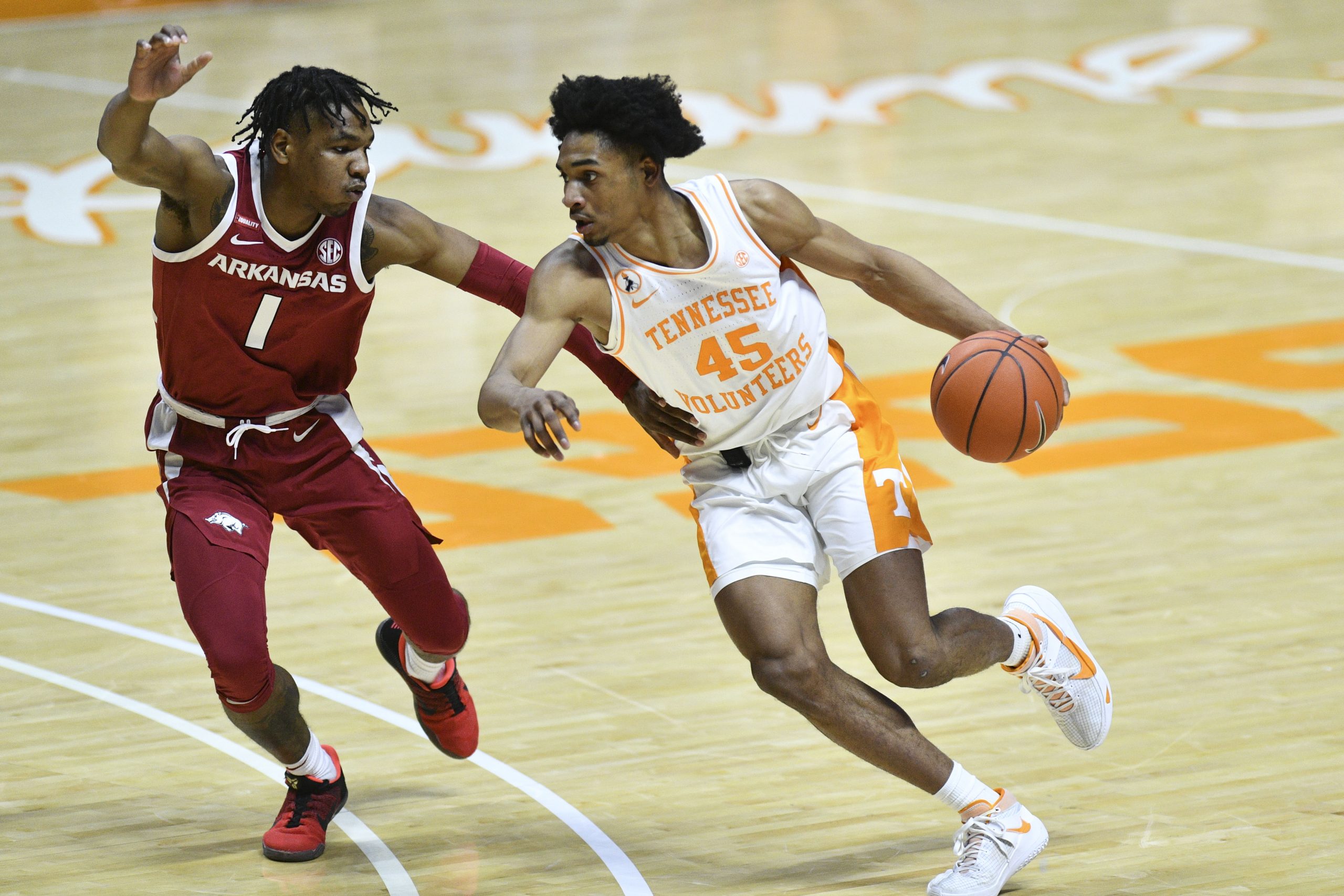
Equally Unheard Of: Defense & Balance

Ten games in, we’d normally be 33% of the way through the regular season. But depending on whether Tennessee’s game with South Carolina gets rescheduled, we’re more like 40-42% of the way home this year. Either way, we’ve got enough data to draw a couple of meaningful conclusions about this team.

Their defense still sets them apart: 87.1 in KenPom’s defensive efficiency ratings is second nationally, and still the best for any Tennessee team ever. I still think the offense played better than it felt at Texas A&M, in part because they got a lot of action late in the shot clock: “This possession isn’t going anywhere, wait no here’s a bucket…”. On Sunday evening the Vols are 27th in KenPom’s offensive ratings, flirting with that dual Top 20 set every national champion has.

But the most striking thing about the offense continues to be how truly balanced it is.

Through these first ten games, Tennessee’s top seven scorers all average between 8-12 points per game. It makes the Vols harder to scout, harder to defend. Five of those seven have led the team in scoring already, but Santiago Vescovi’s 23 on Saturday are still the team’s season high.

And we really haven’t seen anything like that on a tournament team at Tennessee.

This year should/will make 10 NCAA Tournament teams from Tennessee in the last 16 years. The other nine had either four or five players each account for at least 10% of Tennessee’s total points (it jumps up to six players in 2006 and 2009 if you round up from 9.5%+).

But these Vols currently feature seven players accounting for at least 10% of Tennessee’s points:

Bailey16.1%
Fulkerson15.1%
Vescovi13.4%
Springer13.0%
Johnson11.1%
James10.8%
Pons10.2%

Offensively, Tennessee’s best teams have leaned either to the one-two punch, or far more balance:

One-Two Punch

Year1st Scorer% of Pts2nd Scorer% of PtsTop 2
2007Lofton26.1%J. Smith19.1%45.2%
2011Hopson24.1%Harris21.7%45.8%
2014McRae26.2%Stokes21.2%47.4%

In each of these cases, Tennessee’s top two scorers nearly outdid the rest of the team by themselves. Doing it this way can make your ceiling heavily reliant on what the third guy can give you: see Josh Richardon’s late emergence in Tennessee’s 2014 run. The 2007 Vols were guard dominant, still playing Dane Bradshaw post minutes while Ramar Smith was the team’s third leading scorer. And in 2011, there really wasn’t much happening behind Hopson and Harris, and little fluid offense overall beyond those two getting their own shots: Cameron Tatum was the third-leading scorer at 12.5% of the team’s points, the lowest for any third scorer on these tournament teams.

You can find the more balanced groups simply by looking at how much each team’s leading scorer contributed:

Balance

YearLeading Scorer% of Total Points
2014McRae26.2%
2007Lofton26.1%
2011Hopson24.1%
2019Williams22.8%
2009T. Smith22.2%
2006Lofton21.2%
2018Williams20.5%
2010Chism19.2%
2008Lofton18.7%
2021Bailey16.1%

In 2008, Tyler Smith’s arrival (and Chris Lofton’s health) made Tennessee far more diverse offensively, with great results. Tyler Smith also skews the 2010 math somewhat after being dismissed in early January, but Chism, Hopson, Prince, and Maze all ended up scoring between 14-19% of that team’s points overall, a strong sense of balance amongst that group.

Tennessee’s best offensive team walked the line between both: two years ago, Grant Williams had 22.8% of Tennessee’s points, Admiral Schofield 20%. But it was Jordan Bone’s offensive maturity – going from 9.8% of Tennessee’s points in 2018 to 16.4% in 2019, the third-leading scorer – that made a huge difference, while Lamonte Turner and Jordan Bowden continued to do their thing.

At the 40% mark, we shouldn’t expect these Vols to have a breakout offensive superstar. But I’m not sure we fully know what to expect beyond that, simply because we’ve never seen a Tennessee team rely on so many guys to get it done. That means one of the biggest unanswered questions is, “Who gets it done in crunch time?” Without Jaden Springer against Alabama and with John Fulkerson off the floor, Tennessee struggled. The late-game answer against Cincinnati and Arkansas was getting to the free throw line, with John Fulkerson a key component.

KenPom projects the Vols to play four one-possession games left on their schedule (at Florida, Kansas, at Kentucky, at LSU). The ebb and flow of a season suggests we’re going to see more than that in these last 14-15 games. Keep an eye on the crunch-time lineups.

The lead story should continue to be Tennessee’s defense. But the extraordinary, “It’s not about me,” balance of Tennessee’s offense is, so far, equally unheard of around here.

Tennessee-Texas A&M Four Factors Forecast: We heart extra possessions

Here’s the GRT Four Factors Forecast for Tennessee’s game against the Texas A&M Aggies this afternoon.

Summary and Score Prediction

The good news: The Aggies give the ball away like they’re downsizing and moving to another country for the rest of their lives. Also, they’re advertising an all-you-can-eat buffet on the offensive boards on their dime, so expect Tennessee to benefit from a ton of extra opportunities through turnovers and second-chance possessions.

The bad news: Texas A&M draws fouls like roadkill draws flies. The Vols’ ability to defend without fouling has recently fallen from the lofty perch of the elite, and although they’re still very good in this regard, they’ll be challenged today. Expect more trips to the foul line than normal for the villains and hope it doesn’t matter.

Vegas has the Vols as 10.5-point favorites. With an over/under of 129.5, that puts the score at something like Tennessee 70, Texas A&M 59.

KenPom likes the Vols by 9 and puts the score at Tennessee 67, Texas A&M 58, which translates into a 78% chance of winning.

Our new Hoops Statsy Preview Machine also likes the Vols by 9 points (Tennessee 66, Texas A&M 57).

Details below.


Baseline

Here’s what each team looks like at this point of the season.

Decided advantage for the Vols here. Tennessee is currently No. 9 in the AP Top 25, while Texas A&M is unranked. In KenPom, the Vols are No. 9, and the Aggies are No. 97.

Four Factors: Straight-Up

Effective FG%

Conclusion: Ags are about like the Vols here, good, but not as good as Colorado or Arkansas at hitting from the field.

Turnover %

Conclusion: Ooh. Smells bad, and that’s good. Actually, now that I’m looking at it again, that’s a disparity that involuntarily triggers a chuckle.

Offensive Rebound %

Conclusion: The Vols are slightly better on the o-boards, but TAMU isn’t bad there, either.

Free Throw Rate

Conclusion: Goodness. These guys get to the free-throw line better than all but five teams in the country.

Four Factors: Opponent impact

Effective FG%

Conclusions

The Vols have a chance to shoot a better percentage from the field today than they usually do, but their shooting defense has slipped quite a bit the last couple of games. They could ratchet that back up again today against the Aggies.

Turnover %

Conclusions

Both teams are extremely good at forcing turnovers. Fortunately, Tennessee is also good at not turning the ball over, while A&M seems to have reverse magnetism in this regard.

Offensive Rebounding %

Conclusions

The Vols should be able to rack up offensive rebounds at will today. Things should be about normal on the other end.

Free Throw Rate

Conclusions

Tennessee sending opponents to the foul line has also taken a bit of a dive lately, but they’re still good at defending without fouling. They will, however, be going up against a team that absolutely excels at drawing fouls. That’s something to watch today and could well be a key to the game.

Go Vols.

On Hendon Hooker at Virginia Tech

In the midst of what feels like perpetual uncertainty, a surprise: the Vols picked up a transfer portal commitment from Virginia Tech quarterback Hendon Hooker. I live in the Blacksburg “metro”, and have spent nine of the last 15 years in southwest Virginia. I’m by no means an expert on the Hokies, just someone who watches them more closely and interacts more often with their fans than the average Tennessee fan. You can find good analysis on Hooker’s game out there – here’s a few thoughts on how he got there.

Virginia Tech’s stability at head coach under Frank Beamer manifested itself into great stability at quarterback. There’s a long line of multi-year starters in the post-Vick era: Bryan Randall, Sean Glennon, Tyrod Taylor, Logan Thomas, Michael Brewer. As Justin Fuente took over in 2016, however, the pattern breaks. The first year the Hokies went the juco route with Jerod Evans, who we saw in Bristol. They won their division and gave Clemson a scare in the title game, Fuente was ACC Coach of the Year, all was well. Evans actually set some VT passing records…and then declared for the draft, where he was not selected, and has yet to play a down in the NFL.

In 2017 the Hokies went with freshman Josh Jackson. They again finished the regular season 9-3 with losses to Clemson and a good Miami team, and fell to #14 Oklahoma State in the bowl game. All was well. Then Jackson broke his leg in the third game of the 2018 season, what ended up being a catastrophic 49-35 loss to Old Dominion, maybe the first sign of some real defensive trouble under Fuente. Jackson ultimately transferred to Maryland.

Hendon Hooker was a freshman in 2018, but when Jackson went down the job went to Kansas transfer Ryan Willis. The Hokies were game against Notre Dame in a loss, then suffered four straight defeats in which they gave up 49, 31, 52, and 38 points. Willis again had the job at the start of the 2019 season, which opened with a loss to Boston College, close wins over Old Dominion and Furman, and a 45-10 beatdown in Blacksburg at the hands of David Cutcliffe. At this point, as people were commenting on the heat of Jeremy Pruitt’s seat after Georgia State, BYU, and Florida early in year two, the sudden temperature of Fuente’s seat in year four made for a helpful comparison: Pruitt shouldn’t be in trouble after 15 games, this is what being in trouble actually looks like, etc.

Then Virginia Tech went to Hendon Hooker.

In his first start at Miami, the Hokies scored 42 points thanks to five turnovers and won by a touchdown. Hooker was 10-of-20 for 184 yards and three touchdowns, plus 76 yards on the ground. His numbers were similar in a win over Rhode Island, and got off to a good start against North Carolina before a familiar theme emerged: he got hurt in the first half, missing the rest of a six-overtime win over the Tar Heels. And he also missed Virginia Tech’s trip to South Bend the following week.

He returned to guide a three-game winning streak over Wake Forest, Georgia Tech, and Pittsburgh, never throwing for more than 260 yards but also never throwing an interception. His rushing totals became less productive – 7 for 10 against Georgia Tech, 20 for 27 against Pitt – but the Hokies were winning and their defense was playing well again.

In the last two games of 2019, the Hokies played wild affairs with Virginia and Kentucky. Hooker was 18-of-30 for 311 yards against the Cavs, but threw his first two interceptions of the year, the first on a hail mary at the end of the first half. The last one came with VT driving to take the lead in Virginia territory; he was also sacked three times in a row on the next drive. This is a theme you’ll hear on Hooker: if the defense knows you’re throwing it, he can struggle.

He was better on the ground against Kentucky in the bowl (12 for 50), but the Cats did a good job stopping him through the air (12-of-22 for 110).

Obviously, you take everything in 2020 with a grain of salt. Covid testing showed an unrelated medical issue that kept Hooker out of VT’s first two games of the year, wins over NC State and Duke. Oregon transfer Braxton Burmeister ran an efficient offense and stayed at the helm against North Carolina, where the Hokies lost 56-45 in a game both QBs played in. From there it was back to Hooker, who was sensational on the ground in a win over Boston College (18 for 164). He went for 98 more rushing yards against Wake Forest the next week, but threw three interceptions and the Hokies lost. The next week, however, he was 10-of-10 passing for 183 yards and ran for another 68 in a 42-35 win over Louisville.

Against Liberty, Hooker was again really good: 156 yards rushing, 20-of-27 for 217 through the air with three touchdowns and no interceptions. The Hokies lost a 38-35 shootout. Miami’s defense was better at taking all that away, beating Virginia Tech 25-24. And then the defense totally collapsed against Pittsburgh in a 47-14 defeat. Hooker again wasn’t bad statistically, but VT was never really in the game after halftime.

Then more weirdness: against Clemson, Hooker fumbled a snap on the opening drive and looked shaken, so Fuente went to Burmeister. He led a touchdown drive, so he stayed in the game. He was later removed for a scoop and score fumble, but the Hokies still trailed only 24-10 and had the ball in Clemson territory when Hooker returned. But he fumbled again, and appeared to have a medical issue on the sideline where he was shaking and “couldn’t get warm.” He did not play in the season finale against Virginia.

Had he thrown it enough to qualify, Hooker’s 2019 passer rating would’ve trailed only Trevor Lawrence among ACC quarterbacks. The Josh Dobbs comparisons I’ve seen are most fitting for pre-2016 Dobbs, the guy we wondered if they’d ever let him throw it deep down the field. That answer turned out to be an emphatic yes. Hooker’s dual threat skill set is something the 2020 Vols did not have on the roster, and he can certainly be efficient and mistake-free. It’s when defenses put him in third-and-long or he had to get them downfield in a hurry without his legs that Hooker struggled in particular. But there is no doubt potential and far more experience than anything the Vols will bring back next year.

Tennessee-Arkansas Four Factors Forecast: More clangers

Here’s the GRT Four Factors Forecast for Tennessee’s game against the Arkansas Razorbacks tomorrow.

Summary and Score Prediction

Tennessee’s defense has another tough test this evening as the Hogs are one of the best-shooting teams the Vols have played this season. In fact, the whole game figures to be a defensive contest, as both teams know how to keep opposing offenses from posting good shooting percentages. Neither team turns the ball over very much, both get after the offensive boards, and the difference in getting to the foul line is marginal.

Here’s our humble suggestion on what to watch for:

  1. Learn to love defense, as both the Vols and the Hogs look like they’re built to make opposing offenses look ugly.
  2. With most everything else being something close to equal, the winner is likely going to have to play a clean game and make the most of any advantage. Fortunately for the Vols, their numbers suggest that a slightly better defense should be the difference in the game.

KenPom likes the Vols by 7 and puts the score at Tennessee 74, Arkansas 67, which translates into a 73% chance of winning. Vegas likes the Vols by 8.5 and puts the over/under at 141.5, so projects the score to be around 76-67, Vols.

Our new Hoops Statsy Preview Machine likes the Vols by only six points (Tennessee 70, Arkansas 64).

Details below.


Baseline

Here’s what each team looks like at this point of the season.

That’s making things look pretty darn even. Tennessee is currently No. 9 in the AP Top 25, while Arkansas is receiving votes. In KenPom, the Vols are No. 8, and the Hogs are No. 40.

Four Factors: Straight-Up

Effective FG%

Conclusion: Arkansas is the best-shooting team the Vols have played so far this season, with the exception of Colorado.

Turnover %

Conclusion: And they are the best at protecting their possession of the ball.

Offensive Rebound %

Conclusion: And also the best at offensive rebounding, although the Vols are even better on the o-boards.

Free Throw Rate

Conclusion: The Hogs don’t get to the free throw line nearly as often as do the Missouri Tigers, but they’re head-of-the-pack at this among teams the Vols have played this season.

Four Factors: Opponent impact

Effective FG%

Conclusions

Okay, so if you were frustrated by the way the Vols shot against Missouri, get ready for a possible repeat of that, as the Hogs are good at keeping opponents from sinking shots.

The Vols will return the favor on the other end of the floor. If you’re watching with someone who thinks both teams are just bad, rev up the whole “it probably has something to do with the defense, don’tcha think” conversation.

Turnover %

Conclusions

Neither team is giving up many turnovers, although Tennessee’s defense is more likely to stress Arkansas in this regard than vice versa.

Offensive Rebounding %

Conclusions

Again, both teams are pulling down offensive boards at a good clip. Both respective defenses are going to make that more difficult this game, with Tennessee appearing to have a slight edge.

Free Throw Rate

Conclusions

The Vols aren’t terrible at getting to the foul line, but they are better at it than the Hogs. And one more time — both defenses are going to have a not insignificant impact on that. Tennessee’s defense is better at defending without fouling, though.

Go Vols.

In Search of Weakness: We found some!

It makes sense, especially in pandemic times, that just when you’re feeling most confident about your team, you’re brought swiftly back to earth.

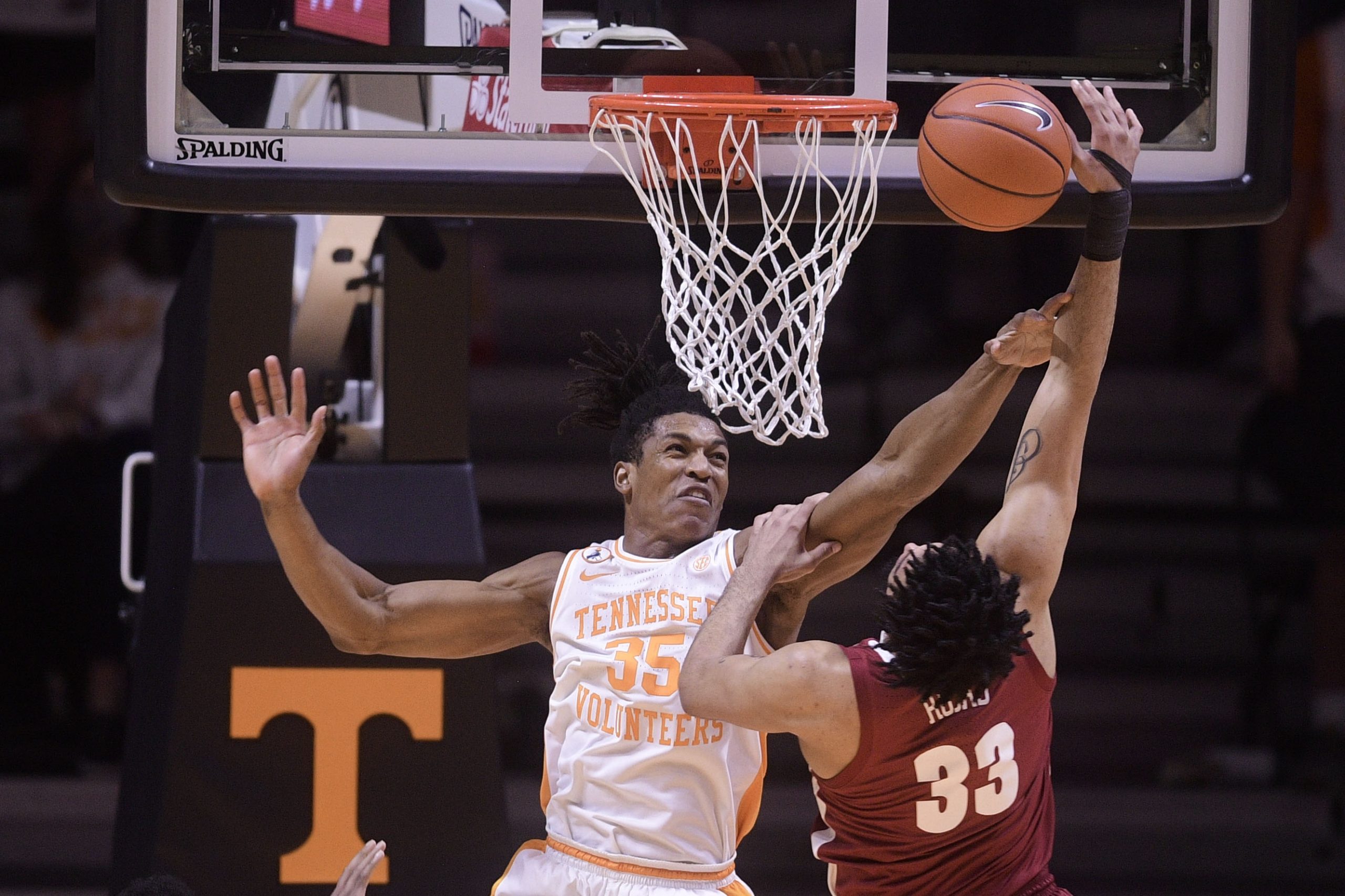
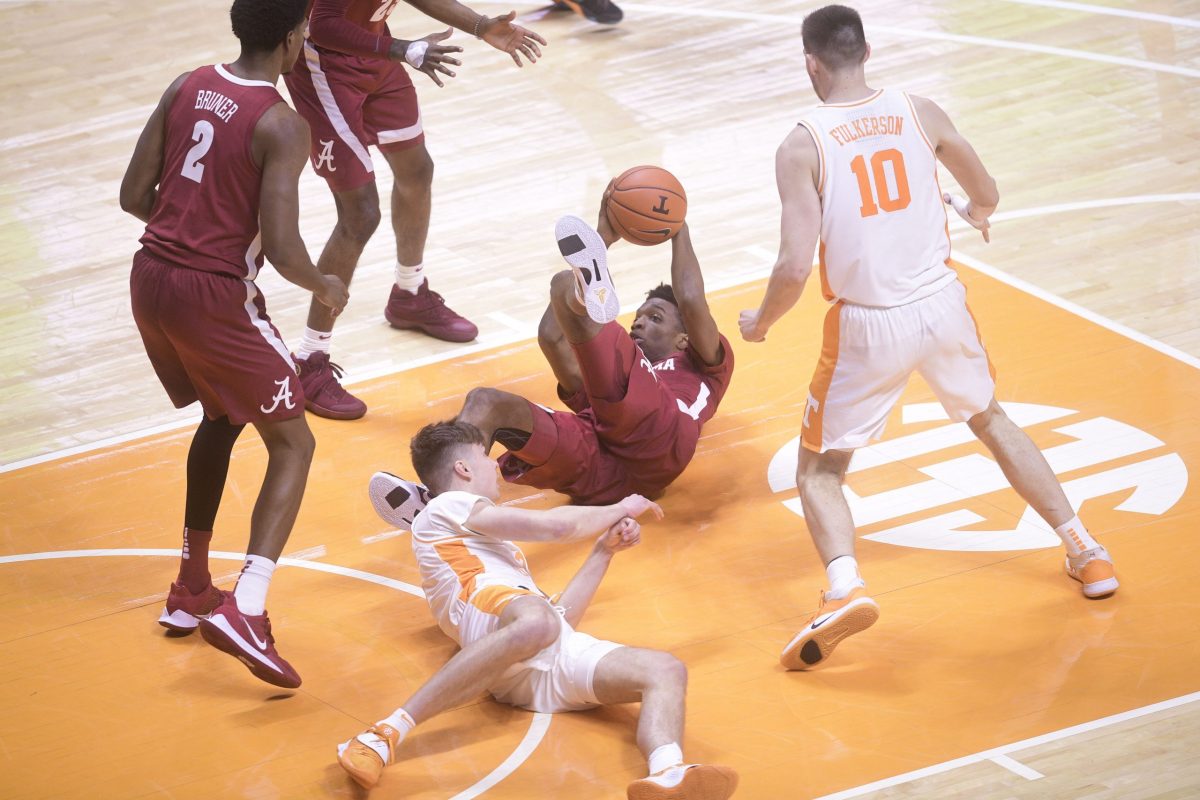
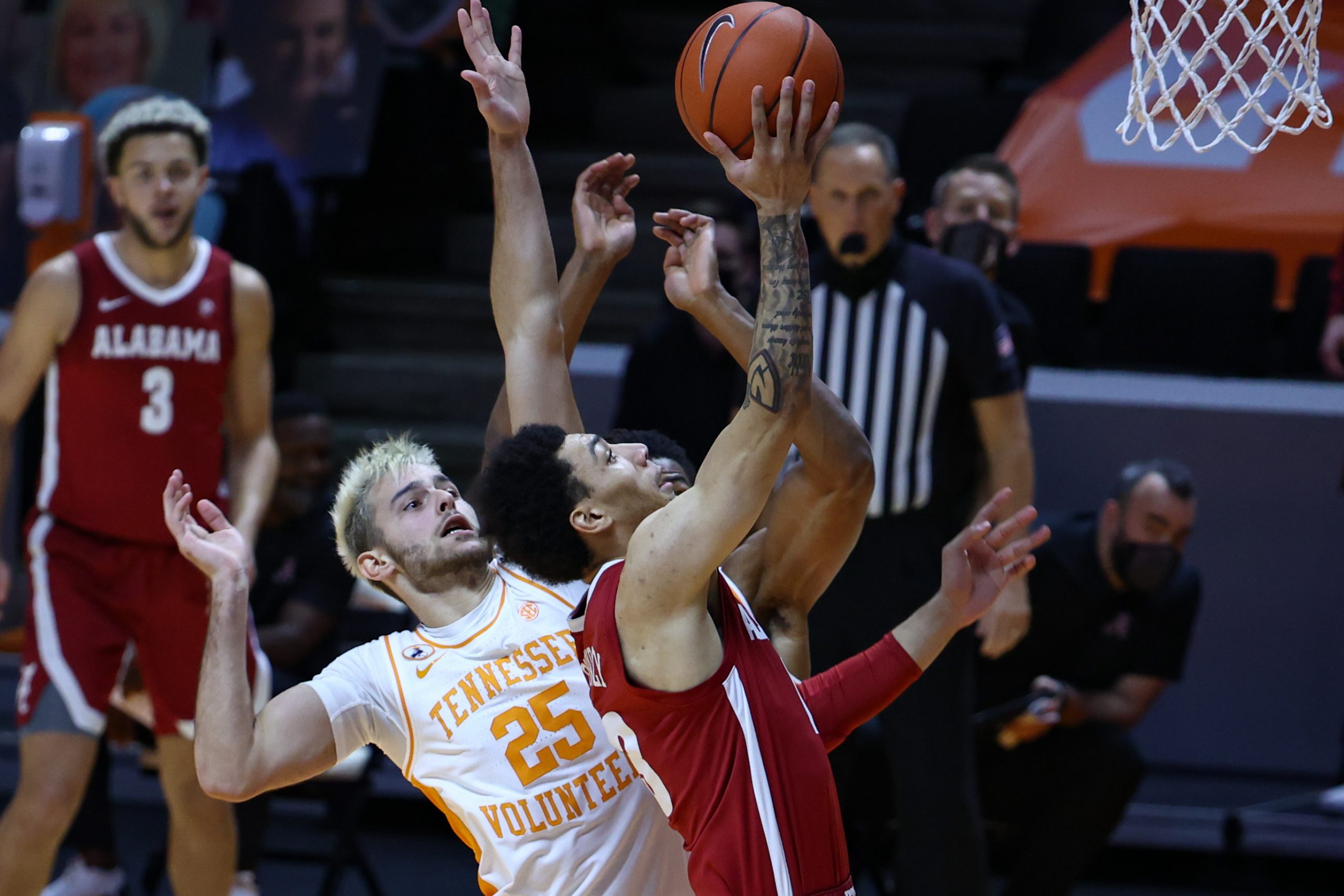
Tennessee’s 71-63 loss to Alabama dropped the Vols from sixth to eighth in KenPom, though the Vols now have the best defense in the nation in those ratings thanks to an equally rough day for Texas Tech. The Crimson Tide were battle tested and loved the three, and in the second half it loved them back.

The three biggest factors in Saturday’s loss were (hopefully) varying degrees of weirdness. Let’s take them in order from most to least weird, or how much we should be worried about them showing up again in the future.

Bama shooting 10-of-20 from three

After going 2-of-9 in the first half, Alabama was a ridiculous 8-of-11 from the arc in the second half, pushing the lead to double digits quickly then never allowing the Vols to get back within less than six. How often is a shooting display like that going to happen?

The good news: not very often.

Last year only Kentucky in Knoxville hit 50% from the arc against the Vols, and that was only 5-of-10. Two years ago, we saw how dangerous any team can be when they get this hot from three, as Colgate went 15-of-29 from the arc in the first round of the NCAA Tournament. The Vols also survived South Carolina hitting 14-of-23 in Knoxville, but still won by scoring 85 points of their own. The Gamecocks also hit 7-of-13 in Knoxville in 2017; no team hit that high a percentage in 2018.

In general, this kind of game tends to happen only once or twice a year, unless you’re just incredibly unlucky: see Cuonzo Martin’s last team, which was really good defensively but saw NC State and Texas A&M hit 50% or better from the arc in Knoxville, then Michigan hit 11-of-20 in the Sweet 16. Overall five teams hit 50%+ against the 2014 Vols from three, helping them finish 341st in luck in KenPom.

You can tip your hat to Alabama, and hope the Vols maybe close out better in the corner going forward. But overall, this part should be more of an anomaly.

Vols missing nine free throws

Tennessee still shoots 74.7% from the line, 59th nationally. So nothing to worry about here just yet. But you only have to go back to…the previous game to find Tennessee shooting something worse than they did against Alabama at the stripe: 17-of-26 (65.4%) against the Tide, 14-of-24 (58.3%) at Missouri.

John Fulkerson was 3-of-8 against Alabama, but is still 27-of-35 on the season. Victor Bailey is 17-of-19, Santiago Vescovi 10-of-10, Josiah James 15-of-16. The biggest concerns here so far: Keon Johnson is 14-of-24, E.J. Anosike is 12-of-18.

You’re not going to shoot 75%+ every night, but other than those two guys getting better, I’m not worried here just yet.

Lineup Issues

In the first half, Jaden Springer got hurt, Yves Pons sat with two fouls, and Santiago Vescovi picked up his second (and eventually a Rick Barnes technical) with four minutes to play. Tennessee led 26-23 at that point. UT’s offensive possessions in those last four minutes went:

  • Keon Johnson missed front end of one-and-one
  • Drew Pember turnover after two offensive rebounds
  • Drew Pember missed layup
  • John Fulkerson hits 1-of-2 free throws
  • Victor Bailey made jumper
  • Rick Barnes deadball technical
  • Keon Johnson missed layup

The Vols went into the locker room trailing 31-29. More unusual lineups ensued when Barnes benched Fulkerson for the final eight minutes, sticking with Vescovi, Bailey, Johnson, James, and Pons. That group was down by nine at the under eight timeout, and lost by eight, never getting closer than six. They outscored Alabama only 9-8 in those final eight minutes, with two of those Bama points on late fouls: good defensively, but inefficient offensively.

Overall, Tennessee’s scoring remains incredibly balanced with seven players between 8-13 points per game. But if you take it per minute, Tennessee’s most efficient scoring options look like this:

  • Jaden Springer 22.8 points per 40 minutes
  • Victor Bailey 19.9
  • John Fulkerson 16.6
  • Keon Johnson 16.2

Without Springer and Fulkerson down the stretch, the Vols looked like they lacked an identity offensively in crunch time. When things were tight against Cincinnati, it was Fulkerson drawing fouls (and hitting free throws) that pushed the Vols back in front, followed by a big shot from Pons. Down the stretch, there was a lot of one-on-one stuff from Bailey and Johnson, but it wasn’t enough.

In good news/bad news, Arkansas will provide a similar challenge on Wednesday: they love to go fast and shoot threes, and they join Missouri and Alabama as the kind of team Tennessee might see in the second round of the NCAA Tournament. We’ll see if Jaden Springer can go and how much Fulkerson plays; I bet Arkansas shoots less than 50% from the arc and the Vols miss fewer than nine free throws. But the lineup stuff will be most intriguing, even if the Vols don’t need a bucket down the stretch.

In Search of Weakness: Quick Whistles

The Vols did their thing against Missouri, leading by 19 in the first nine minutes, 25+ for stretches of the second half, and 20 at the final buzzer. It wasn’t close, but it could’ve been closer in one regard: Missouri got to the line 30 times, but only made 18 of them.

It’s only the second time all year a team had more than 20 free throw attempts against the Vols, and the first was a function of pace: Saint Joseph’s went 15-of-21 at the stripe in 78 possessions, ten more than the Vols’ current average. File that away for the next two games, when Alabama and Arkansas will both try to speed things up and shoot a ton of threes. It’s the right order to catch it in, I think, as the Hogs do it better than the Tide so you ramp up along the way. It did not, however, work for St. Joe’s, who scored 66 points but gave up 102.

So I’m not worried about teams that try to run and gun with the Vols. But if we’re realistically at the point of trying to earn a number one seed in the NCAA Tournament, it’s worth diving into any possible weakness. It’s not foul trouble alone; Tennessee is deep enough to handle that, I think. But getting to the stripe is by far the best way to try to score on Tennessee.

Last year Tennessee was 1-7 when their opponents shot 27 or more free throws. The lone victory came against Arkansas, who shot a season-high 36 against the Vols, but Tennessee shot 30 themselves. You had to really get up there two years ago, but Tennessee was 1-4 when teams shot 30+ free throws in 2019. Four of those five games went to overtime, and it’s interesting to note that none of them shot it particularly well when they arrived, including Purdue’s 16-of-33 at the stripe in the Sweet 16. Obviously, some of this makes sense if you’re fouling down late. But it still holds true that when Tennessee’s best team got in trouble, it showed up mostly clearly at the line.

It’s a trade Rick Barnes’ teams have often made at Tennessee, whether by preference or personnel: emphasize aggressive defense, try to force turnovers, and hope you come out in ahead in the balance on the whistle. It is, in may ways, the opposite of what Cuonzo Martin’s defenses did at Tennessee: defend without fouling and eliminate offensive rebounds. Instead of not giving a team any second chances, Barnes’ Vols – especially this team – prefer to create turnovers on the first chance.

His first team was average in both regards, but starting in 2017 the Vols have been whistled more often. Via KenPom, here’s Tennessee’s national rank in free throw rate allowed under Barnes:

YearFT Rate
202169
2020248
2019232
2018264
2017321
2016180

Even what we thought of as a really good defensive team in 2018 struggled here. No surprise, they went 2-4 when allowing 29+ free throw attempts.

Keep an eye out next week: the Vols go to Texas A&M, currently third in the nation in offensive free throw rate with Emanuel Miller one of the best in the nation at drawing fouls. For the Vols, this has mostly been a backcourt issue with Vescovi and Keon Johnson picking up the quickest whistles, but per minute those honors belong to backup post players in Anosike and Nkamhoua.

But here again, the Vols put Mizzou on the stripe 30 times…and won by 20. Right now the weaknesses go under the microscope, both because this Tennessee team is capable of so much, and so far it’s the only way to see them.

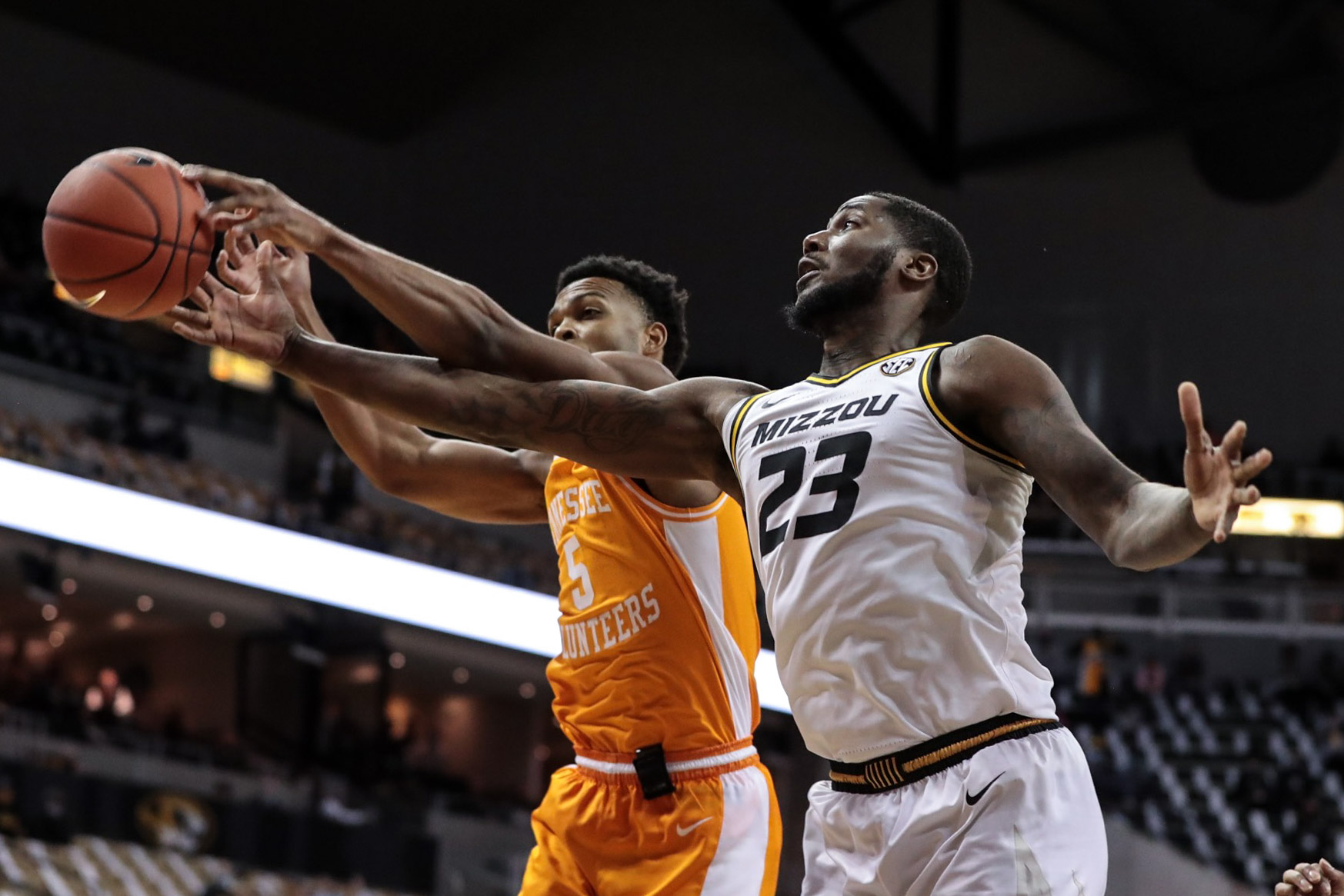
Tennessee 73 Missouri 53 – Defense: Everywhere. Offense: Everyone.

Okay.

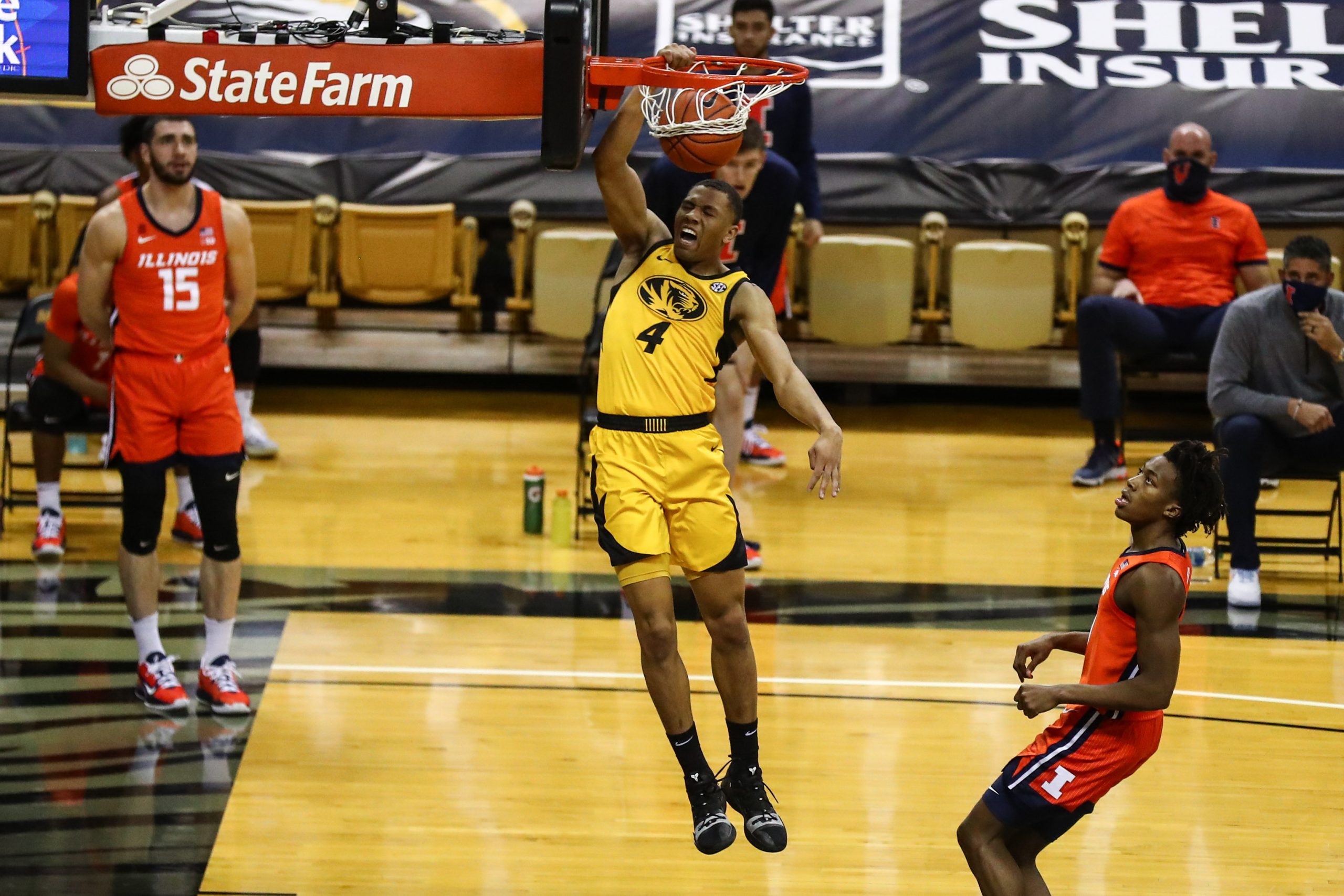
Missouri was undefeated with wins over Oregon, Wichita State, and Illinois. They’re ranked 12th in the country.

And Tennessee jumped them 23-4 in the first 8.5 minutes. The Tigers never got within single digits.

Defense: everywhere. Offense: everyone. This is Tennessee.

Missouri shot 36.4% from the floor, 3-of-16 from the arc, and turned it over 21 times. If there was a flaw tonight, it was some combination of Tennessee’s over-aggressiveness and the referees’ response in calling so many fouls. Missouri shot 30 free throws, but missed a dozen of them. And Yves Pons had four soul-crushing blocks.

Offensively, it’s like drawing names out of a hat: 15 from Vescovi, 13 from Pons and Springer, 11 from Fulkerson, 9 from Bailey. The Vols shot 50% from the floor, took just seven threes, and made five of them.

This Tennessee team should move into second place in program history in the KenPom era, passing another Cuonzo Martin squad from 2014. We’ll need more data to figure out if they’re better than the 2019 squad. But every data point with this team, as with that one, is a joy.

It’s one SEC game, but when it’s on the road against the only other ranked team in the league, you’re allowed to dream. And here’s what Tennessee should put out there in front of themselves:

  • Win the league outright, for the first time since 2008 and only the third time ever.
  • Get a one seed in the NCAA Tournament for the first time ever. If Gonzaga and Baylor are playing at a level above everyone else, the only way you guarantee you don’t see them until the Final Four is to earn one of the other one seeds.

Watching this team, these aren’t farfetched ideas.

This was a late tip tonight. But you should watch this team. A lot.

It’s Alabama next, Saturday at 6:00 PM in Knoxville. One down, 17 to go.

Go Vols.

Tennessee vs Missouri: Plan C

Big, big game tonight.

Cuonzo’s teams make a good living off of frustrating their opponents. When it happens, it can really happen: his second Tennessee team beat Kentucky by 30, his third beat Virginia by 35 and won five straight by 15+ points at the end of the regular season and the first round of the SEC Tournament. And they thrive at home: even last year, a 15-16 Missouri team beat Florida by 16 and Auburn by a dozen in CoMo.

So one of the most impressive things the 2019 Vols did came quietly: three days after opening SEC play with a 96-50 beat down of Georgia, Tennessee went to Mizzou. Cuonzo’s team did their thing: they held Grant Williams to four points on 1-of-8 shooting. It was his lowest point total of the year, and only one of three games when he didn’t hit double figures.

Then they took away Tennessee’s ball movement. The Vols finished with just 12 assists, tied for their lowest total all year in victory. Only LSU (10), Kentucky (11), and Auburn (11) held Tennessee to less, all Sweet 16 teams.

Missouri led by nine with seven minutes to play in the first half.

Tennessee won by 24.

That’s how good the 2019 Vols were: when forced to go to Plan C on the road, they still dominated. When Grant was held in check and the offense couldn’t create good looks through good ball movement, it was Jordan Bowden (20 points) and Kyle Alexander (14 points, 17 rebounds) who got the job more than done.

This Missouri team is plenty good, and plenty capable of frustration. What’s this Tennessee team’s Plan C?

…and are we sure we’ve figured out their Plan A yet?

The answers to any plan will include, “Defense, obviously.” The Vols are currently in the Top 13 nationally in all four defensive factors. That’s, uh, pretty good.

Offensively, I think Plan A is still to run through John Fulkerson. Last year Fulky was one of the nation’s surest bets from inside the arc, and he got to the line as well. He’s still doing that, and currently 21-of-23 from the stripe this year. The raw numbers are different because everyone is playing fewer minutes this season. But if you need a bucket down the stretch, I think #10 is getting the ball.

We haven’t really had to see Plan B yet. When Cincinnati took a 53-51 lead with six minutes to play, it was defense first – they didn’t score for another 4.5 minutes – and Fulkerson doing the dirty work. He hit four straight free throws to put Tennessee back on top, then it was Yves Pons adding a jumper to push it out to two possessions. That part we know.

The new pieces remain fascinating, especially as they all seem so capable. Victor Bailey leads the team in scoring at 13.2 points per game, and any one of seven Vols seem capable of leading them in scoring on any given night. It’s a little early for this kind of fun, but right now the Vols have six players responsible for at least 10% of the team’s points, and Pons is just outside at 9.3%. Among our recent NCAA Tournament teams, only the 2006 Vols had six different players account for at least 10% of the team’s points; no one else had more than five. This bunch might get seven. We’ll see.

One of these plans feels like, “out-talent them.” Get your own shots, let the freshmen do their thing, etc. Missouri probably isn’t the one to find out if that’s good enough against. The things Tennessee does well – get high percentage shots, don’t turn it over, get offensive rebounds – it will take a particularly good defense and/or a particularly cold shooting night to fall short with. And Tennessee’s defense is so good, as we saw against Colorado and Cincinnati, option number two may not matter anyway.

But in a game like this, how much of Tennessee’s offense will still go through Fulkerson? And if Missouri takes away Plan A again, where will the Vols turn this time?

Lots of questions tonight, and plenty of intrigue and possibility in the answers. 9:00 PM ET, SEC Network.

Go Vols.

Tennessee-Missouri Four Factors Forecast

Here’s the GRT Four Factors Forecast for Tennessee’s game against the Missouri Tigers tomorrow.

Summary and Score Prediction

The commencement of the SEC basketball season brings with it the toughest test so far for the Vols, as they travel to CoMo to take on CuoMa’s Missouri Tigers. The Tigers’ numbers aren’t quite as impressive as are the Vols’, but they are so much closer than the rest of the competition to date that everything could change, especially if the Vols throw good money after bad by getting frustrated into taking more bad shots to make up for misses and if they lose the battle for free-throw-attempts.

Here’s our humble suggestion on what to watch for:

  1. Expect both offenses to look ugly and for some level-headed commentator to eventually pipe up that one person’s ugly offense is another’s beautiful defense. Shots will probably do a lot of clanking for both teams, but as long as you end up with the most points on the scoreboard, you’re good.
  2. Expect trips to the free-throw line to be at a premium. Both teams play solid defense, and whichever one does the best job at defending without giving up free trips to the free line may well win this one on that basis alone.

KenPom likes the Vols by 2 and puts the score at Tennessee 67, Missouri 65, which translates into a 57% chance of winning.

Our new Hoops Statsy Preview Machine, still discovering its legs, likes the Vols by 12 points (Tennessee 69, Missouri 57).

Details below.


Baseline

Here’s what each team looks like at this point of the season.

Hmm. Kind of even-ish-looking. We’ll see what the rest of the data shows, but it’s looking like Missouri hates three-point shots like the Grinch hates the Whos, no matter who’s taking them.

Four Factors: Straight-Up

Effective FG%

Conclusion: A step up from most of the competition so far this season. More like us when shooting the ball than anyone else save Colorado.

Turnover %

Conclusion: The Tigers are protecting possession most like Colorado and St. Joe’s. Not nearly as well as the Vols are, though.

Offensive Rebound %

Conclusion: Missouri is the best offensive-rebounding team the Vols have played so far this short season, but Tennessee is still a ways out in front on this, uh, front.

Free Throw Rate

Conclusion: Ooh, look. It’s Yeti. Sasquatch. The Loch Ness Monster. We haven’t yet seen much of any opponent doing anything of any importance better than the Vols so far this season, but here it is: The Tigers are getting to the free throw line much more often than the Vols.

But let’s see what that stifling Tennessee defense might do to those offensive numbers.

Four Factors: Opponent impact

Effective FG%

Conclusions

As is customary for a Cuonzo Martin-coached team, the Tigers are going to frustrate a team blindly hoping for shots to go down easily. Tennessee is shooting well enough, but Missouri’s going to make it more difficult than usual.

The difference is more pronounced on the other end, though, where the Vols’ defense figures to frustrate Missouri’s offense even more.

Turnover %

Conclusions

Missouri might hate three-pointers, but they much more like the carve-the-roast-beast version of the Grinch when it comes to stealing stuff. They will not steal the ball, especially from a team who locks it up in a bank vault on a Cayman Island in Switzerland. Yeah, my fingers just did that. Don’t care, because it makes the point. 🙂

On the other side of the court, Tennessee has zero qualms about relieving you of your possessions, although Missouri does seem to be a bit more protective than most teams we’ve played so far this season.

Offensive Rebounding %

Conclusions

Man, do I love those numbers for the Vols. They’re getting after it on the offensive boards (and Missouri shouldn’t present too much of a hindrance to that this game), and they’re getting after it on the defensive glass just as well. Mo boards, mo possessions, mo points, mo wins.

Free Throw Rate

Conclusions

And here’s where it appears we have a push, as Tennessee’s not doing especially well at getting to the line, and Missouri’s not likely to help much. On the other side of the court, the Tigers are used to free shots, but they’re not used to playing Tennessee, which plays defense without fouling.

Go Vols.