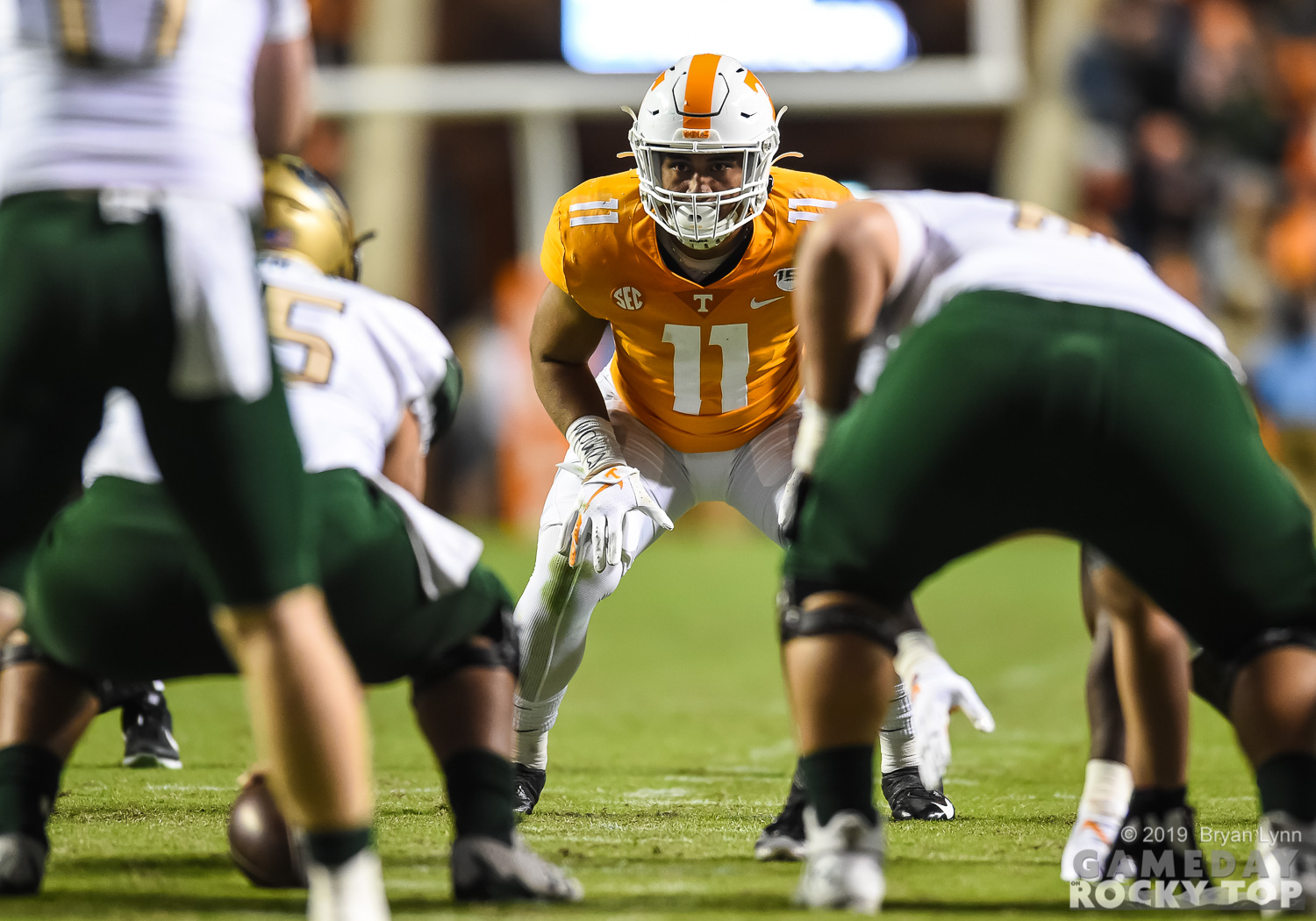
Could Tennessee have one of college football’s best defenses?

The answer may surprise you!

When we get excited about the 2020 Vols, the conversation usually centers on the offensive line, or the individual breakout potential of sophomores Eric Gray and Henry To’o To’o. But one of our favorite big picture metrics heavily favors the Tennessee defense.

Bill Connelly’s SP+ ratings got a Week 1 update at ESPN.com this week. Tennessee checks in at 19th, with the usual caveat of, “Yeah, but we play five of the Top 11.” The biggest takeaway in the new ratings to me: while Tennessee’s offense is a pedestrian 50th overall, the defense is sixth. Not in the SEC. In the nation. With all 130 teams accounted for.

(A quick reality check here: Georgia is first at 6.8, miles ahead of #2 Oregon at 12.1. So any conversation on, “Does Tennessee have one of college football’s best defenses,” would start with, “After Georgia, of course.”)

It feels like the Vols lost their most productive player in getting to the quarterback (Darrell Taylor), in setting up the defense (Daniel Bituli), and in the secondary (Nigel Warrior). But the strength of Tennessee’s 2019 defense (which finished 19th in SP+) was less about individual accolades – with one notable exception – and more about the basic building blocks the 2020 defense could replicate:

  • No big plays. The 2019 Vols finished first in the nation in 30+ yard plays allowed and first in 30+ passing plays allowed (data via SportSource Analytics). Last year Tennessee allowed just 10 plays of 30+ yards. By comparison, in 2016 the Vols allowed 37 plays of 30+ yards.
  • Interceptions. Nigel Warrior led the way with four, but Bryce Thompson added three and seven other Vols got one as well. Fifteen interceptions last season was good for 13th nationally, the most for Tennessee since 2014.
  • Solid finish all around. In the 2-5 start, Tennessee allowed 5.44 yards per play. In the 6-0 finish, Tennessee allowed 4.51 yards per play, with none of the victims in that streak getting more than five yards per play against the Vol defense.

Even without Taylor, Bituli, and Warrior, can the 2020 Vols follow that same blueprint? The biggest question to answer: who gets to the quarterback? Darrell Taylor had 8.5 of Tennessee’s 34 sacks, also their highest total since 2014. The Vols seem unlikely to put a pass rusher in the first two rounds of the 2021 NFL Draft. Can a committee replace some/all of that production?

On the other hand, there’s also room for improvement. Tennessee was average on third down last year, allowing a conversion on 39.34% of opponent attempts, 68th nationally. A year ago yesterday, Georgia State went 10-of-17 on third down against the Vols. Alabama went 6-of-10 in Tuscaloosa before we even throw in the referees; Georgia was 5-of-11. But again in the winning streak, Tennessee made significant strides: South Carolina went 4-of-18, Missouri 4-of-15, Indiana 4-of-13. There’s a whole chunk here about the quality of offense the Vols faced in that winning streak. But if we’re finding nice things to say about the new SEC schedule, outside of Alabama the Vols won’t face anything like the Oklahoma offense we lost.

If Jeremy Pruitt, Derrick Ansley, and the defensive staff continue to get improvement from the returning pieces, the Vols could keep doing those building blocks well while finding critical improvement on third down. The sack totals will probably come down without Darrell Taylor, but the defense overall could still be noticeably better in 2020. Be great again at taking away explosive plays, create turnovers in similar fashion, and improve on third down? That’s the makings of a great defense.

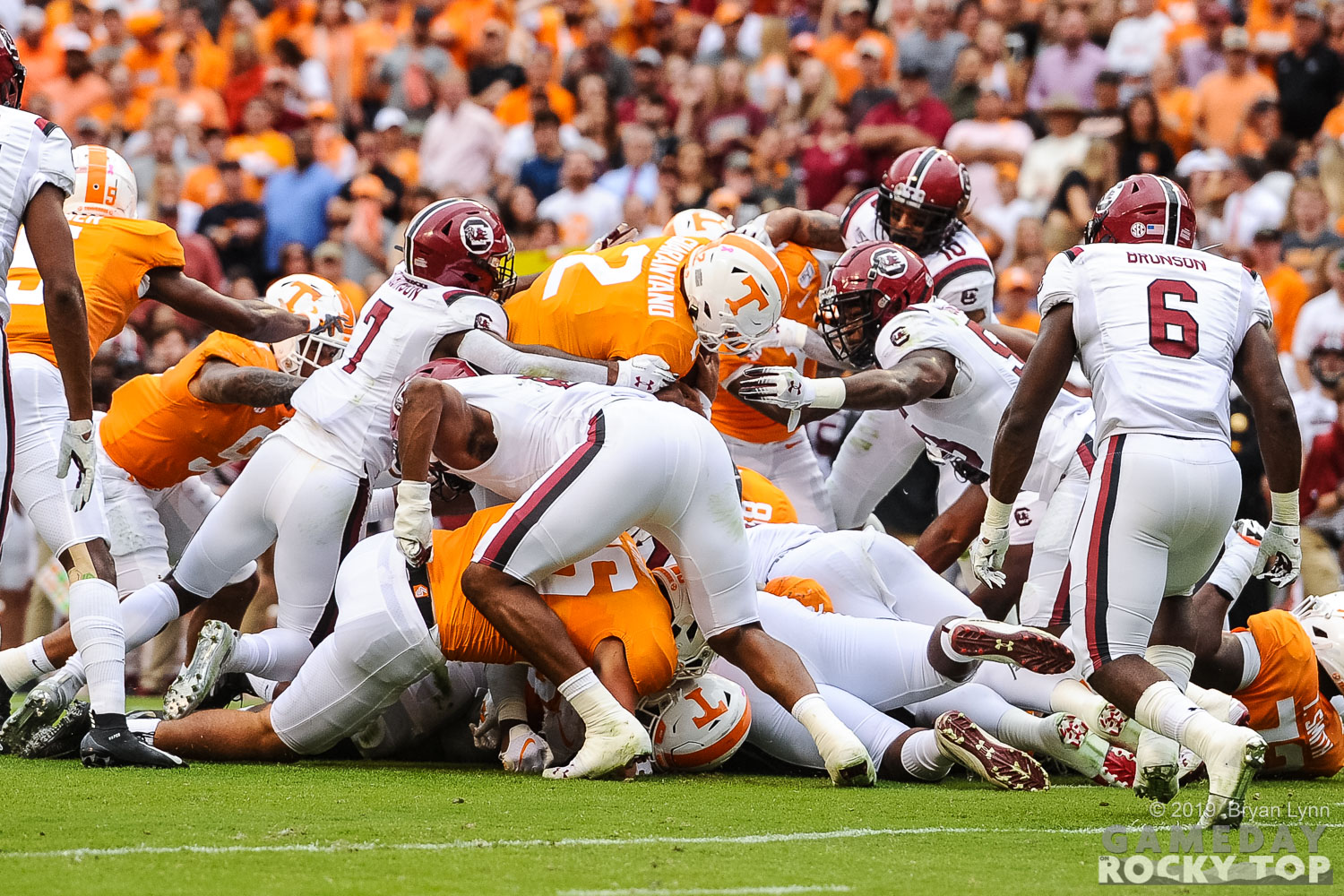
We don’t often outright credit the defense for individual wins at the end of last year, not beyond a goal line stop at Kentucky that probably doesn’t get enough praise. And maybe enough upperclassman star power was lost to not make us think of it as a unit that can go out there and win games by itself. But if we’re looking for realistic versions of how the Vols make significant progress in 2020? A defense that leads the way might be more of a factor than we’re giving it credit for.


2020 Gameday on Rocky Top Picks Contest

It’s a weird year, but hey, there’s college football this week! For the first time in the history of our contest, prepare to pick every FBS vs FBS game on the schedule this week!

Our free picks pool is back at Fun Office Pools. If you’ve played in previous years, you should’ve received an email this afternoon with an invite. You can also join with a free account at Fun Office Pools by clicking here.

Normally, we pick 20 games each week straight up with confidence points: place 20 points on the outcome you’re most confident in, 1 point on the outcome you’re least confident in, etc. This year we’ll start with five games this week, then expand next week, and go from there.

If you have any questions, you can leave them here in the comments. The picks contest is one of my favorite things to do all year; there was a strange sense of, “Hey, this season might actually happen!” in putting it together. Hope you find some fun in these crazy times from this pool too.

Here we go again: Vols ranked 25th in the AP Poll

Historical poll data will become meaningless in week two, with no Big Ten and Pac-12 teams around to fill out the nation’s best 25 teams in a given week. Take them out of the preseason AP poll today, and the Vols would be 16th. But whatever perception is worth, we get one look at Tennessee compared to the rest of the nation, and the Vols grabbed the last spot in this year’s initial AP poll at #25.

This is year three for Jeremy Pruitt. In the preseason poll before Derek Dooley’s third year, the Vols were also receiving votes at 33rd. Tennessee moved into the poll at #23 after a 2-0 start, then lost to Florida. It was the only appearance in three years for Dooley’s Vols. (Poll data from College Poll Archive)

In the preseason poll before Butch Jones’ third year, the Vols were, you guessed it, 25th. They moved up to #23 with the win over Bowling Green, fell out after losing to Oklahoma, and only reappeared in the season finale, finishing #22 after throttling Northwestern in the Outback Bowl.

For Tennessee’s last three coaching staffs, the outset of year three is when the college football world gives you just enough benefit of the doubt to slide in the poll, then asks you to prove it. Dooley, Butch, and Pruitt never flirted with the Top 25 in years one or two; the Vols finished 34th in votes received after beating Indiana in the Gator Bowl last year. Dooley’s Vols were 34th after beating Jones and Cincinnati in week two of the 2011 season, but lost to Florida and never got close again that year due to injury. So each of Tennessee’s last three coaches has come to this moment in more or less the same spot: we think you might have it in you, but now you have to prove it.

When it was clear Butch Jones was on his way out, we talked about how we might measure progress between rebuilding and championships the next time around. One good metric: longevity in the polls, which is probably worth more than where you finish the season when it comes to relevance. That was the case in 2015, when the Vols were clearly competitive with championship-caliber teams, but because they lost those games by the thinnest of margins, never got back into the Top 25 until the very end.

There’s plenty of good historical context in the post linked above from 2017, but in short:

From Tennessee’s return to the Top 25 in September 1989 through the end of the Fulmer Era in 2008, it’s easier for me to tell you when Tennessee wasn’t ranked:

  • October-November in 1994, playing freshman Peyton Manning at quarterback. The Vols finished #24 in the final poll after beating Virginia Tech in the Gator Bowl.
  • Mid-October through early November in 2000 after a 2-3 start in a rebuilding year. The loss to Kansas State in the Cotton Bowl bounced the Vols from the final poll.
  • November of 2002 through the final poll
  • Late October of 2005 through the final poll
  • The week after losing to Alabama in 2007

From 1989-2007, that’s it.

From 2008-2019, it’s easier for me to tell you when Tennessee was ranked:

  • 2008 preseason poll
  • The week of the Florida game in 2012
  • The first two weeks and the final poll in 2015
  • The first nine weeks of 2016, plus the week of the Vanderbilt game and the final poll after beating Nebraska in the Music City Bowl
  • The first three weeks in 2017

So now, we’re back in the poll for the first time since September 10, 2017. The point about staying ranked will be less potent if the Vols jump 10+ spots by beating South Carolina and nine other teams being removed from the poll because they’re not playing. But the point about staying relevant very much remains. These year three Vols, similar to their Butch Jones predecessors, got here by a strong finish in year two without beating any ranked teams along the way. They’re good enough to be dangerous, and in no way good enough to avoid danger themselves. Staying relevant this year will look like staying alive in the SEC East race; a 6-4 finish with a loss to Florida in December will feel different than, say, a 6-4 finish that started 2-3.

We’ve been here before, more than once. The way forward looks much different in a pandemic. But it’s up to the 2020 Vols to see that being ranked in the preseason poll is more than just a brief historical footnote this time around.

Finding the Rhythm in Tennessee’s New Schedule

We fired up our Expected Win Total Machine this week as soon as the SEC released the new 2020 schedule. If you haven’t already, you can go there and put in your win probabilities for every game on Tennessee’s new schedule, and the machine will give you how many games you think the Vols will win this season. It’s one thing to say you think the Vols will go 6-4 with wins over abc and losses to xyz. But we find it to be a better, healthier exercise to assign win probabilities for each game to get a record projection.

What does a successful season look like now? Our community projects the Vols to win 5.82 games against this schedule. If you round up to a 6-4 finish, that would guarantee Tennessee beat at least one of its five preseason Top 15 opponents. Pre-pandemic, an 8-4 finish against the original schedule felt like the head-nod verdict: yep, okay, that’s probably what we should expect, moving on. But whereas an 8-4 finish against the original schedule didn’t guarantee you a marquee win, a 6-4 finish against a 10-game SEC slate should include at least one signature win.

As we know, not all 8-4’s are created equal, and neither will all 6-4’s this year. But some of the things we use to measure success – like a traditional January 1 bowl – may not be available this season. Signature wins will be more important than ever, but so too will overall progress in metrics like SP+. It still holds that one of the best ways to measure progress for the 2020 Vols is the, “We have a chance to win this game,” test. After 2001, the only Tennessee team not to lose at least one three-possession game is 2015. That would be a good list for the 2020 Vols to be on.

Everything is about the SEC East race. That should really always be the case. The original move of the Georgia game to November would’ve kept the Vols in the SEC East chase much longer than usual, just for the hope of knocking off the Dawgs in Athens towards the end of the season. Now Georgia is in week three, but I think Tennessee actually benefits from that trade: Florida is the season finale instead of a mid-November date, and the Gators’ schedule offers them a better chance to be the team to beat. Lose in week three to Georgia and you’re behind, but the Dawgs are in Tuscaloosa the very next week, where Tennessee could instantly get a game back. Simply by playing Alabama, Georgia is the easier team to catch in the standings if you don’t beat them head-to-head. And even if the Gators do find success against their lighter load, Tennessee can still knock them off in Knoxville in December. The Vols should stay in the race for a long time this season, and that in and of itself will feel very much like progress.

Trap opponents out of trap weeks. If we assume Vanderbilt and Arkansas don’t qualify as trap games because the Vols should be able to overwhelm them with talent, the remaining candidates are South Carolina, Missouri, and Kentucky…and the Cats only qualify because they haven’t won in Knoxville since 1984. But now, Tennessee gets trap opponents in weeks one and two. If we learned anything at all from Georgia State, the Vols shouldn’t be caught off guard out the gate. So while we didn’t want to play two non-Top 15 opponents back-to-back to help with the schedule’s overall rhythm, it’s a really good setup on the front end.

Here’s how our community rates Tennessee’s chances in each game:

  • at South Carolina: 67.1%
  • Missouri: 76.1%
  • at Georgia: 30.0%
  • Kentucky: 68.0%
  • Alabama: 23.6%
  • at Arkansas: 85.3%
  • Texas A&M: 50.4%
  • at Auburn: 46.9%
  • at Vanderbilt: 88.6%
  • Florida: 46.1%

What does a balanced schedule for Tennessee look like?

“Not one with Auburn and Texas A&M,” you might say. But with those two added to the docket, the order of opponents becomes much more important: if you’re playing five preseason Top 15 teams for only the second time ever, you don’t want to play any of them in consecutive weeks if you can help it.

The Vols, of course, can’t help it: they’ll get what the league office gives them, which clearly didn’t work to our advantage last time. Today we’ll discover our week one opponent at 3:00 PM ET and the full slate at 7:00. Aside from putting some distance between our five marquee opponents, what would be most advantageous for the Vols?

If you gave me the authority to set Tennessee’s entire schedule, I’d go with something like this:

Week 1: Missouri – the Vols face two year one coaches in 2020, and with one of them at struggling Arkansas, I’ll take my chances in week one with Missouri. The assumption here is no spring practice is especially cruel to new coaches, and the Vols get a shot at Eli Drinkwitz’s squad before they get their feet set. And if fans are allowed in the stands, it’s nice to open at home.

Week 2: at Auburn – The rhythm you want puts a Top 15 opponent between a not-Top 15 opponent, and I’m taking the Tigers first. Auburn now has Chad Morris running the offense, another disadvantage with no spring practice. It fills the week two hole where Oklahoma would’ve been, and is a lower-risk entry to big-time football as a cross-divisional opponent: lose and it’s not an enormous setback in the SEC East, win and you do wonders early.

Week 3: at Vanderbilt – I put Tennessee’s two easiest games around two of their most difficult:

Week 4: Florida – The Gators maintain their traditional place on Tennessee’s schedule, and the healthy distance from the Georgia game the Vols would’ve enjoyed for the first time in 2020 anyway.

Week 5: bye – It may seem more advantageous to put the bye in the dead center of the schedule the following week, but I like it better here to do things this way:

Week 6: Alabama – The Vols retain their bye the week before the Crimson Tide come to Knoxville, and avoid whatever emotional response would come from winning or losing to the Gators in playing the following week.

Week 7: at Arkansas – What might be Tennessee’s easiest game on the schedule needs to surround one of their big three rivalries and preseason Top 10 games, so we’ve got Arkansas in the aftermath of Alabama, where it also serves as a nice buffer for…

Week 8: Texas A&M – Whatever you want to believe about the Aggies’ ceiling in preseason will surely be known by now, so you either get another marquee game or a frustrated squad with less to play for. Similar logic comes into play with:

Week 9: at South Carolina – I was tempted to make the Gamecocks Tennessee’s week one opponent, but you’d rather catch a potentially embattled coach later in the season when things might already be lost.

Week 10: Kentucky – As it originally existed on Tennessee’s schedule, this is the warm-up…

Week 11: at Georgia – …and this is the finisher. Having Georgia at the end could keep SEC East hopes alive throughout the season, just by having the possibility of an upset win in Athens on the table. Having spent our entire SEC East existence playing Florida (other than 2001) and Georgia in the first half of the season, we’re used to our fate being sealed by the second week of October. I hope the league office keeps the Dawgs at the end of our road; it’s an enticing option if they want to keep the Cocktail Party’s place in the order intact, and keep Alabama and Auburn on the final weekend. The Dawgs and Gators are used to facing key rivals this weekend anyway, so I’d love for Tennessee to get one of those Week 11 spots on their schedule.

Anything you’d most like to see when the schedule is released today?

A Coalition of the Willing?

Three weeks ago we had some fun with post-pandemic fantasy booking, creating a 32-team college football super division. It was a fun exercise to pass the late-July time, but only fun because Tennessee would easily make any cut of 32: if you want to know who’s most likely to be left standing on the other side of all this, follow the money.

It’s no surprise then, in the present, which schools from the Big Ten are arguing loudest for fall football in any form or fashion.

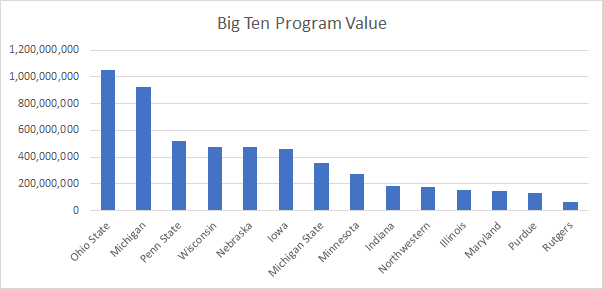
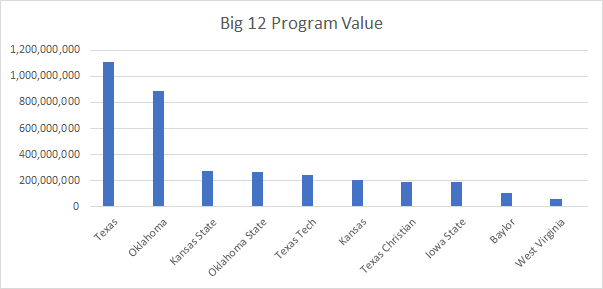
Who are the bigger programs? That’s a pretty easy answer in each of the power five conferences. What might be noteworthy, from the data in our fantasy booking story, is how much bigger those programs are than their league brethren.

Using the Wall Street Journal’s list of college football’s most valuable programs from 2018, we noted distinctions in a couple of tiers:

Thirteen programs are valued at $500+ million:

  • Half the SEC (Six traditional powers plus Texas A&M)
  • Big Ten: Ohio State, Michigan, Penn State
  • Big 12: Texas & Oklahoma
  • Notre Dame
  • ACC: zero
  • Pac-12: zero

Thirty-two programs are valued at $250+ million:

  • SEC: 11 of 14
  • Big Ten: 8 of 14
  • Big 12: 4 of 10
  • Notre Dame
  • ACC: 3 of 14
  • Pac-12: 5 of 12

Sometimes the dividing line between the haves and the have-nots is easy to spot. In the SEC, Mississippi State ($223 mil.) just misses making it 12 of 14 to clear $250 million in value. From there, it’s a steep drop to Missouri ($122) and Vanderbilt ($81). A “no” from Nashville isn’t going to be worth much.

In the ACC, there’s clear separation between the top three (Clemson, Florida State, and Virginia Tech all between $275-300 million) and the rest of the league (Georgia Tech is next at $215; no one else is above $200). But those top three are starting so much farther back than the biggest fish in the SEC, Big Ten, and Big 12 ponds, it’s uncertain how much weight they carry among the other 11 ACC institutions in a basketball conference, even when two have rings from the last decade. Washington has a healthy lead on the rest of the Pac-12 ($440 million; Oregon is second at $348), but there’s no clear separation between an upper and lower class there either, and no financial superpowers.

Who wants to play in the Big Ten? Take a guess:

It seems contractually unlikely anyone could break ranks and play out-of-conference this fall. But if you’re looking at who might be itching for something different – especially if other power conferences do play this fall – it’s the top half of that chart. They can share revenue all they want, but the longer this goes the more it becomes about survival for college athletics. And the top half of that chart is far more likely to find a way.

So now, if so much hangs on what the Big 12 wants to do?

How much of that conversation is really about what Texas and Oklahoma want to do? Especially considering half of the remaining conference also resides in one of those two states with the same politicians?

I don’t know if playing this fall is the best idea or not. But if you’re looking for teams who are most likely to come alongside it, keep following the money.

Is this Tennessee’s most difficult schedule ever? Almost.

There’s no historical context for a 10-game SEC season in the modern era, so sure, you can make the argument that this kind of gauntlet, absent any FCS cupcakes or mid-major challengers, is harder than anything else the Vols have faced before. But as the major talking point is how the Vols are playing five teams in the preseason Top 15 (in the coaches’ poll), it’s a good way to compare what the 2020 Vols might/will face to what Tennessee teams of the past have seen.

(For this piece I used the preseason AP poll data from College Poll Archive, which goes back much farther than their coaches’ poll data.)

Tennessee’s schedule, as you know, is always hard: Florida, Georgia, and Alabama are ever present, ever elite. Alabama has been ranked no lower than third in the preseason AP poll for 11 years in a row, no big deal. Georgia has been ranked third or fourth in the preseason poll the last three years. And though not quite that high in the present, Florida was preseason top five three times under Urban Meyer and eight under Steve Spurrier, including six years in a row from 1994-99. Those teams are always going to be there. The Vols have two top five and three top ten teams on their 2020 schedule, but nothing about that is unusual for Tennessee.

The Vols have also played a historically difficult non-conference opponent each year. Since the league expanded to divisional play in 1992 nearly 30 years ago, Tennessee has faced a preseason Top 15 non-conference foe eight times; Oklahoma would’ve made nine this year.

So, how does playing five preseason Top 15 teams (#3 Alabama, #4 Georgia, #8 Florida, #11 Auburn, #13 Texas A&M) compare to Tennessee’s recent history? Since divisional play began in 1992, only one season can match it: Butch Jones’ first year in 2013, when the Vols played five preseason Top 10 teams: #1 Alabama, #3 Oregon, #5 Georgia, #6 South Carolina, and #10 Florida. (Preseason poll only, so that fun doesn’t include eventual national runner-up Auburn or SEC East champion Missouri, which finished fifth.) Remember that?

In four other seasons since 1992, the Vols have faced four preseason Top 15 teams:

  • 2014: #2 Alabama, #4 Oklahoma, #9 South Carolina, #12 Georgia
  • 2011: #2 Alabama, #4 LSU, #12 South Carolina, #15 Arkansas
  • 2009: #1 Florida, #5 Alabama, #8 Ole Miss, #13 Georgia
  • 2006: #7 Florida, #8 LSU, #9 California, #15 Georgia

Again, the preseason poll is prone to error: the Vols beat South Carolina in 2014 and dominated Cal in the 2006 opener. It’s all perception at this point, and an accurate one to say 2020 would be one of the most difficult schedules the Vols have ever faced going in…just not quite at the top of that list. And those Butch Jones Vols in year one were both less talented and had their chances. So if we do play this thing, there’s still reason, even in the midst of nearly unprecedented difficulty, to see opportunity.

First Impressions of the New SEC Schedule

We said for weeks if the Vols added one of Auburn/LSU/Texas A&M and one Mississippi school, in any combination, Tennessee would be getting a fair deal. Turns out, not so much: the Vols travel to Auburn and host Texas A&M (for the first time! in front of few/no fans!).

Our immediate takeaways:

The imbalance with Florida and Georgia hurts most. The Gators and Dawgs each play two of the SEC West’s top four teams, AND now they both play Arkansas as well, negating whatever advantage that already provided Tennessee. Georgia added the Hogs and Mississippi State to their already-difficult combo of Alabama and Auburn. Florida, who had the scheduling advantage before the pandemic, keeps LSU and adds Texas A&M while also facing Ole Miss and Arkansas. But the Vols will get Alabama, Auburn, and A&M. That’s two Top 15 SEC West opponents for Florida and Georgia, but three – including Alabama – for Tennessee. This is the biggest gripe, and the biggest block in the way of any dark horse hopes in the SEC East.

Arkansas has the most difficult schedule in the conference. Which makes sense for a team riding a 19-game SEC losing streak? One thing was clear: the league favored its best teams instead of balance across the board. One SEC West team had to play both Florida and Georgia, and the league decided it should be the Razorbacks.

Using the SP+ tier system from our mock schedule, here’s how each division’s schedules rank:

SEC East

  • 9 tier points (most difficult): Kentucky, South Carolina, Tennessee
  • 10 tier points: Georgia, Missouri, Vanderbilt
  • 11 tier points: Florida

SEC West

  • 7 tier points: Arkansas
  • 8 tier points: Alabama, Auburn
  • 10 tier points: Mississippi State, Texas A&M
  • 11 tier points: Ole Miss
  • 12 tier points: LSU

For reference, LSU plays Florida, Missouri, South Carolina, and Vanderbilt. It’s good to be the king, apparently.

How the schedule falls is now the most important thing for Tennessee. Since literally half the schedule is against a Top 15 opponent, the Vols should really hope to see those five teams every other game, alternating between:

  • Alabama, Auburn, Florida, Georgia, Texas A&M
  • Arkansas, Kentucky, Missouri, South Carolina, Vanderbilt

But, as we’ve seen, don’t count on the powers that be in the SEC to show favor to a program that isn’t at the top right now.

One final note: Tennessee’s current athletic director comes from a time when the Vols welcomed anyone, anywhere, anytime.

If they play this thing, we’re gonna need all of that mentality.

Go Vols.

Our Updated SEC 10-Game Schedule Proposal

While we’re waiting for the real thing, here’s my best attempt at a mock 10-game league schedule. The guiding principles:

The two new opponents are added based on strength of schedule. I used preseason SP+ data to put each division in four tiers:

  • SEC East 1: Florida, Georgia
  • SEC East 2: Kentucky, Tennessee
  • SEC East 3: Missouri, South Carolina
  • SEC East 4: Vanderbilt
  • SEC West 1: Alabama
  • SEC West 2: Auburn, LSU, Texas A&M
  • SEC West 3: Ole Miss, Mississippi State
  • SEC West 4: Arkansas

We originally did this exercise to pick new opponents more than three weeks ago, but I made a copy/paste error on Auburn’s schedule and fooled myself into thinking no SEC West team had to play both Florida and Georgia. In reality, someone does, and I went with Auburn for a couple of reasons. The Tigers get the benefit of also playing Vanderbilt. If we anticipated full stadiums, I would’ve given Alabama both the Dawgs and Gators in Tuscaloosa. But that seems out of balance with home field worth far less this year, so this way both Auburn and Alabama play Georgia, then split the rest of the SEC East, with Auburn getting both Florida and Vanderbilt for balance. There’s also still a rivalry factor (I think) with the Gators and Auburn, annual foes before the league switched formats in 2003. Otherwise, I stuck with the two new opponents selected in that piece three weeks ago.

If each tier is worth its designated point value, every team in the league plays a cross-divisional schedule worth either nine or ten points, except now Auburn is at eight points.

TeamAnnual2020NewNew
FloridaLSUOle MissAuburnTexas A&M
GeorgiaAuburnAlabamaArkansasMiss State
KentuckyMiss StateAuburnLSUOle Miss
MissouriArkansasMiss StateAlabamaLSU
S CarolinaTexas A&MLSUAlabamaArkansas
TennesseeAlabamaArkansasOle MissTexas A&M
VanderbiltOle MissTexas A&MAuburnMiss State
AlabamaTennesseeGeorgiaMissouriS Carolina
ArkansasMissouriTennesseeGeorgiaS Carolina
AuburnGeorgiaKentuckyFloridaVanderbilt
LSUFloridaS CarolinaKentuckyMissouri
Ole MissVanderbiltFloridaKentuckyTennessee
Miss StateKentuckyMissouriGeorgiaVanderbilt
Texas A&MS CarolinaVanderbiltFloridaTennessee

Now that we’ve got the teams, the schedule itself:

Division games are played the first seven weeks, with annual rivalries taking up the odd team out slot each week. So from September 26 through November 7, each week would feature six divisional games and one annual rivalry. Every team gets a bye on November 14. This leaves room for any early season cancellations to slide over. Then the existing 2020 rotating opponent is played on November 21 (SEC West hosting this year), so we put SEC East hosts for new games on November 28 and back to the West for the season finale on December 5.

(If you can’t see the full tables, turn your phone to landscape mode or click here for a better look via Google Sheets.)

SEC East

FLAUGAUKMIZSCARTENVAN
9.26UKAUBat FLAVANTENat SCARat MIZ
10.3LSUat MIZat TENUGAat VANUKSCAR
10.10at VANat SCARMSUat TENUGAMIZFLA
10.17vs UGAvs FLAVANat SCARMIZALAUK
10.24MIZat UKUGAat FLAA&Mat VANTEN
10.31SCARTENat MIZUKat FLAat UGAMISS
11.7at TENVANSCARvs ARKat UKFLAat UGA
11.14
11.21at MISSat ALAat AUBat MSUat LSUat ARKat A&M
11.28A&MMSULSUALAARKMISSAUB
12.5at AUBat ARKat MISSat LSUat ALAat A&Mat MSU

SEC West

ALAARKAUBLSUMISSMSUA&M
9.26at ARKALAat UGAMISSat LSUA&Mat MSU
10.3at MISSat MSUA&Mat FLAALAARKat AUB
10.10A&MLSUat MISSat ARKAUBat UKat ALA
10.17at TENat A&MLSUat AUBMSUat MISSARK
10.24at LSUMISSat MSUALAat ARKAUBat SCAR
10.31MSUat AUBARKat A&Mat VANat ALALSU
11.7AUBvs MIZat ALAMSUat A&Mat LSUMISS
11.14
11.21UGATENUKSCARFLAMIZVAN
11.28at MIZat SCARat VANat UKat TENat UGAat FLA
12.5SCARUGAFLAMIZUKVANTEN

It’s not perfect, but really any of those first seven weeks can be moved around. The way I’ve drawn it up, the Vols get Georgia and Florida back-to-back, and Alabama plays four of its first five on the road, something I think we’d have to see the conference office do to believe it. But in a season of weirdness, I like the balance this schedule is built on. Like anything else right now, it seeks to make the best of the given moment.

Vols in the NBA Restart: Perfect Timing

The nearest available certainties in sports world right now:

  • Bubbles are best, moving the NBA front and center
  • If you’re watching the NBA, there’s never been a better time to be a Tennessee fan
https://twitter.com/Vol_Hoops/status/1288844296821432320

The league returned to action with two games last night, and – with apologies to Jordans McRae and Bone, eliminated from playoff contention outside the bubble in Detroit – Tennessee’s NBA contingent in Orlando will see its first action today, with Washington vs Phoenix at 4:00 PM and a showdown between Boston and Milwaukee at 6:30 (ESPN).

Until…well, really until right now, this season, the NBA experience through the eyes of a Tennessee fan was about individual players. Bernard King was a four-time all-star, two-time first-team All-NBA player, and won the league’s scoring title in 1985. Six years after he entered the league, Dale Ellis began an 18-year NBA career that included an all-star appearance and three-point shootout crown in 1989. And a decade after Ellis was drafted, Allan Houston began his 12-year career that would include two all-star appearances, a gold medal in the 2000 Olympics, and a run to the 1999 NBA Finals featuring a classic series-ending shot.

Those three guys have their numbers in the rafters at Thompson-Boling. And for a program like Tennessee, it’s reasonable to expect three NBA All-Stars to come through your doors over 15 years.

The problem was, on the NBA level, there were really no other options. Between King and Ellis, Reggie Johnson was drafted in 1980 and played four years, averaging eight points per game. Between Ellis and Houston, four Tennessee players saw action in the league but none played more than 50 games. And after Houston, Vincent Yarbrough and Marcus Haislip had initial opportunities, but neither were able to stick.

(Shout out to Real GM and Basketball Reference for their usual excellence)

C.J. Watson caught one year of Bruce Pearl’s magic and grew into a 10-year backup point guard, averaging 20.2 minutes per game with four playoff appearances. Tobias Harris slowly built his career from one-and-done success at Tennessee through four teams and only one playoff appearance, swept by LeBron in round one four years ago. But now in Philadelphia, he’ll make his second straight postseason appearance with the Sixers, with aspirations of staying in Orlando for a while.

Harris, a could-be all-star, fit nicely into the mold of cheering for one player that Tennessee fans had for so long. Add in Watson and Jordan McRae, who got a ring with Cleveland in 2016, and the Vols were slowly building NBA depth. But then two of our favorite Vols of the last decade changed everything: Josh Richardson and Rick Barnes.

Richardson had one of the most satisfying four-year arcs of any Tennessee player I’ve ever seen. And it turned out the curve didn’t stop in Knoxville: he maintained his consistent improvement through four seasons in Miami, and led the team in scoring in 2019 with 16.6 points per game. Not bad for a defensive stopper we thought, “Yeah, but can he be the alpha?” after Cuonzo Martin’s Sweet 16 run.

Traded to Philly for Jimmy Butler, now he and Tobias average more than 30 minutes per game. If you want Vol quantity and quality, the Sixers are your team…and if they can figure out the right combination of their fascinating pieces, could be trouble in Orlando, currently tied for fifth in the Eastern Conference.

Kyle Alexander is on Miami’s bubble roster, currently fourth in the East, but is yet to play an NBA minute. The biggest bubble opportunity might belong to Admiral Schofield, playing on an injury-riddled Washington team. He averaged 10.9 minutes in 27 games with the Wizards this season, but should be more opportunities in the eight seeding games Washington is guaranteed. Congrats to Admiral for being the only person in America to lose weight in quarantine, who slimmed down to guard more positions but:

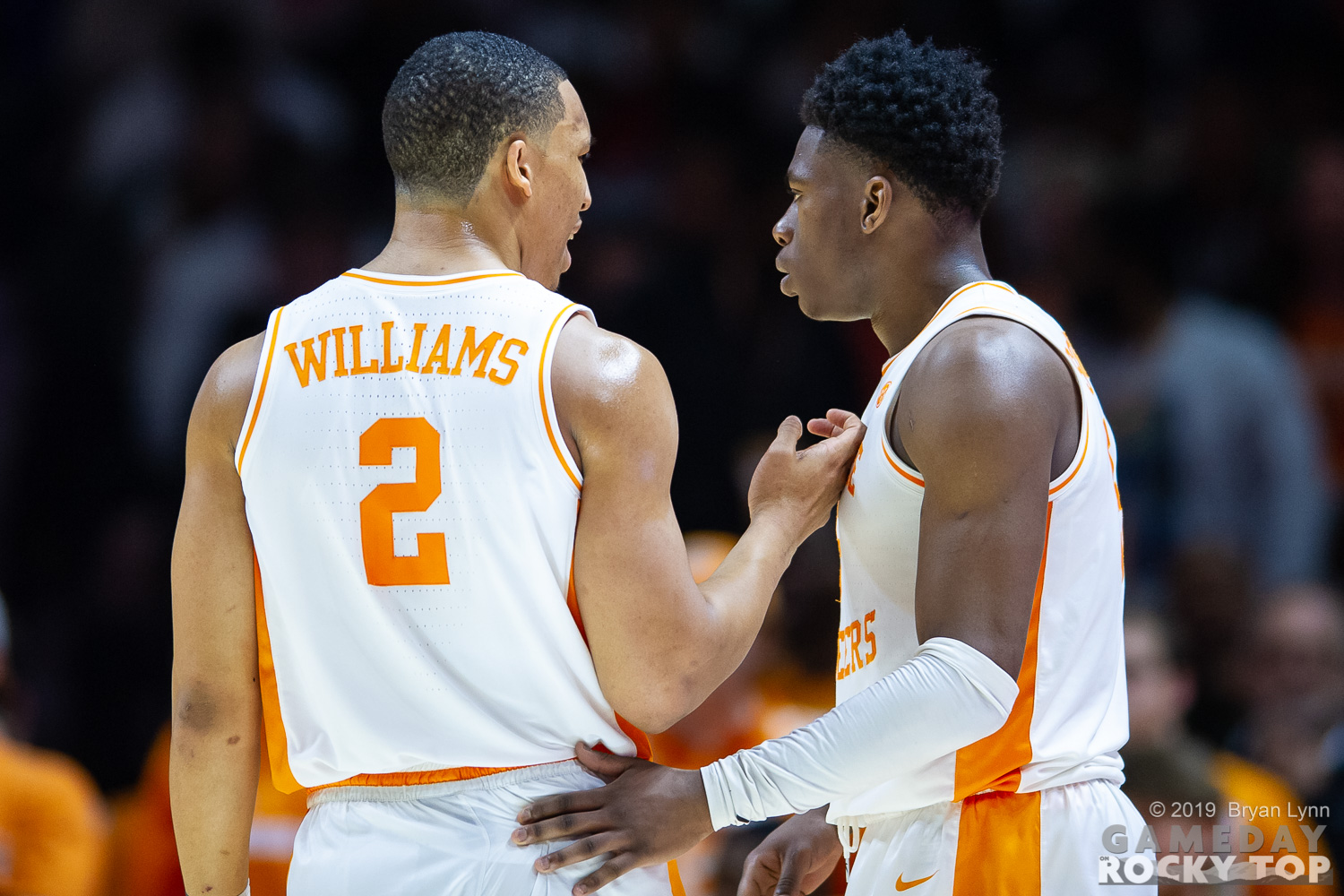
And then there’s Grant Williams.

Look, you know what you’re getting from me as a Celtics fan. But let’s just talk about Tennessee for a minute. Bernard King and Allan Houston had opposite problems. King played on legendary teams at Tennessee, but never found much team success in the NBA. In 1984 the Knicks took the eventual champion Celtics to seven games in the second round, and King averaged 29.1 points in the series. But the Knicks failed to reach the postseason in his scoring title season the following year, and then injuries closed his window in New York. Houston, as noted, was a part of plenty of team success with the Knicks at the turn of the century. But his Tennessee teams, though fueled by his scoring, never made the NCAA Tournament.

It’s incredibly rare to earn both individual and team success at Tennessee and in the pros, and not just in basketball. Reggie White is one of the greatest defensive players in the history of football. But his Tennessee tenure is light on team success. Alvin Kamara is one of the most exciting players in the NFL right now…which only makes his college career more frustrating.

And some of our most beloved individual performers at Tennessee – Heath Shuler, Chris Lofton – didn’t make it at the highest professional levels. But those are the guys you want to cheer for most. If Josh Dobbs earns a starting job, I think you’ll see incredibly high levels of support for him.

For almost 20 years, Peyton Manning carried this torch for Tennessee. Since his retirement, who’s got the belt now? Which former Vol has the best combination of collegiate and professional success? Who do you want to cheer for the most, who then gives you the best opportunity to be for them?

I’d argue Candace Parker should be the best answer to that question, but I’m not sure how many of us are watching the WNBA.

The answer isn’t necessarily Grant Williams right now. As a rookie, he averages 16 minutes per game. You’ll see twice as much action from Tobias and JRich.

But Williams carries so much love and success from his Tennessee tenure, you want it for him so badly. And on a Boston team that has a hard time putting its best five players on the floor together, Williams was already seeing some action in fourth quarter small-ball lineups. All signs point to him playing meaningful minutes in playoff games, where Boston is currently the three seed in the East. For our purposes, hopefully the Celtics and Sixers don’t run into each other in the first round.

In scrimmage work in Orlando:

That’s just one of many small moments of joy from Williams this season, that could potentially blossom into a big following from Tennessee’s fan base.

Okay, again, I’m biased for Boston. But still: 30+ minutes from Tobias and JRich, a huge opportunity for Schofield, and Grant Williams doing Grant Williams things in the playoffs?

This is the best it’s ever been for Tennessee in the NBA at a time when the NBA is in the best position in sports. Whatever does or doesn’t happen with football – now three weeks later in the calendar anyway – enjoy what the Vols will give us in Orlando.