Can you make this Alabama offense tap the brakes?

Two weeks after facing one of the best defenses we’ve seen since playing both LSU and Alabama in 2011, the Vols get one of the best offenses we’ve seen in the last 15 years. The Crimson Tide are number one in offensive SP+ this year, and their 48.0 rating puts them in elite company among offenses the Vols have faced in the last 15 years.

In SP+, here are the 10 best offenses the Vols have seen since 2005. What have Tennessee defenses been able to do against units like this? Considering what the Vols have been since 2005, the answer is usually not much…but there is one sliver of hope if you want it.

(Full chart at the bottom of the post)

10-9. 2013 & 2012 Alabama

The A.J. McCarron Tide teams had no trouble with Sal Sunseri’s defense in 2012, then dominated in Butch Jones’ first year as well: 44 points in 2012, 45 points in 2013.

8. 2018 Georgia

The Dawgs led 24-0 after the first drive of the third quarter, but Tennessee’s defense forced consecutive stops to get it close again at 24-12. Georgia overwhelmed the defense on the following drive, then used a short field via fumble to get the final seven points in a 38-12 win.

7. 2015 Arkansas

Of the four games the 2015 Vols lost, all by one possession, the most honest defeat came to an 8-5 Arkansas team with three one possession losses of their own. The Hogs weren’t sexy, but they were ruthlessly efficient with Brandon Allen and Alex Collins. They only scored 24 points against us, but piled up 494 yards, turned away twice inside the 10 yard line late with a missed field goal and a fourth down stop.

5a/5b. 2013 Auburn & 2013 Oregon

The participants in the 2010 BCS title game were plenty good three years later. The Ducks Marcus Mariotaed the Vols in week two, going for a ridiculous 59 points and 687 yards. The Tigers made for a more compelling football game later in the season, thanks in part to a pick six just before halftime that pulled the Vols within seven at 27-20. But Tennessee would be outscored 28-3 from that point on.

4. 2019 Alabama

Most of these numbers belong to Tua Tagovailoa, who was of course knocked out of the Tennessee game then lost for the year the next month against Mississippi State. But the 2019 Tide are the only offense on this list to gain less than 400 yards against the Vols, and join 2015 Arkansas as the only ones to score less than 38 points. If you’re looking for hope, this is the best available option this week.

3. 2020 Alabama

Stay tuned.

2. 2007 Florida

Tim Tebow’s Heisman season included a one possession game and the Vols with the ball with five minutes to play in the third quarter. And then the Gators scored 31 unanswered points, first via an Arian Foster fumble returned for a score, ultimately winning 59-20 with 554 yards of offense…which was a whole lot worse in 2007 than it sounds today.

1. 2018 Alabama

For those of us wondering if Tua was as good as advertised before our first encounter, the answer was an emphatic yes: 58 points and 545 yards, and Bama hit 51 points with 13 minutes to play in the third quarter. If you’re looking for the worst case scenario Saturday, it’s this.

While the 2020 Tide offense isn’t quite at 2018 Tua levels yet, it’s also helpful that the 2020 Vol defense has come a long way from 2018. The thing that’s been hardest for me to remember this week is Tennessee’s performance against South Carolina and Missouri. For the moment, the Vols still have the second best defense in the SEC in SP+; it sure looked like it in the first half against Kentucky.

Any best case scenarios for the Vols, in general, include some version of, “Let’s see what happens when we quit turning it over,” especially on consecutive drives. It’s too much to ask this Vol defense to stop Alabama, especially when Georgia’s all-world defense just tried and failed. But we’ve already seen enough of a blueprint in this matchup last year. Tua was 11-of-12 before he got hurt, the one incompletion a costly red zone interception. But once he went out, Tennessee’s defense kept the Vols in the game with a third down sack, forcing a missed Alabama field goal, forcing and getting a 3rd-and-10 stop, then getting a 3rd-and-6 stop after a holding call gave Bama 2nd-and-14.

You’re not going to stop these guys often, so if you get them in third-and-long, you’ve got to make it count. The Crimson Tide lead the nation in third down conversions at 61.9%, in part because they’re so good on first and second down. How much can Tennessee’s defense take off from that number?

SP+ likes Bama to score 37 points on Saturday; no joke, Tennessee’s defense could give up 30+ and still feel like they did a pretty good job. They’ll need something from the offense, of course; it’s a good week for the 2018 Auburn gameplan, with Tennessee’s receivers winning one-on-one balls deep down the sideline. I don’t know who’s going to play the most number of snaps at quarterback for Tennessee, but it was Jarrett Guarantano on that day two years ago, so perhaps there’s something in this particular matchup that suits him a little more than what he’s seen the last two weeks.

This is a historically great Alabama offense. Can a relatively good Tennessee defense, at least in our recent history, get off the field enough times to make it interesting?

Here’s the full chart of the best offenses the Vols have seen in the last 15 years in SP+:

OpponentSP+ OffensePts AllowedYds Allowed
2018 Alabama50.958545
2007 Florida50.159554
2020 Alabama48
2019 Alabama47.735373
2013 Auburn46.855479
2013 Oregon46.859687
2015 Arkansas46.624494
2018 Georgia45.938441
2012 Alabama45.744539
2013 Alabama45.645479

Quality, Quantity, and Guarantano

In the last 30 years, 13 Vol quarterbacks have attempted at least 250 passes as a multi-game starter. Right in the middle of that list is Jarrett Guarantano, who has now thrown 753 passes in a Tennessee uniform. The six quarterbacks in front of him are record-setters and/or champions of one kind or another: Manning, Clausen, Ainge, Dobbs, Bray, Kelly. Not far behind him are Tee Martin and Heath Shuler, who started for only two years. And the rest of the list is filled with guys who won, lost, and in some cases re-won the starting job: Matt Simms, Rick Clausen, Justin Worley, and Jonathan Crompton.

It’s Crompton who feels like the closest comparison to Guarantano a lot of times. Where Guarantano has mixed and matched good and bad in his career, Crompton felt like all of the latter before a stunning transformation to the former. He was at the helm of the Clawfense, which guaranteed his numbers would suffer in comparison. And before that Georgia game, now 11 years old, Crompton’s bad in that offense felt worse than anything I’d seen before.

So there’s a temptation, after losing 34-7 to Kentucky in Knoxville, to throw that “accolade” on Guarantano, especially when it follows the second half at Georgia, and Georgia followed up by surrendering 41 points to Alabama. At 753 pass attempts, we have plenty of data on JG. And it can feel like we keep banging our heads against the same wall.

But over the full course of those 753 pass attempts, Guarantano isn’t the worst we’ve ever seen. In fact, he’s among the top five of those thirteen quarterbacks in the stats that cause the most frustration (data via SportSource Analytics and Sports Reference).

In touchdown-to-interception ratio, Guarantano is fifth among those thirteen QBs, behind Shuler, Manning, Bray, and Casey Clausen. Guarantano has 36 touchdown passes to 16 interceptions, adding three to his total in the last six quarters. “He’s just not accurate,” is a common complaint, especially after struggling so mightily on third down early this season. But in completion percentage, Guarantano (61.2%) is fourth on that list behind Manning, Shuler, and Dobbs.

In yards per attempt, a holier grail than many quarterback statistics, Guarantano is fifth behind Manning, Bray, Shuler, and Martin.

And in interceptions per attempt…Guarantano is first. Not as in worst. As in best: Guarantano has thrown 16 interceptions in 753 attempts, firing one on 2.12% of his passes. Heath Shuler threw 12 in 513 attempts, 2.34%. Peyton Manning threw 33 in 1,381 attempts, 2.39%.

Take his entire career or even his entire season this year, and Guarantano’s numbers are solid. So why do we feel like things are so bad?

I think Guarantano’s problems remind me most of the Arian Foster conversation: “He fumbles all the time!” Which wasn’t true. But his fumbles often came at the worst possible times in critical moments: at the goal line against South Carolina in 2005, a scoop and score in the Outback Bowl against Penn State, another against Florida in a one possession game in 2007, inside the five at UCLA in 2008, one more scoop and score at Auburn a few weeks later. That’s five fumbles in four years, but it was enough to plant the idea in the minds of many.

Guarantano doesn’t turn it over all the time; as interceptions go, he turns it over less than any long-term Tennessee starter in at least the last 30 years.

But when he does turn it over, he has a habit of doing it in bunches and bad moments.

I looked up each of his 16 interceptions. I added the first two from his freshman year for completion’s sake, but I wouldn’t judge him too harshly by what he did in 2017. But starting with the Florida game in 2018 – in something that just felt like unique bad luck at the time – you’ll notice a pattern:

Jarrett Guarantano’s Career Interceptions

1. 2017 Alabama: Intercepted in the end zone (Vols down 38-7)

2. 2017 Vanderbilt: First play of the drive (Vols down 35-17)

3-4. 2018 Florida: Strip sack on the opening drive, intercepted at the Tennessee 12 yard line on the next drive to help Florida take a 14-0 lead. Intercepted on the first play of the drive in the third quarter (Vols down 33-6).

5. 2018 Vanderbilt: Last drive of the first half (Vols down 17-0)

6. 2019 Georgia State: Fumble on pass in the flat on the second play of the game (not his fault?), strip sack at midfield on the drive following Georgia State taking a 28-23 lead, sack and interception on the first two plays of the drive when Georgia State led 35-23.

7. 2019 BYU: Third play of the third quarter at the UT 31 yard line

8-9. 2019 Florida: Intercepted in the end zone (Jennings bobbled), then intercepted at midfield, both with Florida leading only 7-0

10. 2019 UAB: Intercepted in the end zone (Vols led 23-0)

11. 2019 Vanderbilt: Intercepted on the opening drive

12-13. 2019 Indiana: Intercepted on the last drive of the first half, then pick-sixed on UT’s second play of the third quarter

14. 2020 Georgia: Strip sack to open the third quarter, interception at the UT 32 three plays later, scoop and score in the fourth quarter

15-16. 2020 Kentucky: Fumble at the Kentucky 26, pick six on the next drive, pick six on the following drive.

Throw in the goal line scoop and score at Alabama last year, and you’ve got a mess here.

Of Guarantano’s 16 interceptions:

  • Three in the end zone
  • Seven within the first three plays of the drive, which usually means bad field position
  • Three pick sixes, all in the last five games

Six different times, Guarantano has been involved with turnovers on consecutive drives: 2018 Florida, 2019 Georgia State, 2019 Florida, 2019 Indiana, 2020 Georgia, and 2020 Kentucky. When it rains, we drown (or become the only team to come back from down 13 with less than five minutes to play all year).

The stakes were higher for Arian Foster, who was surrounded by more talent. You can chicken/egg that sentence. These turnovers don’t all fall at the feet of Jarrett Guarantano, who has taken a ton of punishment over his career and is still seeing his guys struggle with pass protection in front of him.

Guarantano doesn’t throw a lot of interceptions. But he doesn’t throw a lot of harmless ones either. And that has repeatedly put the Vols in bad positions they’re usually not capable of overcoming.

I don’t know that any version of this Tennessee team is capable of overcoming Alabama, though I like their odds better a week before kickoff than I did last year, and they certainly had their chances then. I don’t know for sure what you do after that, or how you feel about Harrison Bailey with no spring practice and little fall camp. At this point in his career, I think it’s best to accept Guarantano for who he is, and what he can and can’t do. He’s actually statistically better at not throwing interceptions than any Tennessee starter of my generation. But when it gets away from him, it really gets away. What does Jeremy Pruitt do at quarterback to keep things from getting away from the Vols this year? We’ll find out more on Saturday.

Praise, Blame, and Defense

The thing I keep coming back to most often – “Georgia’s defense is the best in the country” – is, of course, the most hopeful scenario. So maybe don’t trust it yet; trust it a lot if it shows up well against Alabama, which has the best offense in the country. Stay tuned next week when we get to try to solve that problem.

But by the end of the year, that’s the hope: Georgia’s defense is, in fact, not just the best in the nation, but the best we’ve seen in a while.

The last time we saw anything better, via SP+, was 2017 Alabama. (Mis)matched against the anemic Vol offense in Butch Jones’ final season, Tennessee went for 108 total yards at 2.35 yards per play, and zero offensive points. Before then, the last time Tennessee saw a defense who ended up in that neighborhood was 2012 Florida, Will Muschamp’s eventual Sugar Bowl team. The high-powered Vol offense scored 20 points, but had just 4.72 yards per play, their lowest total of the year before imploding at Vanderbilt.

The 2012 Gators ended the year at 6.6 (points allowed vs the average offense) in defensive SP+. 2017 Alabama finished at 5.6. Georgia was at 6.2 before playing the Vols, actually coming down a bit to 7.1.

The Vols gained 214 yards on Georgia last week at 3.40 yards per play. That’s clearly not going to get it done against an elite team, and is just as indicative of the outcome as turning the ball over three times in the second half.

As a result, Tennessee’s defense faced 77 plays, its second-highest total in the last two years. The Vols allowed 44 points (37 for Georgia’s offense), got hurt over the middle, and don’t come out of Athens carrying a world of confidence.

But when you put all the numbers on the table this season, and consider what’s happening around the rest of the league? Pick whichever one makes you feel best, because they both might still be true after the Georgia game:

  • Tennessee might have the second best defense in the SEC
  • Tennessee might have its best defense in 10+ years

In SP+, both are true right now. Georgia’s otherworldly defense leads the nation at 7.1 in SP+; Ohio State is number two at 14.1, a full seven points behind. The field gets more crowded from there, but among SEC defenses after three weeks and plenty of points:

TeamSP+ DefenseNational Rank
Georgia7.11
Tennessee17.313
Auburn1818
Florida19.420
Alabama19.822
South Carolina19.923
Missouri20.527
Kentucky21.228
Texas A&M21.629
LSU22.537
Arkansas26.358
Ole Miss27.765
Vanderbilt27.866
Mississippi St27.967

Tennessee’s defensive rating of 17.3 is a hair ahead of last season’s 17.4, spurred on by a fantastic defensive effort in the six-game winning streak to close 2019. That rating was Tennessee’s best of the decade, which isn’t overly shocking; the 2015 Vol defense came closest at 17.8. What is more shocking is the size of the gap between where the Vols are now and where we’ve been in the last few years:

SeasonSP+ Defense
200915.5
202017.3
201917.4
201517.8
201118.8
201419.9
201023.6
201625.2
201725.7
201326.1
201228.3
201828.9

In the post-Fulmer era, only Monte Kiffin’s 2009 unit faired better than last year, and this year’s potential. And, in the spirit of having a chance to win every week, that’s a group – 2015, 2019, 2009 – you want to be in. Much better than the company Tennessee’s defense kept in 2016-18.

So maybe we’re not ready to think of the 2020 Vol defense as elite, or even “very good”. But if the numbers hold weight, they’ll play their way into at least that second category.

Which brings us to Kentucky.

Fresh off gaining 157 total yards at 2.96 yards per play against Mississippi State – six interceptions, 24 points – the Cats head to Knoxville. Last year Kentucky scored 13 points against us, seven the year before that. In winning four straight after losing to us in 2019, Kentucky scored 38, 50, 45, and 37 points. In winning three straight after losing to us in 2018, Kentucky scored 34, 56, and 27. Jeremy Pruitt’s defense has done some of its very best work against Kentucky.

Tennessee’s offense has its own demons to exorcise, and I’m not sure how much of that will take place the next two weeks. But if Tennessee’s defense is simply as good as statistically and historically advertised? They can carry the day against a team like Kentucky. And along the way, might start getting a little more credit and higher expectations.

Georgia 44 Tennessee 21: No Straight Lines

Throughout the off-season and especially with a 10-game SEC schedule, we’ve talked about Tennessee’s final record being a less reliable indicator of progress this year. Instead, how about, “Do we have a chance to win every week?”

Did Tennessee have a chance to win today? Not when it turns the ball over three times in the second half. Not against Georgia.

It might be tempting to cut this game in half, but we need the data from all four quarters. For a time, Tennessee was wearing out the underdog playbook: defensive touchdown, make them kick field goals, a pair of fourth down stops. It felt like the kind of game Georgia might regret.

But then, Georgia wore Tennessee out. Literally: the Dawgs snapped it 77 times, the Vols 63, with a dozen of those on the final drive. The Vol defense, heroic deep into the afternoon, was asked to do far too much too often. And Georgia, despite running a less efficient version of it early, got to play their game: limit turnovers, lean on you offensively, and let that defense do the damage.

All of these things are true at the same time:

  • Georgia might have the best defense in the country. They do in SP+, by a significant margin, and that may only grow next week.
  • Tennessee’s offensive line got a reality check. I’ll be curious to see where they go from here, but their ceiling was not as high as it needed to be to beat Georgia, plain and simple. Ty Chandler and Eric Gray ran 16 times for 36 yards (2.25 per carry).
  • Tennessee’s passing game shares the blame. It includes Jarrett Guarantano, but is not his exclusively. JG was sensational in the first half, then self-destructive on Tennessee’s first two turnovers in the second. On the third, I’m not sure what he’s supposed to do when the backs fail to pick up the blitz like that. Guarantano was part of the problem, but there’s plenty of blame to go around.

How many of those problems will show up when we’re not playing Georgia? Ask Alabama in two weeks.

I said on the radio on Friday that it felt like these Vols skipped a step: all that winning to get back to a game like this, but now you’re playing it at #3 Georgia instead of against, say, #21 Texas A&M or #13 Auburn. Those chances will come. We’ll see if the full picture of this team will still look like progress; that starts with Kentucky next week, and will still include plenty of chances for meaningful wins. If Georgia falls at Alabama next week, the Vols can still hang out in the SEC East conversation, thanks in part to Texas A&M’s win today.

We’ve mentioned this stat a bunch, and it’s painfully worth repeating: since 2001, only the 2015 Vols haven’t lost a three-possession game. Those typically come from being too far behind in talent. That’s true with Georgia; credit Tennessee, particularly its defense, for giving itself a chance for a long time today. But when those chances ran out, Georgia ran by us again.

Progress is not a straight line, though we thought it might look that way for a minute or two today. We’ll see what it looks like next week.

It’s more than beating Georgia at their own game

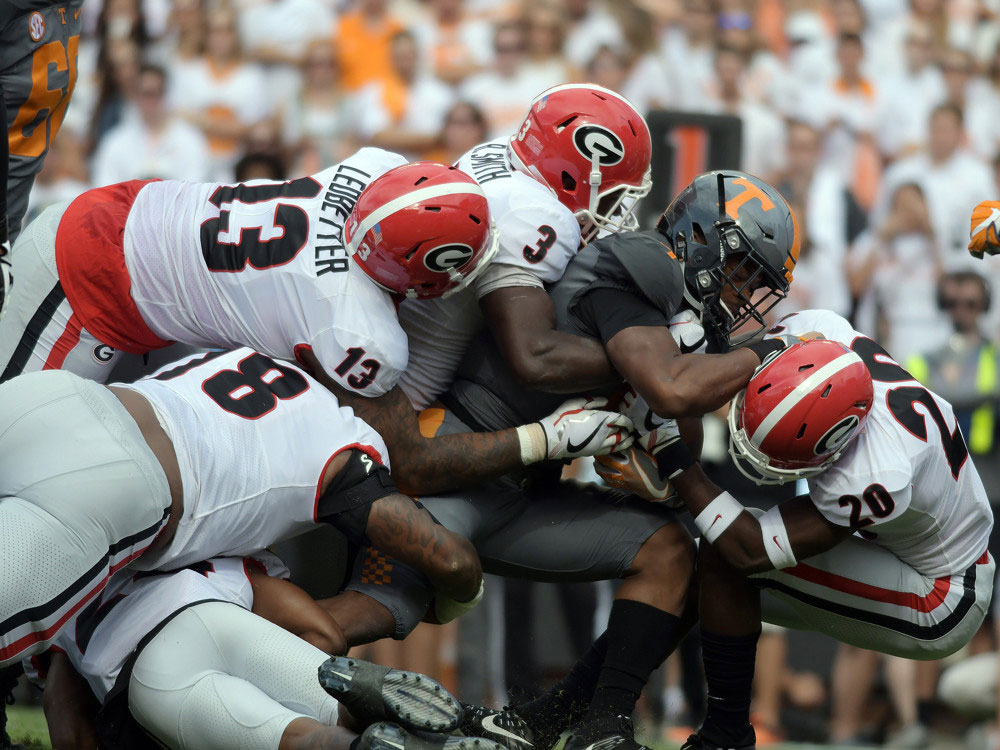
That photo is from three years ago, the last time Tennessee played in a game like this. Georgia came in ranked seventh, the Vols out of the poll after their hail mary loss at Florida. The Dawgs came out on the other side of a 41-0 victory in the top five, and ended the year a breath away from a national championship. Tennessee left that day knowing the program had probably climbed as high as it would climb under Butch Jones, not yet knowing how swiftly or how far it would fall from there.

It was also the day Jarrett Guarantano became Tennessee’s best option at quarterback, taking over for Quinten Dormady in the third quarter with the Vols down 31-0. Tomorrow will be the 35th game Guarantano has played in at Tennessee. He is eighth on Tennessee’s all-time passing list, and will pass Jeff Francis sometime this month if he stays healthy, leaving a string of last-name-only quarterbacks in front of him: Manning, Clausen, Ainge, Bray, Dobbs, Kelly.

But Jarrett Guarantano has never played in a game like this. There’s a fullness to the circle that it’s Georgia tomorrow.

To be sure, Guarantano has played elite teams; to be Tennessee’s quarterback is to see them on the schedule every year. And he’s gotten it done as the two-touchdown underdog, his performance at Auburn two years ago maybe his best. That Auburn was not this Georgia. But those Vols were not this Tennessee.

Stetson Bennett has played in a game like this, because he just did it last week. And he gave exactly the kind of performance Georgia wants while riding its elite defense: 17-of-28 (60.7%) for 240 yards (8.6 ypa), one touchdown, no interceptions. Nothing spectacular, everything solid.

This kid is still a mystery, and some percentage of Tennessee’s best chance to win is in revealing it, and discovering Stetson Bennett IV is some percentage of Joe Tereshinski III. Tereshinski was a good story until he went 12-of-20 for 164 yards with two picks against the Vols, the last time Tennessee beat a Top 10 team all of 14 years ago. Good stories have a way of being replaced by great talent in this league; Matthew Stafford had the offense not long after.

There’s some historical harmony for Tennessee on the table tomorrow. The Vols have beaten 11 ranked teams since that 2006 game in Athens, including a handful of almost-Top-10 opponents: #12 Georgia the following year, which went on to finish #2. #11 South Carolina in 2013. #12 Kentucky in Pruitt’s first season. But a win tomorrow would be Tennessee’s first Top 10 victory since #10 Georgia in 2006, its first Top 5 win since #4 LSU the year before, and its highest win over a ranked foe since #3 Georgia the year before that.

Since 1985, Tennessee’s wins against the top five:

  • 1985 #1 Auburn
  • 1985 #2 Miami
  • 1989 #4 Auburn
  • 1991 #5 Notre Dame
  • 1992 #4 Florida
  • 1995 #4 Ohio State
  • 1998 #2 Florida
  • 1998 #2 Florida State
  • 2001 #2 Florida
  • 2004 #3 Georgia
  • 2005 #4 LSU

That’s eleven Top 5 wins in 35 years, none in the last 15 years. And only six Top 3 wins in 35 years.

This is the first time Tennessee has played in a game like this in three years, which makes us all kinds of eager. Understand how rarified the air of victory would be.

How do we get there? Two years ago the Vols punted on each of their five first half drives, down 17-0 at the break at #2 Georgia. The Dawgs opened the second half with a 10-play, 75-yard drive to make it 24-0. Tennessee, to their credit and Jeremy Pruitt’s delight, had some fight in them: the Vols responded with a 10-play, 75-yard touchdown drive in kind, then made Georgia punt twice in a row before responding with another score to make it 24-12 with 11 minutes to play. The Dawgs did their thing: 13 plays, 75 yards, converting three third downs but none longer than 3rd-and-4. Then Tennessee fumbled on its next snap, adding one on in a 38-12 Georgia win.

Last year with Brian Maurer at the helm, the Vols fell behind 7-0 before hitting a big play to Marquez Callaway to tie it, then took the lead on a 10-play drive, ending on the first snap of the second quarter. They held Georgia to three again, then traded punts for three series before the Dawgs scored again to take a 20-14 lead. Brent Cimaglia missed a 47-yard field goal with a minute to play in the second quarter, and Georgia pounced with a quick-strike touchdown to make it 26-14 instead of 20-17.

Tennessee’s defense actually held it at two possessions longer than I remembered: Georgia’s first three second half drives produced a three-and-out, field goal, and turnover on downs. But the offense got no traction, with Maurer throwing a costly first down pick at midfield with four minutes left in the third quarter. Georgia put on another 10-play, 75-yard drive in the fourth, then another late fumble pushed the margin to 43-14.

Tennessee’s defense is built around denying big plays: best in the nation in not giving up 30+ yard plays last year, tied for 10th in that stat so far this year. Georgia’s offense has been good enough to play that game and win it against the Vols.

Their touchdown drives against Jeremy Pruitt’s defense the last two years:

  • 8 plays, 86 yards
  • 12 plays, 70 yards
  • 10 plays, 75 yards
  • 13 plays, 75 yards
  • 2 plays, 31 yards (late fumble 2018)
  • 12 plays, 84 yards
  • 6 plays, 60 yards
  • 5 plays, 70 yards (final minute of first half 2019)
  • 10 plays, 75 yards

When they had to have it in a hurry before halftime last season, they got it. Otherwise they’ve grinded the Vols down with third down efficiency: 8-of-14 in 2018, 5-of-11 last year.

And they don’t turn it over, and don’t take sacks: Darrell Taylor got them three times by himself in 2018, but no one touched Jake Fromm last season. Stetson Bennett was sacked once last week. It’s not much different from what Tennessee wants to get from Jarrett Guarantano, only with a more elite defense behind it.

Can Tennessee’s defense make up that difference? The Vols don’t have the talent advantage to simply beat Georgia playing Georgia’s game. So much hype, and rightfully so on both sides, is on Tennessee’s offensive line vs. Georgia’s defense. But I think the biggest way the Vols can impact this game is with their defense vs Stetson Bennett. Those magic numbers again: for all the flaws of the post-Fulmer era, the Vols are 18-4 since 2009 when they get at least four sacks, 25-2 with a +2 turnover margin.

Can Tennessee’s defense impact this game the way Auburn’s couldn’t? Can they force Georgia off their schedule and put more of the game on Bennett’s shoulders? Because that’s a trade I’d take with Guarantano, the one experience advantage the Vols have in this fight beyond offensive line: our quarterback has never played in a game like this, but might have more big third down throws under his belt than any quarterback in the nation.

Tennessee is going to need some. Can they make Georgia need some too?

A Game Like This

It’s #3 Georgia and #14 Tennessee in the 3:30 CBS slot on Saturday. That number next to Tennessee’s name may still look a little new; the Vols haven’t been in the Top 15 since 2016, and not before then since 2007. It’s true the poll is a bit sideways these days: any team can be ranked, and Ohio State, Penn State, and Oregon are all north of the Vols while yet to take the field. Wisconsin and Michigan are behind us; maybe they’d be ahead if we all started on the same day, maybe not.

But Tennessee’s case as a Top 15 team is built on both its eight game winning streak, now tied with Notre Dame for the nation’s longest among the power five, and the way we arrived at wins seven and eight. The Vols are 22nd overall in SP+, but their 13.6 (points better than an average team on a neutral field) rating is just barely behind a bunch of teams just in front of them. Auburn is 15th in SP+ at 14.9, making that game a virtual pick-’em if played in Knoxville.

The number might look strange, but Tennessee has a legitimate argument as a Top 15 team right now. The bigger issue long-term is what Tennessee will do when it gets in a game like this one Saturday.

During the offseason, we looked at Tennessee’s recent history in SP+ and grouped the last 15 years in tiers. At 13.6 in SP+ through two weeks, the 2020 Vols aren’t yet on the “competing for championships” level, last seen in 2015 and in 2006-07 before that. A lot can change there on Saturday. But for now, Tennessee finds itself firmly in the “we have a chance to win this game” tier, similar to what we saw from the 2009, 2012, and 2016 Vols.

We got wildly different outcomes from those groups, who each came into the year with wildly different expectations. But the common thread in Lane Kiffin’s year, Derek Dooley’s year three, and Butch Jones’ year four: you went into and came out of almost every game believing Tennessee had a real chance to win.

Case in point: here’s #3 Georgia, who looked as monstrous as they’ve ever looked under Kirby Smart last Saturday. Via covers.com, last year Tennessee was a 24-point underdog in this game, 30.5 in Athens the year before that. But right now, the Vols are only +13.5. In SP+, the Vols are +12 on a neutral field.

This game is the kind of opportunity we haven’t seen since Kirby and the Dawgs took control in this rivalry three years ago, effectively ending Tennessee’s chances to ascend any further under Butch Jones. It’s been long enough, and it was hard enough getting back here, that I’m taking this thing as all opportunity on Saturday. And not the house money kind, the “we have a chance to win this game,” kind. So now isn’t the time to get into the value of just keeping it close with a late score in garbage time.

But as a measuring stick for the entire season, we’ve long viewed every-week competitiveness as a great benchmark. Since 1998, the 2015 Vols are the only team without a two-possession loss. Since 2001, the 2015 Vols are the only team without a three-possession loss.

I don’t know if we’re ready to beat Georgia; statistically we’re not on par with 2015 just yet either. But are we ready to truly compete? Are we ready to have a real chance to win?

Enjoy the week. This is just the eighth ranked vs ranked game the Vols have played in the last 13 years. And half of those came on consecutive Saturdays in 2016. Other than that stretch, the list is 2012 Florida, 2015 Oklahoma, 2017 Florida, and this week. Eight opportunities like this in 13 years. The Vols played 10 such games in 2006-07 alone.

We took the long way around getting back here, more than once. Getting to a game like this is an accomplishment. Having a chance to win it is the next step.

I don’t know if we’ll beat Georgia. But for the first time in the Jeremy Pruitt era, I believe we have an actual, real live chance. And I can’t wait to find out what we do with it.

Go Vols.

Sunday Stats: Fourth Down, Red Zone & Opening Drives

There are plenty of statistical talking points behind what Georgia did to Auburn last night; we’ll get to that. For now, let’s talk about what Tennessee is doing unusually well:

Have the Vols ever had four fourth down conversions in a single game?

I can’t find this record in Tennessee’s media guide. What I do know about yesterday is it’s the first time the Vols had four fourth down conversions in the same game in at least the last 11 years (also known as the post-Fulmer era), which is as far back as the data goes from SportSource Analytics.

What’s more: four fourth down conversions represent more than Tennessee had in three of the last four seasons: 2-for-12 last year, 3-for-10 in 2017, 2-for-9 in 2016.

That 1-of-11 performance against South Carolina will hang out in our stats for a while. But 6-of-13 against Missouri on third down got the job done, and positions Tennessee nicely as an efficient offense. Third down success is no guarantee – Kentucky leads the nation at 60% and is 0-2 – but the Vols, so far, have done a good job on first and second down, did a much better job on third down yesterday, and are indeed playing without fear on fourth down.

Making the biggest difference in the red zone

Much maligned and rightfully so, the 2019 Vols scored touchdowns on less than half of their red zone possessions, finishing 112th nationally in that stat. This year, through two weeks: nine trips, seven touchdowns, one field goal, one victory formation.

We’ve been led astray early here before: in 2017, the Vols scored five touchdowns in five red zone trips against Georgia Tech (obligatory, “That might’ve been the most insane, least meaningful game in Tennessee football history,” comment). Then the Vols went 3-of-4 against Indiana State.

Then Tennessee scored zero touchdowns in three trips at Florida, and you know how that ended. And you know how the rest of the year ended: eight red zone touchdowns in nine trips the first two weeks, 11 red zone touchdowns in 26 trips the rest of the season. So doing it against South Carolina and Missouri is no guarantee. But it’s already much, much better than what the Vols did in the red zone last year.

An opening drive touchdown!

We looked at what the Vols had done on their first drive just before the South Carolina game. The results: very bad! Only one touchdown and only one field goal on the offense’s first drive last season, while the defense gave up six touchdowns and two field goals on their opening possessions.

Tennessee’s first strike against Missouri was just the second first-drive touchdown of the Jeremy Pruitt era, joining that BYU game from last season. It also meant the Vols won their sixth straight against the SEC East’s second tier, but finally did it without giving up the game’s first points, as they had the other five times.

Scoring a touchdown on the opening drive has been an issue for a while now. Against FBS competition, the Vols did it once in 2019, never in 2018, and only against lesser competition in 2017 (Southern Miss and Vanderbilt) and 2016 (Ohio and Vanderbilt). You have to go back to 2015 to find the offense really humming out of the gate, with five first-drive touchdowns (including a kickoff return and a first-drive touchdown against Arkansas…in a game we somehow still lost). It was just one drive, but the Vols are moving in the right direction.

Good News/Bad News of the Week

Good News: Tennessee is one of only five teams yet to turn the ball over this season (of 74 now to play at least one game).

Bad News: Tennessee is one of only seven teams yet to hit a 40+ yard play. The Vols finished 73rd in this stat last year with 13 40+ yard plays, one per game on average.

Tennessee 35 Missouri 12 – Level Up

Tomorrow, it becomes about Georgia. That really starts tonight; Tennessee’s performance at noon today allows us to sit back and watch the Dawgs and Auburn at 7:30 PM and see what we can learn, seven days before the first measuring stick of this kind for Jeremy Pruitt’s Vols. I’m not sure there’s a bad outcome: an Auburn victory puts the Dawgs one back in the loss column in the SEC East race, while a Georgia win gives Tennessee a chance to knock off a Top 5 team for the first time since The Rally at Death Valley 15 years ago.

But while today’s outcome is still the present, for these next few hours, we should celebrate it as a bridge between what will soon become the past, and what could soon become Tennessee’s future.

Eight wins in a row, by itself, is a significant accomplishment. The Vols have only won eight in a row, appropriately, eight times in the last 35 years:

  • 1986-97 (8): After a 2-5 start on the heels of the 1985 SEC Championship, the Vols won their last four, beat Minnesota in the Liberty Bowl, and started 1987 3-0 before tying Auburn.
  • 1990-91 (8): Following a November 10 heartbreaker against #1 Notre Dame, the Vols secured their second straight SEC title with a 3-0 finish, beat Virginia in the Sugar Bowl, and opened the 1991 campaign 4-0.
  • 2019-20 (8): Started 2-5 with a loss to Georgia State, finished 6-0 with the Gator Bowl, now 2-0 in the new year.
  • 1997 (9): Between a loss to Florida and the drubbing from Nebraska in the Orange Bowl, the Vols won nine straight and the SEC title in Peyton Manning’s senior season.
  • 1988-89 (10): Started 0-6, finished 5-0 in 1988, then started 5-0 in 1989 before falling to Alabama, the only blemish in an SEC title season.
  • 1995-96 (11): Lost to Florida, then won the rest in 1995, finished off with the Citrus Bowl over #4 Ohio State and a #2 finish in the coaches’ poll. Started 1996 2-0 before losing to Florida again.
  • 2015-16 (11): The best of times for Butch Jones: six straight after the loss to Alabama in 2015, a breathtaking 5-0 to open 2016.
  • 1998-99 (14): After the loss to Nebraska to end the 1997 season, the ’98 Vols of course went 13-0 and won it all, then beat Wyoming to open the 1999 campaign before getting Alex Browned in The Swamp.

Tennessee is 2-0, not only avoiding the kind of disaster they courted at the start of last season, but putting some additional distance between themselves and the SEC East’s traditional second tier. Six of these eight straight victories have come against that group, and while the Vols dominated Missouri statistically last season, today was far more comfortable on the scoreboard.

A 23-point win is Tennessee’s best margin against Power Five competition since beating Missouri by 26 at the end of 2016. That it comes with room for improvement is even better. Connor Bazelak went for 218 yards on 10.4 yards per attempt, a day tainted by a disastrous fourth quarter interception. Tennessee’s quarterback came out firing and finished okay, 14-of-23 (60.9%) for 190 yards at 8.3 yards per attempt, one touchdown and another clean slate in turnovers. Brent Cimaglia missed a 39-yard field goal badly.

You take any win by any margin this year, and Tennessee now has eight of them in a row. Disaster avoided and consistency solidified, Jeremy Pruitt’s Vols have moved from the lowest of lows to a clear step above the teams they’ve battled too often in the last decade. That’s a job well done.

And that’s about to be the past, as it should be.

In the future, Tennessee is now 2-0 with Arkansas and Vanderbilt left on the schedule. Take care of business there, and a 7-3 finish only requires splitting the other six. With bowls clearly back in play, even a 6-4 finish could still break the right way to get the Vols to Tampa or, who knows, maybe even Orlando, putting some proof in the very strange pudding of 2020. The progress we celebrate today is also more likely to feel like progress in January now.

That’s the future.

Tonight, tomorrow, and next week, the present levels up.

He’s yet to get in a game like this as Tennessee’s head coach, but Jeremy Pruitt knows the deal:

The Vols took the long way around to games like this, but they’re here now behind eight straight wins and a mammoth offensive line. They’re here with enough talent to let a guy like Jaylin Hyatt get his feet wet instead of going headfirst into the fire. And they’re here with Jarrett Guarantano, who became Tennessee’s quarterback three very long years ago when the Vols were crushed 41-0 the last time they played in a game like this. By Georgia.

Tonight, tomorrow, and hopefully far beyond, that will be the present. Last year’s season and this year in general have taught us plenty about what you can do with assumptions, but a 2-0 start at least puts a solid, forward-progress future in play for this season.

Today, raise a glass to an eight-game winning streak and a 23-point win we can nitpick. This crew has done an exceptional job from where we were about a year ago today. They deserve our thanks and praise.

It all leads to the next, first opportunity. From the depths of Georgia State and BYU and everything else, Tennessee has won their way back to real opportunity.

Now we get to find out just how much it can be worth.

Go Vols.

Bend ‘Til They Break

In Bill Connelly’s preseason SP+ ratings, we were surprised to see the Tennessee defense come in at sixth overall, with all 130 teams accounted for. But some of the biggest pieces of that puzzle – no big plays, get to the quarterback, force turnovers – were things the Vols did well last season. The question was, how would they perform in those areas without Darrell Taylor, Daniel Bituli, and Nigel Warrior?

Your mileage may vary on what we saw from the defense at South Carolina, playing without Shawn Shamburger (which appears to be the case again this week). But in those three areas, the Vols did quite well.

No big plays

How many big plays did South Carolina have?

It feels like a handful, right? But it depends on how you define it.

Tennessee allowed 17 plays of 10+ yards (stats via SportSource Analytics). Among teams who’ve played only one game, only eight teams gave up more. That’s not great.

But only five of those 17 plays became 20+ yard gains. Two of those came on the opening drive, attacking Shamburger’s absence right away. But surrendering five 20+ yard gains currently ranks the Vols 12th in the nation. It’ll be somewhat hard to make these kinds of comparisons this season, because the 2020 Vols don’t have Chattanooga on the schedule, but last year Tennessee gave up only 39 20+ yard gains on the season, three per contest, third nationally.

The best news: last year Tennessee led the nation in gains of 30+ yards allowed, giving up just 10 such plays. How many 30+ yard gains did South Carolina get?

Just one: a 42-yard gain on their first snap of the second half, immediately after the Vols took a 21-7 lead.

Of the 72 teams to play so far this year, only four – Arkansas, Baylor, North Carolina, and Texas A&M – haven’t given up a 30+ yard play. Tennessee is tied with four others, including Alabama, Georgia, and Kentucky, in giving up just one. (That’s almost half the league.)

Is this bend but don’t break? Only if you don’t do the other things well.

Get to the quarterback

How would Tennessee pressure the opposing quarterback without Darrell Taylor? So far, so good: four sacks against the Gamecocks, a player-of-the-week showing from Deandre Johnson, and hope the Vols can continue to cause problems for the opponent the way they did last season. With 34 sacks in 2019, the Vols put up their best total in five years. Taylor had 8.5 of those, making his absence the defense’s biggest perceived issue. But it wasn’t a problem at South Carolina.

In the post-Fulmer era, the Vols are 18-4 when recording at least four sacks. And one of those four losses is the 2015 Alabama game, the closest Tennessee came to beating Bama in the last ten years. Another is last year’s BYU game, which required extreme weirdness to end in defeat. And some of the most meaningful wins since Fulmer was on the sideline show up in those 18 victories: Mississippi State and Indiana last season, 2018 Kentucky (when Darrell Taylor got four sacks by himself), the blowout of Northwestern, and back-to-back wins over South Carolina in 2013 and 2014. Get the QB four times, and you’ve got an excellent chance of winning. That’s in part because getting to the quarterback is the best way to…

Create turnovers

Henry To’o To’o’s pick six was of obvious value. The punt fumble recovery sealed the game. And just as important here was the offense keeping a clean slate, giving the Vols a +2 turnover margin.

In the post-Fulmer era, Tennessee is 25-2 with at least a +2 turnover margin. And you have to get really weird to lose at +2:

  • 2017 Kentucky, when the Vols went +4 but also kicked six field goals, made only four, and lost by three in the, “Okay, Butch Jones is definitely getting fired,” game.
  • 2010 LSU, when the Vols again went +4 but lost after the clock struck zero.

And here again, you’ll find some of our greatest (recent) hits on this list: 2018 Auburn, 2017 Georgia Tech, the Battle at Bristol, the 2015 Outback Bowl, 2013 South Carolina, and both of Lane Kiffin’s signature wins over Georgia and South Carolina in 2009.

The defense, at this point, seems built to not give up big plays. But it’s not bend but don’t break. It’s bend ’til they break: if Tennessee keeps getting to the quarterback, forcing multiple turnovers, and playing a clean game on their end of things? The Vols can do a lot of winning led by a defense that will look strong all season.

Pass Distribution in Week One

Without Jauan Jennings and Marquez Callaway, we prepared ourselves for two outcomes: the instant emergence of mythical freshman wide receivers, or more opportunities for Eric Gray and Ty Chandler in the passing game. It’s hard to use the word “exciting” when those new opportunities come at the expense of no longer having #15 and #1 out there, but both options felt full of possibility.

Instead, 16 of Jarrett Guarantano’s 19 completions at South Carolina went to veteran wide receivers.

It worked, so no complaints here, just an early observation.

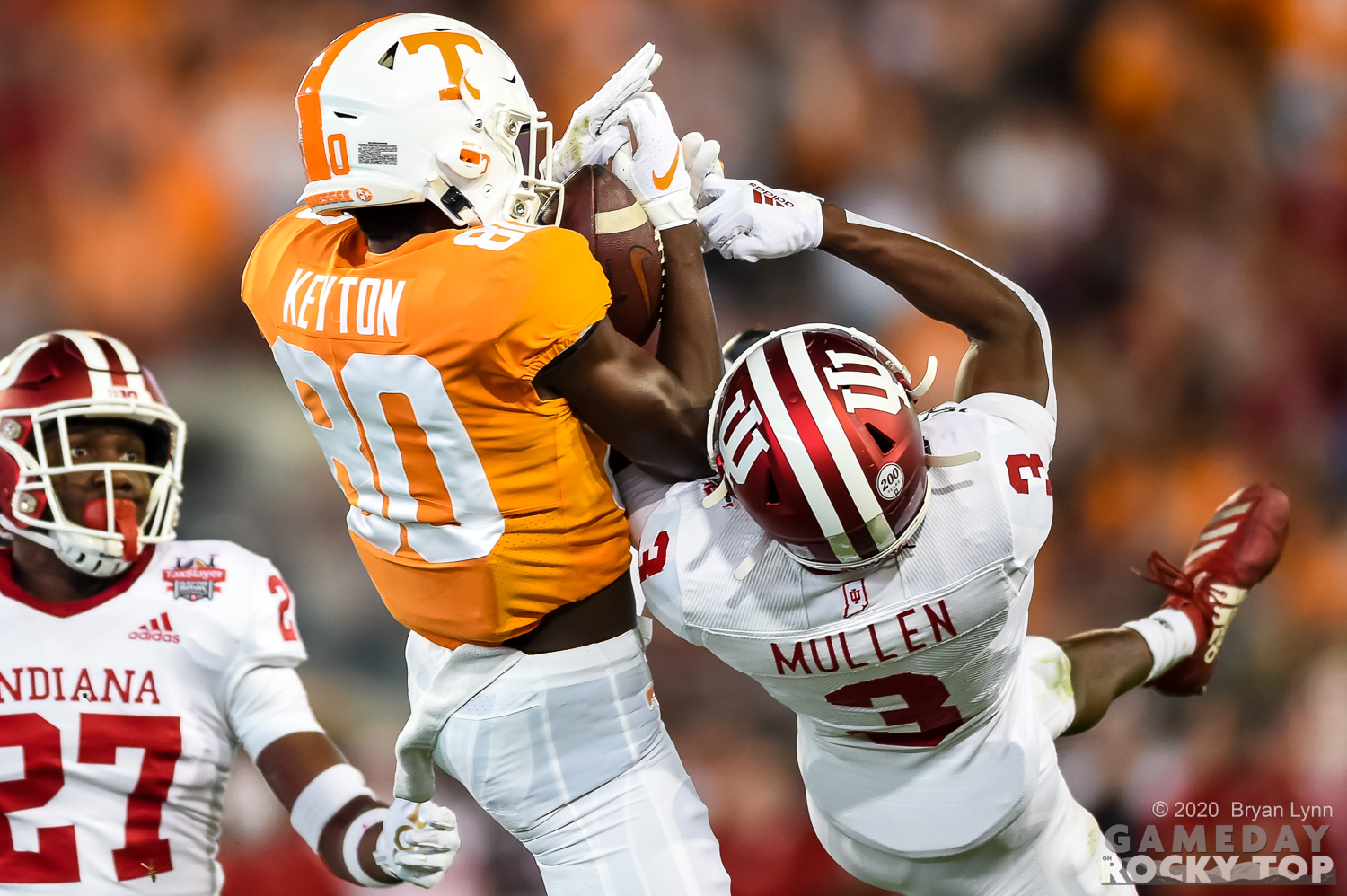
Josh Palmer is one-for-one as the alpha: six catches, 85 yards, and the go-ahead score in the fourth quarter. That’s a great sign. I thought Velus Jones played a role similar to the way the Vols used Von Pearson a few years ago, finishing with five catches and 29 yards, unable to fully break free but with plenty of opportunity ahead, it seems. Brandon Johnson had the best catch of the night, finishing with three for 73. And Ramel Keyton was targeted more often than his two catches for 20 yards.

It’s early, and it’s weird with the virus. But none of the freshmen got involved in the passing game in week one, and Tennessee’s failures on third down didn’t allow enough distance between the Vols and Gamecocks to get them some snaps with Tennessee holding a comfortable lead.

Meanwhile, what we saw from the running backs in the passing game was…basically what we saw from the running backs in the passing game last year. Eric Gray got 31 yards on the ol’ flea flicker check down. Ty Chandler had one catch for 10 yards. And that’s it.

Last year Jennings, Callaway, and Palmer were a formidable trio: 123 catches between them, 61.5% of Tennessee’s total on the year by themselves. Dominick Wood-Anderson added 21 catches at tight end. And the backs? Gray and Chandler each finished with 13, or one per game…which is what they got Saturday. Tim Jordan had six catches in a dozen appearances.

The difference between Pruitt’s Vols and what we saw in Butch Jones’ five years can still feel a bit jarring in this department, considering the running back was an essential part of the passing game from 2013-17:

SeasonRBCatchesTeam Rank
2017John Kelly37T-1st
2016Alvin Kamara40T-2nd
2015Alvin Kamara342nd
2014Jalen Hurd353rd
2013Rajion Neal273rd

Tennessee’s secondary pass-catching RBs got the same kind of work in Jones’ offense that Gray and Chandler saw last year and last week: Marlin Lane had 11 catches in 2014, Jalen Hurd 22 in 2015 and 10 in his shortened 2016 campaign, Ty Chandler 10 in 2017.

Again, the Vols won and I thought Guarantano had one of his best starts. But I’ll be curious to see if the freshmen can get involved at receiver, and if Tennessee looks to Gray and Chandler more often. So far, it continues to be the preference of both the staff and the quarterback to throw the ball to receivers downfield far more often than not, even without Jennings and Callaway out there. If that continues to work, all this will go from curiosity to real strength. And it’s also nice to feel like the Vols have real options in the passing game we haven’t even seen yet.