FPI Wants You to Believe

Vegas likes somewhere between 6.5 and 7 wins for Tennessee this fall, a good starting point for expectations. Advanced stats like S&P+ and FPI turned some heads earlier in the off-season when their initial projections slotted the Vols at 21st and 15th, respectively. But those are power rankings, which don’t take strength of schedule into account The real meat and potatoes of those systems are their projected win total; in S&P+, that’s 6.5 for the Vols (Bill Connelly’s preseason data for every team is available here).

But when FPI released their full projection for Tennessee late last week, their number for the Vols came in at 7.6. And we like to round up.

So you’ve got objective sources and systems putting the Vols somewhere between 6-6 and 8-4 this fall. That part sounds about right. But FPI’s win totals also paint what would be a very favorable bowl picture for Tennessee.

The FPI projected win totals from the top of the SEC down:

  • Alabama: 11.0
  • Georgia: 9.9
  • LSU: 9.5
  • Florida: 8.3
  • Missouri: 8.1
  • Mississippi State: 7.7
  • Auburn: 7.7
  • Tennessee: 7.6
  • Texas A&M: 7.4

In our look at initial bowl projections in late May, we noted that the SEC has put 2.8 teams per year in the College Football Playoff and New Year’s Six. Last year that number jumped to four. With the Sugar Bowl not hosting a semifinal game this year, the highest-ranked non-playoff SEC team is guaranteed a spot there.

So, for instance, if both history and FPI’s projections hold, and the league sends Alabama, Georgia, and LSU to the playoff and New Year’s Six, then sends Florida to the Citrus Bowl? If Tennessee is one of a crowded field of teams at 8-4 in the group of six bowls, its history and its two-year absence from any bowl game will make the Vols a prime candidate for, say, the Outback Bowl. That would be a pretty good year for Jeremy Pruitt in 2019.

Here’s the thing about the difference between 6-6 and 8-4: it will almost certainly be what the Vols did in close games. And Pruitt didn’t get much practice at that last season. The Vols held off Auburn late, and couldn’t finish at South Carolina. But otherwise Tennessee wasn’t sweating out a final drive.

The previous coaching staff courted close games, while also struggling to manage them well. As the Vols make progress and become more competitive, Pruitt will have to learn on the fly with things like clock management, when to go for it on fourth down, etc. And he’ll have to learn how to manage his team after close wins and close losses with much more on the line than we saw at South Carolina last year.

Remember, an 8-5 finish including the bowl game would be the third-best season in the last 12 years, and better than any post-Fulmer coach did in year two. If the Vols have eight wins going into the bowl, as FPI projects? Recent history suggests the Vols will spend the holidays in a better location than we might be imagining right now.

Only 54 days to go. If you’re looking for a reason for your optimism to kick in, FPI is happy to give it to you.

Finding the Rhythm in Tennessee’s Schedule

The Fourth of July always feels like the turning point in college football’s long summer away. Tennessee’s basketball conversation lasted longer than ever this year, and will continue in some ways with multiple Vols in the NBA Summer League over the next several days. But now, everyone’s focus starts to make a hard shift to football. Saturday will be eight weeks to kickoff. Media Days are just a week and a half from now. It’s close enough to count.

We’ll get a good look at two of Tennessee’s September foes right away: Florida opens the entire season a week early against Miami on August 24, and BYU plays the late night opening Thursday game against Utah on August 29. The Utes should be somewhere in the Top 20 when polls are released, and is about a touchdown favorite at BYU. Depending on what else happens in college football’s first full weekend, the Cougars could slide into the Top 25 with an upset, but that seems less likely than not.

Florida, however, is showing up in the Top 10 in just about every preseason magazine. The Canes are no slouch – Phil Steele has them at #15 – and the game is in Orlando. But the Gators will almost certainly still be in the Top 25 when Tennessee comes calling at the end of September; they’d have to lose to both Miami and at Kentucky to not still be ranked by then.

That game opens another difficult stretch for Tennessee, though it is thankfully followed by an open date. The Vols will face Florida, Georgia, Mississippi State, and Alabama all in a row. If you’re looking for the chalk version of how Tennessee gets to 7-5, I’m not sure it includes wins in any of those games. The Vols could hit their Vegas number by getting all of their non-conference games, including BYU, returning to form against Kentucky and Vanderbilt, and beating South Carolina in Knoxville. That particular path would mean a 3-0 start, 0-4 middle, and 4-1 finish.

We’re more used to the 0-4 middle than we’d like to admit, in part because of who’s usually in that middle on our schedule. This could be the last time we see it, as the Vols and Georgia will see their annual rivalry move to November starting next fall. That’s good news for Tennessee, as the Vols have more or less played Florida and Georgia within a couple weeks of each other over the entire 27-year history of the SEC East. You can be essentially eliminated from the division chase by the first week of October that way. In the future, should Georgia continue to be a front-runner, Tennessee can at least carry hope, real or imagined, into November.

But for now, the Vols might face four consecutive ranked foes for the fourth time in eight years. Florida will almost certainly be there. Georgia and Alabama feel like locks, as usual; the Dawgs host Notre Dame two weeks before traveling to Knoxville, while Alabama has to go to Texas A&M the week before hosting Tennessee. But those are their only major threats before facing the Vols.

And then there’s Mississippi State. Last time the Vols and Bulldogs met was 2012, Derek Dooley’s final season. There are similarities between that schedule and this one: NC State and BYU are lower-level non-conference foes than what Tennessee normally faces, and if you’re picking which non-Alabama SEC West team you’d least like to face, the answer usually isn’t going to be Mississippi State. In what became Dooley’s final season, there was still plenty of, “We don’t lose to Mississippi State,” in the atmosphere. Since then, Dan Mullen took the Bulldogs to the New Year’s Six and another Top 25 finish in his final year in Starkville; Joe Moorehead followed up with a #25 finish in the coaches’ poll last year. Mississippi State may not carry the tradition and rivalry of Auburn or even LSU, but the Bulldogs are still in a much healthier place than Tennessee.

And their opening schedule – Louisiana-Lafayette, Southern Miss, Kansas State, Kentucky, and Auburn – means they could come to Knoxville 4-1 or even 5-0, making it four straight ranked foes for Tennessee.

The Vols faced four straight ranked foes in Derek Dooley’s final season, going 0-4 and losing any hope of escaping a coaching change. The following season the Vols faced five straight ranked foes, getting a win over South Carolina in a 1-4 stretch. And in 2016, the Vols beat Florida and Georgia before falling to Texas A&M and Alabama.

Four straight ranked foes often leads to four game losing streaks. The Vols suffered that fate every year from 2010-13, and again in 2017. But they also present opportunities for valuable, momentum-changing upsets; Jeremy Pruitt was able to get a pair of those last season.

The Vols might also get a fifth shot at a ranked foe. If we were in serious consideration for the SEC East this year, right now we’d be complaining about Missouri’s schedule: the Tigers catch Ole Miss and Arkansas out of the SEC West, and also host a rebuilding West Virginia in the non-conference. Missouri’s first eight games: at Wyoming, West Virginia, Southeast Missouri State, South Carolina, Troy, Ole Miss, at Vanderbilt, at Kentucky, followed by an open date. Then comes the fun part: at Georgia, Florida, then the Vols (who are coming off a bye week). The Tigers could build up enough momentum to be fairly high up the polls before facing the Dawgs, Gators, and Vols.

It’s easy to sit back in July and say how much one win or another would be worth, but it never works out exactly the way you think. Last July, beating Kentucky seemed like a reasonable goal. By November, it was a Top 15 feather in Jeremy Pruitt’s cap. What seems most likely is, perhaps for the last time, a brutal late September to mid-October gauntlet, and maybe another four game stretch of ranked opponents. But in Pruitt’s second year, there’s enough optimism to view it as opportunity.

Evaluating Expectations Post-Blackshear

Hey look, basketball content in late June!

A point I would love to have made with Kerry Blackshear coming to Knoxville: in Ken Pomeroy’s player comparisons ($), Blackshear’s 2019 season was most similar to 2017 Johnathan Motley from Baylor…and 2014 Jarnell Stokes. Would you like to add a Jarnell Stokes to Tennessee’s roster? Absolutely. But the Orlando native is headed to Gainesville, and the Vols seem set with their 2019-20 roster.

Adding Blackshear would’ve kept Tennessee in a Top 15 conversation. What do expectations for Rick Barnes’ fifth team look like without him?

In Joe Lunardi’s June 27 Bracketology update, the Vols are an eight seed. That’s down from a six seed on May 16, though I’m not sure if he was counting Grant Williams and Jordan Bone in or out at that point. Tennessee is one of seven SEC teams in the field: Kentucky at two, Florida at three, Auburn at five, then a bunch of teams together with Mississippi State (seven), Tennessee and Ole Miss (eight), LSU (ten), and Alabama (first four out).

Other Vol opponents in Lunardi’s projected field: Memphis is a four seed, Washington a nine, and Cincinnati the Vols’ first round foe in the bracket at nine. Tennessee is the lowest projected seed of the four teams in the Emerald Coast Classic, with Purdue (four), Florida State (five), and VCU (six) all carrying expectations beyond just getting in. Wisconsin, however, is not in Lunardi’s projected field.

As we should expect from Barnes, if the Vols don’t get in it won’t be because of their strength of schedule. It’s also worth noting the last two times the Vols lost the core of one of their best teams in 2008 and 2010, they were in the 8/9 game the following year in 2009 and 2011. That 2011 team could become a decent comparison (without the Bruce Pearl drama) with Josiah James as the program’s first McDonald’s All-American since Tobias Harris that season.

After the UCLA drama, we looked at the expectations that come with paying a coach $4 million plus: make the Final Four at least once per decade, make the Sweet 16 more often than not, and make the tournament 90% of the time. I think the last one is still a good goal for Tennessee this season, and one Barnes won’t shy away from after getting Texas there 94% of the time. The Vols are replacing a ton from Williams, Schofield, Bone, and Alexander. But they also have really good pieces coming back in Lamonte Turner and Jordan Bowden, guys who’ve made big plays in big wins. They understand the expectations because they helped create them.

Sure, Tennessee’s ceiling is going to depend on its newcomers. And not just the five-star, but the supporting cast of Drew Pember, Davonte Gaines, Olivier Nkamhoua, D.J. Burns, and Uros Plavsic. More than one of those guys is going to play a meaningful role right away, and we won’t know exactly what we’ve got here until we see it. There’s also certainly the development factor for John Fulkerson, Yves Pons, and Jalen Johnson.

That ceiling would’ve been higher right away with Blackshear in the fold. Instead, we’ll get to watch it grow for ourselves over the course of the season. Making the tournament is now the regular expectation. We’ll see how well this group can position themselves along the way.

After Guarantano, Which Vol is Hardest to Replace?

You always start with the quarterback when doing the ominous summer piece on who you can least afford to lose. And Guarantano fits that bill, with unproven options behind him and untapped potential in front of him.

It’s more fun to think of this conversation in terms of replacement value. There are plenty of players we know will be valuable to the 2019 Vols, but many of the names that immediately come to mind play positions where depth is on Tennessee’s side: Marquez Callaway and Jauan Jennings, Alontae Taylor and Bryce Thompson, and maybe even Emmit Gooden and Aubrey Solomon. We also don’t know what version, if any, of Trey Smith we’ll get until we see him out there.

You have to look beyond Tennessee’s biggest names on offense, and many of them on defense. I do think you can make a case for Darrell Taylor; his eight sacks last year were the most for any Vol this decade other than Derek Barnett and Curt Maggitt, and his performance against ranked foes from Georgia and Kentucky definitely turned heads. Phil Steele lists him as the number four draft-eligible outside linebacker and a fourth-team All-American. The Vols are especially deep at linebacker, including some of their most exciting freshmen. But if Taylor simply proves to be that much better than the rest of that group, it’s good news for the Vols.

Still, I might through another name out there for most difficult to replace, at least in theory: Dominick Wood-Anderson.

The unrealistic expectations we tend to put on high-profile newcomers were just that for him last season: 17 catches for 140 yards and a pair of touchdowns. He was the number six option in the passing game last season. Likewise, the expectations we might have for Jim Chaney and tight ends may also be unfounded.

But if the Vols do find a spark getting Wood-Anderson involved this time around, it could get really thin behind him.

Tennessee’s only other returning reception by a tight end was a memorable one: Austin Pope against the Gators. I really want something good to happen to that kid. Behind him, it’s a bunch of unknowns, including four-star freshman Jackson Lowe.

The Vols might find something really good with Wood-Anderson this fall. If they do, he’ll instantly become one of the most valuable players on the team, in part because the options to replace him are so unproven.

Who else might be on the hardest-to-replace list?

Grant Williams to the Boston Celtics!

In 1996, the Boston Celtics selected Tennessee’s Steve Hamer in the second round, 38th overall. The Celtics hadn’t made the playoffs the previous three seasons; the Vols hadn’t made the NCAA Tournament in seven years. Hamer averaged 2.2 points per game on the worst Celtics team in history in 1997, and that was it.

It’s a rare and special thing when the pro team you love takes a Tennessee Vol. The only one that really stands out for me is the Titans taking Albert Haynesworth in 2002, which worked out well for all involved. Others have made their way to my favorite teams like Travis Henry and R.A. Dickey. But getting a player you love on a team you love from day one is special.

Williams, we all know, is special. Tennessee’s draft history is sparse since Hamer all those years ago. Ed Gray and Marcus Haislip went in the first round but didn’t stick around, and neither ascended to all-time Vol status while on campus. Tobias Harris is still fun to watch and is finally on a competitive team, but he was a one-and-done. Josh Richardson has become the leading scorer on a great franchise, but did it in continually-surprising fashion from the 40th pick in the draft.

I thought before tonight that Williams would have a chance to have the biggest day-one following for a Tennessee basketball player since Allan Houston. The Vols haven’t had great luck with their players going to NBA teams that are overly lovable: Haislip and Harris to the Bucks, Richardson to the Heat just after LeBron. Even going back to Dale Ellis, who started in Dallas then went to Seattle, NBA Vols haven’t stuck in regionally-friendly environments. Jarnell Stokes had a chance in Memphis but it didn’t work out.

So in this way, Grant Williams and Allan Houston are again similar: Houston went to the Detroit Pistons in 1993, when they still had Dumars, Isiah, and Laimbeer on the roster. For some of us, those guys were hard to like. Likewise, some of you won’t get the warm fuzzies about Grant going to the 17-time world champs; the Celtics inspire strong feelings.

But – if Williams sticks and isn’t caught up in any Danny Ainge shenanigans – it’s a great opportunity. Believe me, the Celtics are ready for more guys who know their role and play it well, and Williams has a chance to help everyone around him get better. It was quite the dichotomy this year being a Celtics fan and a Tennessee fan. The one impossibly talented and a favorite to make the NBA Finals, collapsing under its own weight and chemistry issues. The other a team full of three-stars, imposing its will on college basketball and its heart on Vol Nation for the rest of our lives.

The Celtics can use more of guys like Grant Williams. And we already know how rare guys like Grant Williams truly are. You may not be able to love the Celtics, I get that. But I have no doubt you’ll continue to love Grant Williams, and I’m hopeful it will be in ways that inspire a little more green and white in Big Orange Country for years to come.

Man, this pick made me smile. Go Vols.

We’ve Made This Climb Before: What the Early 80’s Can Teach 2019

Tennessee is 67-70 in the last 11 years, a longer sub-.500 run in the modern era than we can find for any of the other 15 winningest programs in college football history. A more concrete way to look at it: the Vols haven’t finished a season in the AP Top 20 since 2007, sneaking in at #22 after bowl wins in 2015 and 2016. That 11-year drought is also the longest on record in the modern era for any of the 15 winningest programs (via Wikipedia):

TeamYears w/o Top 20 FinishSeasons
Tennessee112008-18
Nebraska82011-18
Florida81975-82
Michigan71957-63
LSU71989-95
Notre Dame61981-86
Oklahoma61994-99
Texas61984-99
Southern Cal61996-2001
Penn State62010-15
Miami62010-15
Ohio State51987-91
Alabama51954-58
Florida State52005-09
Georgia41993-96
Auburn41976-79

The second-longest drought among these teams isn’t actually Nebraska’s current stretch: it’s also Tennessee, 10 years from 1975-84. So good news: the Vols have made this climb before. What Jeremy Pruitt is trying to dig out of is most similar to the challenge Johnny Majors faced in the early 1980’s.

When Doug Dickey left for Florida in 1969, Bill Battle took over and led the Vols to an 11-1 finish in 1970, the highest-rated Vol squad in estimated S&P+ of the last 50 years. Tennessee went 10-2 in 1971, then 25-9-2 in Condredge Holloway’s three seasons at quarterback. The Vols finished in the Top 20 in each of Battle’s first five seasons.

But the Vols went 7-5 in 1975 and 6-5 in 1976, ran their losing streak to Alabama to six straight, and Battle was replaced with native son Johnny Majors fresh off his national championship at Pittsburgh.

Majors’ first four Tennessee teams had a combined record of 21-23-1 and only one bowl appearance. If you’re just looking at wins and losses, his fifth team in 1981 appears to have broken the trend with an 8-4 season. But estimated S&P+ rates that team as the second-worst of the last 50 years behind 2017. Here’s a closer look at Majors’ first five seasons:

WLTPts ForPts Againstvs RankedOne Poss.
19774702292290-31-2
19785512512090-30-0-1
19797503112351-21-2
19805602561891-40-3
19818402442650-36-0

Going 6-0 in one possession games (including 24-21 over Wichita State and 38-34 vs Vanderbilt) is a great way to mask a negative point differential. In reality, these first five years should be grouped together as the downturn before we start talking about Tennessee’s slow and steady ascent.

If 1981 was a relative bottom from a competitiveness standpoint, the Vols made incremental progress every year from there. This too didn’t always show up in the win column, but you can see it in the point differential:

WLTPts ForPts Againstvs RankedOne Poss.
19826512812391-0-13-3-1
19839302821652-23-1
19847413272760-34-2-1

(On the strength of the 1983 defense: see White, Reggie.)

In estimated S&P+ percentile, the Vols went from 35.63 in 1981 to 55.46 to 80.07 to 87.26 in 1984. After a 1-2 start in 1983 with losses to #10 Pittsburgh and #11 Auburn, the Vols won eight of their last nine games and just missed running the table in a 13-10 loss to Ole Miss. Three of Tennessee’s four losses in 1984 came to ranked opponents, the fourth to a Kentucky squad that finished the season ranked.

Progress was there, though it might’ve been harder to see in the moment. I was born in 1981, so I can’t really speak to the personal experience of any of these years. But I can guarantee you what made everything better for Johnny Majors was beating Alabama.

The Tide won 11 straight from 1971-81. But Tennessee upset the #2 Tide 35-28 in 1982, Bear Bryant’s final season. In 1983 it was 41-34 over #11 Alabama in Birmingham thanks to a Johnnie Jones run. And in 1984 the Vols erased a 14-point deficit in the final nine minutes to win 28-27 in Knoxville.

When you get three straight against your biggest rival, everything else matters a little less. Consider how many Butch Jones sins are forgiven if the Vols beat Florida in 2014, 2015, and 2016 (and 2017, for that matter).

After going 29-27-1 (.518) from 1977-81, the Vols went 22-12-2 (.688) the next three seasons. Getting back to being a team that averaged 7-8 wins in an 11-game regular season was a big step. But at this point, the Vols had still gone 10 years without finishing in the AP Top 20.

The breakthrough came in 1985:

WLTPts ForPts Againstvs RankedOne Poss.
19859123251403-1-12-1-2

Not only did the Vols get four straight against Alabama, they dominated Bo Jackson and #1 Auburn 38-20. The Vols won the SEC and, of course, beat #2 Miami 35-7 in the Sugar Bowl, putting an emphatic end to a decade away from the national stage with a top five finish.

It took a little more time for that kind of finish to become commonplace. The Vols yo-yoed with a 7-5 finish in 1986, 10-2-1 ranked 14th in 1987, and 5-6 in 1988. But from there, Tennessee entered its longest stretch of sustained excellence: 129-29-2 from 1989-2001, a .813 winning percentage that was best in the SEC for those 13 years. With the exception of an obvious rebuild in 2000, the Vols played at the 88th percentile or better in estimated S&P+ for that entire stretch. The Vols played at the 87th percentile or below every year from 1975-84.

After last season, Tennessee’s drought in the postseason AP Top 20 reached 11 years, one more than that 1975-84 downturn. To be sure, the Vols seem farther away from a championship breakthrough in 2019 than they were in 1984. But Jeremy Pruitt and the Vols are already following that early 80’s blueprint:

WLTPts ForPts Againstvs RankedOne Poss.
20174802383490-42-3
20185702733352-31-1

2017 and 1981 are the two lowest seasons of the last 50 years in estimated S&P+ percentile; 2017 is far worse at 17.4%, but remember that 1981 team won six one-possession games. They’re not so dissimilar considering Butch Jones’ last team lost on the final play against Florida, South Carolina, and Kentucky.

So we’ve already seen the Vols make progress from the bottom. But like those early Majors teams, Tennessee had a hard time just getting in one-possession games last year. The trap Butch Jones’ teams fell into was believing being close was a good thing, playing far too many one-possession and even final-play games to escape a treadmill that topped out at 8-4. But for Jeremy Pruitt in year two, courting heartbreak via close games would look like progress. It can’t be confused for the destination – Pruitt’s time at Florida State and Alabama blowing teams up should assure he’s already learned that lesson – but it’s a step the Vols can take along the way.

Being gone longer than any other blue-blood program should remind us of the task at hand. But Tennessee’s climb in the early 1980’s – slow but steady – should remind us that such a feat can be accomplished at this university. It may not happen as fast as any of us want, but progress is both readily available and already underway. Keep recruiting and developing well. Get competitive but don’t settle for living there. Make 8-4 an average expectation and not something you have to rebuild after. And, you know, beat Florida.

Tennessee has a long way to go, perhaps longer than any other program with our past can appreciate. But the Vols have made this climb before, and came out of it with their very best days ahead of them. I’m eager to see what the next step will look like this fall.
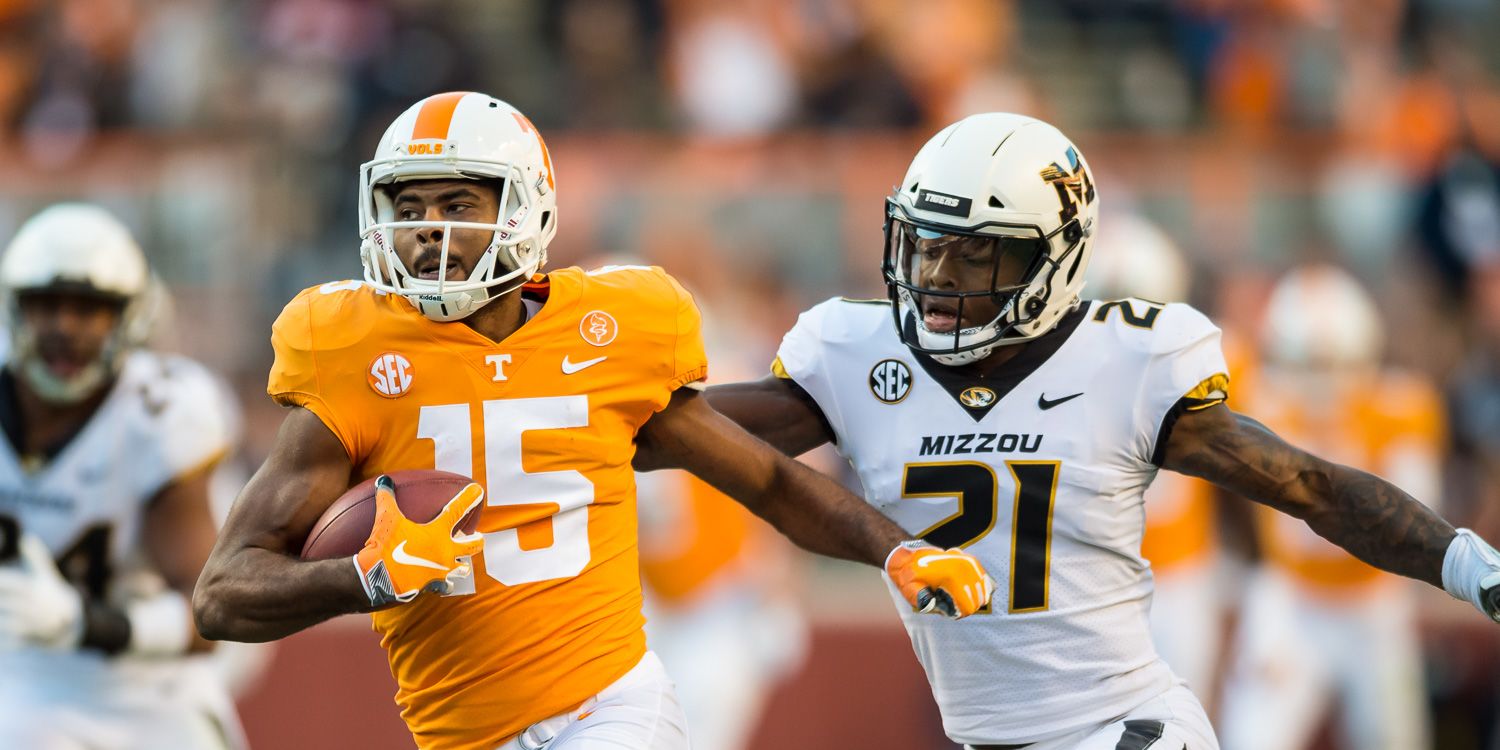
Are we underrating or overrating the importance of Guarantano staying healthy?

There are plenty of scenarios we wouldn’t enjoy this fall – no playmakers emerge on the defensive line, freshmen don’t emerge to build hope for the future – but it’s probably fair to say nothing would impact Tennessee’s ceiling like losing Jarrett Guarantano for any length of time.

Some of that is the possibility of what Guarantano could be with another year under his belt. Tennessee’s starter was seventh among SEC quarterbacks in completion percentage, and higher than that before a banged-up 13-of-31 finish in the last two games. He finished sixth in the league in yards per attempt, and was one of only five quarterbacks in the nation to throw just three interceptions with 200+ passing attempts.

Some of that is the mystery of what’s behind him. This will be the fifth time this decade Tennessee’s backup quarterback(s) has never attempted a pass. Brian Maurer and J.T. Shrout could blossom into real options for the Vols in the future, but Tennessee’s best path in the present is for neither of them to take a meaningful snap.

In the post-Fulmer era, only Jonathan Crompton in 2009 and Josh Dobbs in 2015 & 2016 took every meaningful snap as the starting quarterback (throw in Tyler Bray in 2012 if you don’t count his in-game removal against Vanderbilt). In 2010 Bray took command in November as a true freshman.

But four times in the last eight years, Tennessee’s starting quarterback was lost to a multi-game injury: five games for Tyler Bray’s broken thumb in 2011, a combined ten missed starts for Justin Worley in 2013 and 2014, and a shoulder injury taking out Quinten Dormady for the second half of 2017.

From a history standpoint, the game has changed plenty in the last three decades, but consider how, with the exception of Jerry Colquitt’s tragic knee injury on the first drive in 1994, Tennessee’s starting quarterback took every meaningful snap from 1989-1999. A big part of all that winning was having Andy Kelly, Heath Shuler, Peyton Manning, and Tee Martin out there every Saturday. And in ’94 while the Vols worked Todd Helton, Manning, and Brandon Stewart into the mix, they could also hand the ball off to an NFL running back playing behind NFL offensive linemen. If the Vols have those pieces in 2019, we don’t know it yet.

It’s all of these variables – inexperienced backups, starter prone to getting hit, offensive line still young, and the simple math of QB’s anywhere struggling to take every meaningful snap – that cause concern. An injury to Guarantano would create a need for the pause button on Jeremy Pruitt, but that’s easier said than done. In 2011 Tyler Bray put on one of the best passing days of any Vol quarterback against Cincinnati, then got hurt weeks later (along with Justin Hunter) when things felt too far down the road to just say, “Well, this year shouldn’t really count,” effectively.

I think there’s talent on this team, young and old, that’s going to manifest itself this fall in ways that excite us. That can be true on the defensive side of the ball no matter what happens, and can show signs of progress even if the Vols lose their quarterback early in the year. But it does feel like an awful lot of the progress we want is tied into conversations about Guarantano working with this receiving corps for the last time.

It’s also tough to call a conservative game – at least in theory, since Tennessee did it plenty last year – when you’re still playing catch-up in the talent pool. Justin Worley got hurt both times because the Vols were playing to score points and make big plays, but couldn’t keep him upright long enough to do so against the best defenses in the SEC. Tennessee’s best football involves Guarantano, Callaway, and Jennings making a difference. That will involve, on some level, Guarantano facing pressure behind a young offensive line against great defenses.

It’s a fine line to walk, and it’ll be interesting to see how Pruitt and Jim Chaney choose to handle it. You can’t coach or play scared; I think the Vols have a chance to have a really good passing game. It may just require putting the most important piece of that puzzle at risk to earn that reward.

The Long Way Out of the Wrong Kind of History

Despite everything that’s happened the last 11 years, Tennessee is still 11th in winning percentage all-time, still second in the SEC behind Alabama. This is Tennessee’s historical DNA in both football and basketball: the first challenger to the thrones in Tuscaloosa and Lexington.

But Tennessee’s struggles from Phillip Fulmer’s final season through Jeremy Pruitt’s first are unique among their blue-blood brethren. I’m not sure any of the 15 winningest programs in college football history have seen a stretch of sub-.500 football in the modern era like the one Tennessee is currently enduring.

We already know 2017 was Tennessee’s worst season of at least the last 50 years, and not just in wins and losses: that season finishing in the 17th percentile in estimated S&P+ means Pruitt inherited a deeper hole than any of his current SEC contemporaries in year one. That appears to have been rock bottom, but as we know it took more than a one-year drop-off from 2016 to 2017 to truly get there.

From 2008-18, the Vols are 67-70. That .489 winning percentage is 73rd nationally in that span, better only than Kentucky (.457) and Vanderbilt (.428) in the SEC. Some Top 15 programs have hovered around .500 or even further below for several years in the modern era, but I couldn’t find any stretch of sub-.500 football for this long.

Before we spend some time looking at how the Vols have gotten out of similar holes (if not quite as deep and complex) in their own history, I wanted to see if there were comparisons with other historic programs. Here’s as close as I could reasonably come in search of those comparisons:

Oklahoma 1994-99

  • All-Time Winning Percentage: .724, fifth
  • 1994-99: 30-38-1

Oklahoma went 6-6 in Gary Gibbs’ final season, then hired Howard Schnellenberger. He went 5-5-1 in 1995, then resigned. They hired John Blake, who went 12-22 in three years. Then Bob Stoops went 7-5 in his first season. Of course, they won the BCS title in year two.

Southern Cal 1996-2001

  • All-Time Winning Percentage: .698, seventh
  • 1996-2001: 37-35

John Robinson won the Rose Bowl in 1995, but went 6-6 and 6-5 the next two years and was out. Paul Hackett came in and went 8-5, 6-6, and 5-7; Wikipedia notes it was USC’s first consecutive non-winning seasons since 1960-61. Pete Carroll went 6-6 in his first season. After that: 11-2, 12-1 and a title, 13-0 and another title.

LSU 1989-94

  • All-Time Winning Percentage: .652, 13th
  • 1989-94: 25-41

Mike Archer went 4-7 and 5-6 in his last two seasons. Curley Hallman went 16-28 over the next four seasons, never making a bowl game and leading a 2-9 squad in 1992. Gerry DiNardo was hired and went 7-4-1, 10-2, and 9-3 his first three seasons, but stumbled to 4-7 and 3-9 to close out the 1990’s. LSU hired Nick Saban and the rest is history.

So we’ve seen top-tier teams struggle as much or more than Tennessee in recent history, but only for about half as long. Programs like Oklahoma had unusual coaching turnover that contributed to the problem. While it’s difficult to duplicate Tennessee’s weirdness in the last 11 years, programs we might point to with similar circumstances both found their way out of it sooner and weren’t as bad for as long. Alabama had Mike DuBose in 2000, Dennis Franchione for two seasons, the infamous Mike Price hiring and firing, then Mike Shula to take over in 2003. But the Tide still went 53-40 on the field between DuBose’s final season and Saban’s first, though the official, post-violation record books have them at 32-46 in that span. Other programs had individual coaches that definitely didn’t work – Rich Rodriguez, Gerry Faust – but the next guy brought an upswing.

It’s obvious Butch Jones wasn’t that guy, but it’s still interesting to note how close he was to breaking Tennessee’s down cycle for at least one or two seasons. If the Vols stop Florida on any fourth down in 2015 to win the SEC East, and/or beat Vanderbilt to make the New Year’s Six in 2016, Jones would’ve been seen more like LSU’s DiNardo: not the guy long-term, but brought Tennessee back to tangible prominence for at least a moment and made life easier on the next guy. But you can’t really say the same thing about a pair of 9-4’s when they’re followed by the worst season of at least the modern era.

So we rightfully keep looking at the valley Tennessee has been in as a continuous walk for the last 11 years, with the sub-.500 football to prove it. If there’s a benefit here, it’s the way the length of the journey has forced healthier expectations upon us for Jeremy Pruitt’s second season. It wasn’t one bad hire or even six years away as was the case for Oklahoma, Southern Cal, and LSU. One great hire put a national championship in their hands in year two for Stoops, year three for Carroll, and year four for Saban. Given the length of Tennessee’s absence from that conversation, it should rightfully take a little more time to figure out if Pruitt is that kind of great coach, with other steps rightfully celebrated along the way.

Making Progress: Third-and-Short

We saved the worst for last. In our series on where Tennessee can make the most progress in 2019, we’ve explored:

But if you’re looking for the thing Tennessee was absolutely, positively worst at last season, it’s third-and-short.

Last year Tennessee ran the ball 21 times on 3rd-&-1-to-3. They gained just 20 yards. Those 0.95 yards per carry on third-and-short weren’t just last in the country: Liberty finished 129th, and averaged 1.52 yards per carry. The Vols were the only team in America to average less than a yard-and-a-half per carry on third-and-short, and the Vols averaged less than a yard period.

(Stats, as always, via SportSource Analytics)

Those 21 carries led to 10 first downs, meaning the Vols converted just 47.6% of the time when running the ball on third-and-short. By comparison, here’s what Tennessee did in other situations last fall:

AttFirst DownsSuccess Rate
3rd 1-3 Run211047.62%
3rd 1-3 Pass10440.00%
3rd 4-6 Run9222.22%
3rd 4-6 Pass281553.57%
3rd 7-9 Run7342.86%
3rd 7-9 Pass281346.43%
3rd 10+ Pass341132.35%

Statistically speaking, it was better for the Vols to be in 3rd-&-4-6 and pass than 3rd-&-1-3 and run. And Tennessee had more or less the same chance of getting a first down on a third-and-short run and a third-and-long pass.

The truth is, if you’re in third-and-short, you’ve done fairly well on first and second down. But Tennessee struggled mightily to convert from there. Here’s what the rest of the SEC did when running it on third-and-short:

AttYardsAvg1st DownsSuccess Rate
Georgia361885.222672.22%
Missouri451783.963168.89%
Florida421784.242866.67%
Texas A&M321404.382165.63%
Kentucky461563.393065.22%
Alabama431824.232865.12%
Mississippi State522815.403261.54%
Auburn452665.912760.00%
LSU491984.042959.18%
Arkansas20311.551155.00%
Ole Miss34932.741750.00%
Vanderbilt241134.711250.00%
Tennessee21200.951047.62%
South Carolina21512.43838.10%

Obviously, it would be hard to get much worse in this department. The good news is, because you’re already in a short yardage situation, a little improvement goes a long way toward keeping a drive alive. There may also be a stubbornness component here: I’d imagine Jeremy Pruitt/Tyson Helton had to see it several times to believe the Vols really couldn’t move the pile on third-and-short. Pruitt and Chaney are likely to believe it sooner if it happens again this fall.

Making Progress: Explosive Plays

In 2016 the Vols were one of the most explosive teams in the country: 79 plays of 20+ yards, 19th nationally. In 2017, the bottom fell out hardest here: only 38 plays of 20+ yards, 123rd nationally.

Here too, progress was slow but accounted for last season: 52 plays of 20+ yards, 96th nationally. But remember, Tennessee ran fewer plays than any team in the nation last year. So those 52 explosive plays represented a higher percentage of the whole.

In fact, in the passing game the Vols were really good in their ratio of explosive plays to total passing attempts. In the post-Fulmer era, Jarrett Guarantano’s 7.8 yards per attempt trailed only Tyler Bray (8.3 in the last five games of 2010, 8.0 in 2011 and 2012) and Josh Dobbs in 2016 (8.3). And the percentage of big plays was even higher last season.

Here’s the percentage of 20+ yard passing plays in Tennessee’s total passing attempts this decade:

SeasonPassing Att20+%
20182973913.1%
2017319257.8%
20163795013.2%
2015371369.7%
2014453449.7%
2013344329.3%
20124775311.1%
2011400297.3%
20104195412.9%

(Stats via Sport Source Analytics)

Guarantano (with a small assist from Keller Chryst) connected on big plays in the passing game at a better rate than any Vol squad other than the 2016 offensive juggernaut. Those numbers don’t include sacks as passing attempts – Vol QBs went down on about 7% of drop backs – but Tennessee was still potent in the passing game, thanks in part to the work of Marquez Callaway, Jauan Jennings, and Josh Palmer on the other end of the play. Palmer’s 21.04 yards per catch were the most by any Vol this decade with 20+ receptions in a season; Callaway’s 16 yards per catch trailed only Josh Malone in 2016 (19.44), Cordarrelle Patterson in 2012 (16.91), and Denarius Moore in 2010 (20.87) among those with 35+ receptions in a season.

The Vols may not want to go fast, but they have all the tools to go big in the passing game, including what should be an improved offensive line.

Explosiveness in the running game, however…here’s the percentage of 10+ yard running plays in Tennessee’s total rushing attempts this decade:

SeasonRushing Att10+%
20184194911.7%
20174134611.1%
20165178516.4%
20156179515.4%
20145246111.6%
20134606915.0%
20124135112.3%
2011392307.7%
20104085012.3%

As you’d expect: slightly better than 2017, but in a group of sub-par performances that only top 2011, when the Vols had no passing game to keep defenses honest after Tyler Bray’s injury.

Ty Chandler got hot late in the season and finished with 5.48 yards per carry. But Tim Jordan actually carried the ball most (132 attempts to 115 for Chandler), and his 3.95 average was the lowest for the lead back since Tauren Poole’s 3.71 in that 2011 season. Tennessee’s additional options to find balance created few sparks: Madre London had 206 yards on 42 carries (4.90 per), Jeremy Banks 185 yards on 52 carries (3.56 per).

An improved offensive line should help here, and Eric Gray could provide those needed sparks to assist Chandler and Jordan. Could the Vols use the passing game to set up the run more in 2019? With Pruitt’s conservative nature, that will be interesting to watch. But with the right combination of existing pieces, new faces, and a willingness to pursue more big plays, Tennessee’s offense could show significant improvement in this department.