Tennessee Recruiting: Jalil Clemons Camps, Commits

Tennessee football coach Jeremy Pruitt has fared well recently in picking up several coveted recruiting prospects for the Vols, but he has said time and time again that he trusts his recruiting evaluations over those of analysts.

That manifested itself Sunday with an out-of-the-blue pledge from Starkville, Mississippi, defensive end/outside linebacker Jalil Clemons, who camped in Knoxville this past weekend and committed. He had an offer before heading up to the camp, but the coaching staff saw him in person, and when the two parties liked what they saw — Clemons of campus and the Vols of the prospect — he chose the Vols.

The 6’3″, 240-pound prospect did not have a Power 5 offer besides the Vols. He did have offers from Memphis, UT-San Antonio, Florida Atlantic, Arkansas State and others. Despite the lack of big-time offers, Clemons is a guy the Vols zeroed in on for a while. They love his speed, and he has the body type to add 40 pounds and play at 270-280. That’s intriguing for a staff that wants to make the Vols a much bigger team, as evidenced by recent recruiting exploits.

Clemons told GoVols247’s Ryan Callahan that UT coaches compared him to former Alabama outside linebacker/pass rusher Ryan Anderson, who is now in the NFL. His high school coach, Chris Jones, compared Clemons to MSU defensive end Jeffrey Simmons.

Last year, Clemons had 72 tackles, including 22 for a loss and 11 sacks for the Starkville High Yellow Jackets.

He told 247Sports’ Yancy Porter that the hometown Bulldogs told the school they weren’t going to recruit him because he was too small. That’s a mistake, according to his high school coach.

“Wait until he gets at some of these camps and combines this summer,” Jones told Porter a month ago, according to Callahan’s story. “He’ll blow up. Hands down, he’s better than (LSU commitment and teammate) Zach Edwards. That’s no knock on Zach. Jalil is just in another league.”

As we’ve mentioned before on this site, Pruitt’s evaluations are paramount to Tennessee achieving early success. The Vols may not immediately recruit with the likes of Alabama and Georgia, but they also can’t afford to miss on guys who may not be as highly rated as teams like the Crimson Tide’s and Bulldogs’ prospects. After all, they compete with those teams every year.

So, players like Clemons need to be the kind of player coaches project them to be.

Given the way Pruitt coached and developed in his time as defensive coordinator with the Tide, Bulldogs and Florida State Seminoles, it’s hard to doubt him. Even if you think this may be an early reach, there’s no way this staff quits recruiting outside linebackers. And if Clemons continues to develop, this will wind up a steal.

If he doesn’t, the two can part ways. Happens all the time.

But what more can you ask for? This staff laid eyes on Clemons, liked what they saw, thought he fit the scheme and took a commitment. That may not be what the star-gazers like, but Pruitt gets paid the big bucks to make these decisions.

The Vols are currently ranked 19th in the nation in recruiting and just eighth in the SEC. Expecting a smallish class, it’s going to be interesting to see just how high this class can rise. With limited spots, you know the staff must really like Clemons to take him now. There’s no reason to think this is a stretch taking a commit like this.

I personally like it. I want Clemons to add the weight and come in with a chip on his shoulder. If he’s an SEC prospect, it’ll bear itself out between now and national signing day. Welcome aboard!
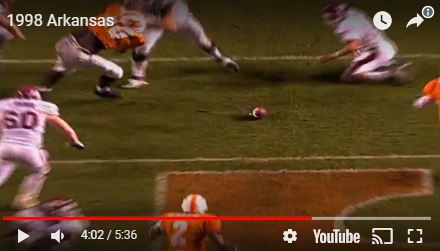
Worth watching: Ward on 1998 Arkansas

I will never, ever tire of this, and Ward’s description of it just makes it all the more compulsory today:


There’s a speech from Ward after Chesney, for those of you who want to skip forward:


The coolest thing about this next video? Ward does that thing he does. At the end, when he shoots for the trash can, you know it’s coming, but he makes you wait. Is he not going to say it? Surely, he’s going to say it. And only then, “Bottom!” It’s this that made me realize that that might be the most magical thing about his voice synched with all those memories all those years.


Bob, talking about Ward.

Worth reading 6.22.18: Newcomers

If you read only one thing about the Vols today . . .

. . . make it this, from Patrick Brown at 247Sports:

Expectations for each Tennessee newcomer in 2018, Part II

Other Vols stuff worth reading today

  1. Jeremy Pruitt remains optimistic regarding Vols’ Trey Smith. via 247Sports
  2. Vols’ Jeremy Pruitt: Individual recruiting prowess ‘overrated’, via 247Sports
  3. Tennessee 2018 FPI – Volunteers, via ESPNESPN’s FPI projects every Tennessee game this season. Only five are over 50%, although two more are right around 40%.
  4. Jeremy Pruitt shares toughest part working for Nick Saban, thoughts on Mack Wilson, via 247Sports
  5. Tennessee Vols football’s 2018 opponents at a glance: Georgia Bulldogs, via 247Sports
  6. Everyone has a John Ward story because John Ward reached everyone, via Gridiron Now
  7. For generations of Tennessee fans, John Ward brought Vols sports to life, via Saturday Down South
  8. Paul Finebaum recalls fond story about John Ward, via 247Sports
  9. John Ward photo gallery, via UTSports

Behind the paywalls

  • Four-star LB Kane Patterson visits Vols again, approaching decision, via 247Sports
  • Offer, visit put Tennessee among favorites for Florida QB Brian Maurer, via 247Sports

Worth watching 6.21.18: John Ward’s best

“The national champion is clad . . . in Big Orange.”


10 greatest games:

Another compilation:

A tribute from the SEC:

100 Yards with John Ward

Also this: John Ward’s most iconic calls as the Voice of Tennessee Vols football, via 247Sports. A collection of YouTube videos compiling some of Ward’s best calls.

Worth reading 6.21.18: John Ward tributes

If you read only one thing about the Vols today . . .

make it this, from Will Shelton of Gameday on Rocky Top:

The Voice

Curation on a day like today is especially difficult due to the flood of so many great options, but nobody does it better than Will. Like Ward, Will tells great stories with a grand economy of words. To Tennesseans, Ward was indeed The Voice.

Other great tributes to The Voice:

  1. Farewell, Friend: How Do We Say Goodbye to John Ward?, via Brad Shepard of Gameday on Rocky Top
  2. Farewell, John Ward, via Celina Summers of Orange and White Report
  3. Remembering the late, great Voice of the Vols John Ward, via Wes Rucker of 247Sports
  4. Greatness is the only way to describe John Ward, via Brent Hubbs of VolQuest
  5. Beloved ‘Voice of the Vols’ Ward dies at 88, via Chris Low of ESPN
  6. Fulmer: John Ward’s voice ‘brought to life’ fondest memories of Vols, via Grant Ramey of 247Sports
  7. “Listen to These Guys, They’ll Answer All Your Questions”, via Brian Rice of WNML
  8. John Ward Remembered, via UTSports
  9. Reactions: Tributes pour in remembering John Ward, via 247Sports. A compilation of tweets.


The Voice

We moved to Virginia today. It’s a new adventure for our family, with all of the emotions that come from leaving a place you love and going to a new place to love.

I started writing about the Vols the first time I moved to Virginia, 12 years ago. In United Methodist world this is the time of year when pastors move to new appointments, and my first was one county over from where we are now, back in 2006. Before that I lived in Knoxville my entire life. It was home. I was 24, single, and suddenly hours from anyone I knew. And so I started writing ten days after I started preaching, more than anything because I missed home.

In time, Ceres became home. And then Athens. And we are so full of hope to say the same thing about Pulaski.

But today, we lost one of my favorite things about Knoxville being home. One of the biggest reasons I loved and love Tennessee enough to write about it for so many years. And if you’re reading this, I bet he was one of your favorite reasons too.

John Ward is the only autograph I’ve ever sought out. I have a handful of others that someone got or bought for me, or passed down from one generation to the next. But the only one I’ve ever stood in line for – sports or otherwise – belonged to Tennessee’s play-by-play announcer when I grew up.

It was my junior year of high school at Foothills Mall in early 1998, before we knew what that year would become. One of my closest friends, then and now, is the son of Gaylon Hill, who played on the offensive line at Tennessee in the early 1970’s. And we stood in line together; him with some pictures of his dad, me with nothing. But I was more than happy to get one of Mr. Ward’s own pictures from the stack next to him.

I was embarrassingly nervous. But Mr. Ward cut the tension, first by remembering my friend’s dad. It’s an impressive thing to know an offensive lineman – a name you rarely call doing play-by-play – 15 or so years after the fact. It’s even more impressive when you consider he had been doing this for more than three decades.

After signing some pictures of Gaylon, Mr. Ward asked if my friend also wanted a photo of himself from the stack. To my unbelief, my friend said, “No thanks.” And John Ward, in perfect cadence, replied, “Why not?”

To me, it was those little things. We all remember the catchphrases and the big moments. But I adore the details. There’s a little chuckle in Jeff Powell’s run in the 1986 Sugar Bowl when he says, “Forty-five, forty…” as if to signify that he, too, can’t believe all of this is happening but it is. He also let the moments be the moments without over-inflating them. The way he says, “Thirty-four, twenty-seven after Aaron Hayden’s first touchdown at the Miracle at South Bend is perfect. Instead of spending two dozen words to speak to what a tremendous comeback this would be for Tennessee, he does it in one syllable.

And I remember all of this because so many of us not only turned down the TV and turned up the radio for all those years, but heard his voice on so many highlight tapes season after season. I have no doubt Mr. Ward would tell you there are many, many people at the Vol Network who helped make him great; they all certainly helped make it great to be a kid in East Tennessee in the 1990’s. I did play-by-play for Alcoa High School for three years in the early 2000’s, and would find random calls Ward made coming out of my mouth unintentionally when Alcoa did something similar because I’d seen those tapes and heard those calls so many times.

And that’s the thing, at least for my generation. The story was undeniably great. But the storyteller was so unbelievably good, we would’ve been lucky to have him regardless of how many wins he got to tell us about.

I believe in story. It’s what changes things. Even when we think we’d rather have the bullet points, it’s story that truly transforms. In my line of work, I find we sometimes think things would’ve been easier if God just gave us more lists. But what we get is story. And the character at its heart, even as a carpenter by trade, chooses to speak its language. Because a good story can save your soul.

So tonight, in an unfamiliar house in a place we’ll soon call home, I’m comforted yet again by the sounds of my childhood. They were some of Tennessee’s best stories. But a good story is only good if you tell it well.

And nobody told it like John Ward.

Farewell, Friend: How Do We Say Goodbye to John Ward?

Every time I sit down to write, a blank canvass stares back at me. The space is waiting to be filled with words. With excitement. With pain. With sadness. With euphoria.

With life.

Tonight, I have to write about death, and I don’t know where to start. How can any of us? What all do we owe the great John Ward, the voice the Vols for so many years, who told us so many stories, shared with us — authored to us — so many great memories, so many great games? I owe him greatness on this computer screen with words of my own.

I’ll fall short.

The first word that comes to my mind, honestly, when I think of John Ward is “Vols.” I think he’d love that. He’s synonymous with the university, with the athletic department, with years and years of success and failure, the ebbs and flows of any program. The second word I think of when I hear John Ward is “storyteller.” I think he’d love that, too.

He was more than an announcer. Every Saturday of my childhood, I let him and Bill Anderson into my living room. They sat down with me, sometimes around a three-channel television and sometimes without, and gave me three hours of joy, of heartache, of happiness, of dejection.

They never knew the ending, but the story of each game was a journey where we lived and died.

So many words fill my head now, so many of his calls. “The national champions are clad IN BIG ORANGE.” “Ladies and gentlemen, he’s running all the way to the STATE CAPITOL!”

“GIVE HIM SIX! TOUCHDOWN, TENNESSEE!” “BOTTOM!”

The catch phrases are simple, the deliveries were on-point. There’s no way to forget them.

When somebody gets his mitts on a story and truly does it justice, you not only remember the story but the teller. Sometimes, the stories fade, but the experiences meld together to mean a lot more. For me, John Ward narrated my childhood…

When I try to tell a story, I feel as if there are things lurking just below the surface of the skin of my fingertips, jumping toward the surface, trying to come out. Honestly, that’s the way it is. Sometimes, when I have a story on my mind and I’m driving home, I’ll have to stretch my fingers or pop them to keep them at bay. Other times, I’ll clinch my fists to fight them back.

My feelings take shape long before I sit at a keyboard, and I’m often left feeling spent afterward; whether I knocked it out of the park or grounded out to the pitcher, I’ve gotten it off my chest. There’s a sense of accomplishment, and of nakedness. “Here I am world, for better or for worse.”

You try to do life — experiences — justice with words. Sometimes, you succeed. Other times, you fail. But you want to tell a story. You want to paint a picture. You want to leave a mark.

Few people in my lifetime have done that for me when it comes to art. For my money, nobody spins a yarn like Stephen King. It’s impossible for somebody to hear the English language and translate it like Cormac McCarthy. When it comes to sports writing, Wright Thompson wields a mighty pen. Chris Cornell’s voice wove tapestries of silk and gravel. Jason Isbell writes songs that see to our souls.

In sports announcing, it was John Ward. Hands down.

Yes, I appreciate legendary Los Angeles baseball announcer Vin Scully — the standard bearer when it comes to storytelling from the booth. But as a Southern boy with orange blood, those Dodgers may as well been on another planet. I appreciated them from my Vanntown home every now and then when Scully’s voice came across my television speakers. But Ward was my own personal sports preacher, sitting high above the cathedral of Neyland Stadium and laying the gospel of “Go Vols!” on me every Saturday before the real preacher hit me upside the head with the Lord to end the weekend.

When I was about 8 on up through about the age of 17, many of my Saturdays were spent waking up early for “Coaches’ Coffee” on WYTM-FM in Lincoln County, Tennessee, where our beloved Falcons sat at Stone Bridge Restaurant in Fayetteville and talked about the game from the night before. Given that we won three state championships in my childhood, most of these mornings were victorious. I’d listen to the radio while playing my Nintendo Entertainment System and always look forward to hearing Leonard’s Losers afterward.

Sometime in here, I’d grab a football, lay on my bed, and toss it in the air, waiting on Ward and Anderson to start the pregame show. Then, they’d deliver the main event, and I’m not sure I ever remember anybody Ward loved more than Heath Shuler, who became one of my all-time favorites. Listening to Ward call a Shuler play was music.

Then came Peyton and Tee and Al Wilson and Phillip Fulmer. Then came heights the program hadn’t reached in my lifetime.

Ward called them all.

When I first met him as a college sophomore — my first year covering a college football game of any type and the year after UT won the national championship in 1998 — I tried hard to be unfazed. After all, as a professional journalist, you’re supposed to be unflappable. Nothing — nobody — is supposed to rattle your chain.

I failed.

I’m pretty sure my eyes were bigger than the plates on which they were serving the media dinner. When I shook his hand, it felt as if I’d dipped my hand in the Tennessee River, it was sweating so much.

There he was, newly retired and a real-life legend. This man was one of my idols. He’d meant so much to me, and I knew no matter how hard I tried, I’d never be able to tell a story like him. Ever.

His voice was college football’s watermark for me. It still is. It always will be.

The Vols won the national championship in 1998, and he walked away. What a storybook ending for the greatest storyteller of my lifetime. How could it end any better than that? Then, in a flash, he was gone. We had to get snippets of his golden voice from halftime interviews and Natural Gas commercials. It was like little moments of sunshine in the cold and barren wasteland of the past 15 years of Tennessee football.

Every time he spoke, I thought of better days, better times; not only for Vols football but the simpler days, when all I had to do was wake up and live my life and maybe listen to a football game here and there.

The night before my Papaw died, my dad and I sat down with him and listened to John Ward call a rare Thursday night Tennessee game. Papaw was too far gone then, but we’d listened to so many Vols games together that it was only fitting that we got to do it one last time, whether he remembered it or not. The night of my first date at 16, as I was walking out of the house, John Ward was on the radio, getting ready to call a Tennessee-Oklahoma State game in 1995.

In many ways, his voice is a soundtrack to my youth.

That voice left us many years ago, and now he has, too. How can we thank him for all hours we spent with him? How can we do justice all the moments, all the calls, all the wins, all the losses? What can I say to convey to all of you what I can’t articulate in my brain?

I can’t. We can’t. There’s no way.

There are no itchy fingers tonight just waiting to type something as I sit here writing this because there are no words. None of us can do or say enough.

Thank you, John. For being the constant voice of my youth, for giving me so much more than football and basketball. For telling me stories that became memories.

Worth watching 6.20.18: Johnson inspires the team

Commit twice: When you feel like it, and when you don’t.

More great stuff on the VOLeader program at UT:


Hype!


Another former Vol pinning hopes on Pruitt’s “old-school” style:

Stuff worth reading 6.20.18: Opportunities to improve

If you read only one thing about the Vols today . . .

make it this, from Will Shelton:

Where Can Tennessee Show the Most Improvement?

Other Vols stuff worth reading today

  1.  Expectations for each Tennessee Vols football newcomer in 2018, Part I, via 247Sports
  2. 8 Tennessee Volunteers who could benefit from new redshirt rule, via 247Sports
  3. Kennedy, London Officially Join Tennessee Football Team – University of Tennessee, via UTSports
  4. Could Tennessee football benefit from legal betting? Phillip Fulmer has ‘antennas up’, via SEC Country
  5. Ranking the SEC football coaches | WNML-AF, via Sports Radio WNML
  6. Alvin Kamara ‘constantly’ looking to build his receiver skills, via 247Sports

Behind the paywalls

  • Tennessee Vols football recruiting: Injury impacts four-star CB Woodi Washington’s camp plans, via 247Sports
  • Tennessee Vols football recruiting: Florida QB Brian Maurer ready to visit Tennessee, expecting offer, via 247Sports

Where Can Tennessee Show the Most Improvement?

(Or, what was Tennessee worst at last year?)

That’s a long list, as you might remember. Or, if you’re like me, you might not. Tennessee’s 2017 season became about the future after the Georgia loss. And when that future headed toward change soon after, it was easier to pay attention to potential new coaches every Saturday than document what Team 121 was doing.

So there’s an obvious joke here about this year’s team being able to show improvement basically everywhere; the 2017 Vols didn’t excel at anything in particular. But, thanks to the data from Sports Source Analytics, we can pinpoint a number of more specific ways the 2018 Vols can be better. Out of 130 teams nationally, these are the five categories Tennessee was statistically worst at in 2017.

Big Plays: 123rd in 20+ yard plays in 2017 (38 in 12 games)

Don’t remember any big plays from the Tennessee offense after the Georgia Tech game? That’s because there weren’t many. Only 38 plays of 20+ yards for the Vol offense was the lowest total since the injury-plagued 2011 season (36). Under Butch Jones the Vols were more explosive every season until last year, going from 46 20+ yard plays in 2013 to 55, 63, and 79 in 2016. But the bottom fell out without Josh Dobbs and under new offensive coordinator Larry Scott, cutting UT’s explosiveness almost literally in half.

Where will big plays come from in 2018? For what it’s worth, Marquez Callaway excelled during Quinten Dormady’s early tenure, catching eight passes for 198 yards and three touchdowns in the first three games of the year. We’re also familiar with the work of Jauan Jennings, who caught 11 passes for 250 yards against Florida, Georgia, and Texas A&M in 2016. The Vols could also use more explosiveness in the ground game; you may recall John Kelly showing plenty of that in the early going (38 for 269, 7.1 yards per carry against Georgia Tech and Florida) before injuries up front and the general ineffectiveness of the offense eliminated much of the possibility. Explosiveness is one of the most important factors for success; the Vols have lots of room for improvement.

Run Defense: 121st in yards per carry allowed (5.43)

By contrast, Jeremy Pruitt’s Alabama defense led the nation in yards per carry allowed last season at 2.72. Tennessee’s number swells to 5.60 yards per carry allowed if you take out the Indiana State game, and it wasn’t just Georgia Tech (6.22) who did the damage. Lost in the flames of an assumed coaching search were 8+ yards per carry performances by Kentucky and Missouri. That’s the sort of number you expect to see only when facing elite competition: 2011 Arkansas, 2013 Auburn, and 2016 Alabama all went for 8+ against the Vols. But, alarmingly, so did Kentucky…in 2016 and 2017.

It was the worst performance against the run by a Tennessee defense in at least the last ten years, and probably far beyond that. Some old standbys – being more physical, defenders swarming to the ball, etc. – can help, but the Vols also need more size and more options up front. There’s some hope, especially if you still value recruiting stars, in the starting lineup, but little proven depth behind them.  We’ll see how big of an issue that becomes if teams continue to simply pound away at Tennessee late in the game. Again, nowhere to go but up.

Negative Plays: 121st in TFLs allowed (7.42 per game)

Not only did the Vols fail to create explosive plays, they were also one of the worst teams in the country in the opposite direction.

Tackles for loss allowed are one part offensive line and one part scheme. You can track strong (2013) and weak (2010, which was most of the 2013 line as freshmen) offensive lines fairly well through this stat alone. But if it felt like the Butch Jones offense went backwards more than usual, the stats back up the perception. After allowing only 5.25 TFLs per game in 2013 (37th nationally), the Vols were next-to-last in the nation in TFLs allowed in 2014 (7.77 allowed). The only offense behind them was, you guessed it, Wake Forest.

Even nationally competitive Vol squads in 2015 (7.08 TFLs per game allowed, 108th nationally) and 2016 (5.54, 53rd) went backwards more than their fair share, before things bottomed out last fall. I think the scheme change will help things by itself here: USC was 35th nationally in TFLs allowed last season. Under Tyson Helton the Vols will probably be doing less behind the line of scrimmage; hopefully that also translates to more explosive plays.

Third Down: 120th in conversion percentage (30.67%)

When you can’t be explosive and you go backwards a lot, you don’t do well on third down. Two years after being one of the best teams in the nation on third down in 2015 (45.97%, 21st nationally), the Vols were one of the worst teams in the nation on third down last fall.

For what it’s worth, Tennessee went 1-of-12 against both Georgia and Alabama on third down, meaning the Vols were at 34.5% against the rest of the schedule. Not great, but not the worst in the land either. The Vols were entirely ineffective against the Dawgs and Tide, which means yet again there’s plenty of room for progress this fall. But you’ll also find a 2-of-13 performance in there against Southern Miss. The entire offense has plenty of room to grow, and the best way to convert on third down is to be better on first and second down. But for the Vols to be successful in 2018, they’ll need to be better in crucial third down situations as well.

Interceptions: 119th nationally (5 in 12 games)

Some of this is a byproduct of teams getting ahead of the Vols and not needing to throw it; Tennessee saw only 279 pass attempts from the opposition, the fourth-fewest nationally. But that’s still just five interceptions in 279 tries, just 1.8% of passes. Even when taking a number of beatings in 2013 and 2011, the Vols still had interception rates above 2%.

Corner is one of the biggest question marks for this year’s team, and any group looking to overachieve will need to create turnovers to get there. Pruitt’s Bama defense had 19 interceptions last year; just putting guys in better position to make a play can help this defense show significant improvement over last year.