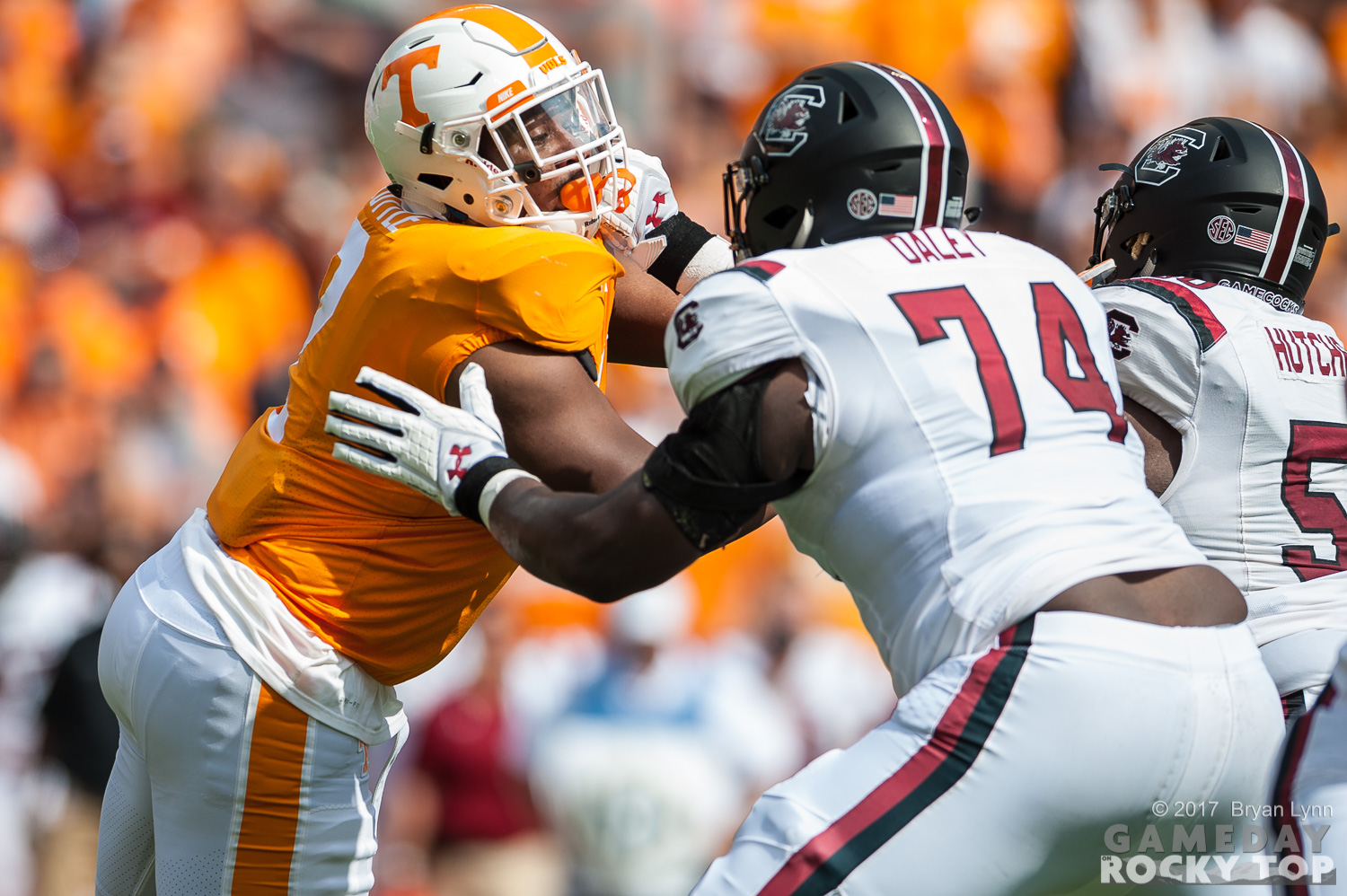
10 Questions for 2018: Vols vs The Non-UGA SEC East

Tennessee takes the stage in Atlanta today, and the media will unveil their picks for the 2018 SEC standings before the week is out. Georgia should be the overwhelming favorite in the SEC East coming off a near-miss in the national championship game and the number one recruiting class of 2018. How the rest of the division shakes out will be of interest to Tennessee, and not just this season.

This is an era Tennessee fans of my age (36) and younger are unaccustomed to. Georgia hasn’t won the SEC in consecutive years since the Herschel Walker days in the early 1980’s. The Dawgs have two sets of back-to-back division titles (2002-03 and 2011-12), but both times the second year came via a tiebreaker. Tennessee fans who grew up familiar with Georgia playing third fiddle have never seen a Bulldog program consistently on top the way they’ll have a chance to be in 2017, 2018, and beyond.

And the gap between one and two is substantial. Their traditional contemporaries at Florida and Tennessee changed coaches. Missouri seems due for an up year on the field, but is yet to level up in recruiting. Kentucky and Vanderbilt have yet to shed their reputations under their current administrations. Will South Carolina be the #2 pick in this year’s SEC East?

That idea may also seem foreign to those of us holding on tightly to Tennessee’s glory days in the 1990’s. But the truth is it’s not just South Carolina, but the vast majority of the SEC that’s been better than Tennessee the last ten years:

SEC Overall Records 2008-2017

Team Wins Losses Pct.
Alabama 125 14 .899
LSU 95 34 .736
Georgia 95 39 .709
Florida 86 43 .667
Auburn 83 48 .634
South Carolina 81 49 .623
Missouri 80 50 .615
Texas A&M 77 52 .597
Mississippi State 74 54 .578
Ole Miss 69 57 .548
Arkansas 67 59 .523
Tennessee 62 63 .496
Kentucky 53 72 .424
Vanderbilt 53 72 .424

(data from the always-helpful stassen.com)

This is the Tennessee recruits know: not Kentucky and Vanderbilt, but not on par with the rest of the league either.

And this is where Jeremy Pruitt’s first comparison must fall: not to Georgia, and certainly not to Alabama. But what are his Vols doing against the rest of the SEC East?

#5: The Vols vs The Non-UGA SEC East

At the old site we did an annual off-season piece ranking the importance of each game for the upcoming season. It was equal parts fun and futility, because it’s impossible to know how good or bad Derek Dooley’s offense will actually be when Missouri comes rolling into Knoxville on November 17. But in general, I think we can say this for 2018: the five most important games will be the ones against the non-Georgia SEC East.

West Virginia will be the first impression and would be fun to steal, but Pruitt’s first real measuring stick will be how this rebuild is going compared to the one in Gainesville, how quickly it can catch what’s happening in both Columbias, and how well it can avoid another loss to Kentucky or Vanderbilt.

A little more than a month ago we looked at Pruitt’s relative recruiting success compared to the non-UGA East in blue-chip ratio. Tennessee’s has fallen, for the moment, below the 50% threshold needed to be in the national championship hunt. But the Vols are still out-performing the rest of the non-UGA division. Six of Tennessee’s 14 commitments for 2019 are four-or-five-stars, 42.3%. South Carolina sits at 6-of-16 (37.5%), Florida at 4-of-11 (36.3%), while Kentucky, Missouri, and Vanderbilt are yet to nab a four-or-five-star.

That’s good news for climbing the ladder in the future. In the present?

Here’s how the non-UGA SEC East projects in ESPN’s FPI, Bill Connelly’s S&P+, and Phil Steele’s Power Poll:

Team FPI S&P+ Steele
Florida 21 32 23
Missouri 29 30 28
South Carolina 28 35 24
Tennessee 54 79 70
Kentucky 60 64 75
Vanderbilt 76 75 85

As you can see, the preseason expectation for Tennessee is basically what the last ten years have been: better than Kentucky and Vanderbilt, but in a lower tier than Missouri, South Carolina, and Florida’s restart.

We’ve got this as only the fifth most important question for Pruitt’s first year. But it will rise quickly as time goes on. Derek Dooley had the Vols competitive for four quarters with the entire division in 2012 until he was a dead man walking, but couldn’t take advantage. Butch Jones should have won the SEC East in 2015 and 2016, but too many close games led to too many close losses before the bottom fell out. Now Georgia is the biggest threat within the division since Urban Meyer and Tim Tebow a decade ago.

The early returns in recruiting suggest Pruitt will bring in the necessary talent to get the Vols back in the conversation. How much progress will we see on the field in those five games this fall?


10 Questions for 2018

10. Which backups on the defensive line will be starters in 2019?

09. Can special teams make the difference in a coach’s first year?

08. What do we know about Tyson Helton’s offense from his time at USC?

07. Who’s the third/fourth wide receiver in an offense that will actually throw them the ball?

06. What about team chemistry with a first-time coach and a hodgepodge of players?
 

The Next-Step List: Ryan Johnson and Theo Jackson


Football is near.

And it won’t be long until we’re gearing ourselves up for the Vols to usher in the Jeremy Pruitt era.

We all know 2018 likely isn’t going to be a pretty sight, but that doesn’t mean we can’t talk ourselves into the Vols being much-improved under the former Alabama defensive coordinator. After all, Butch Jones is gone.

You just can’t help this time of year to be a tiny bit optimistic, even if logic (and recent history) suggests this is going to be yet another rebuilding campaign in Knoxville. Pruitt wants to win now, and he definitely isn’t used to losing after successful tenures in Tuscaloosa, Tallahassee and Athens, Georgia.

He’s outfitted UT’s roster with more size, and an infusion of collegiate talent. And he’s won some recruiting battles for guys who must be able to come right in and make an impact.

But what about the dudes already on the team? Who needs to make a major step forward in 2018 for the Vols to rise above the 4-8 doldrums of a historically horrible season where it looked like the team quit on former coach Butch Jones and his staff?

Let’s take a look at our latest installment.

OFFENSE

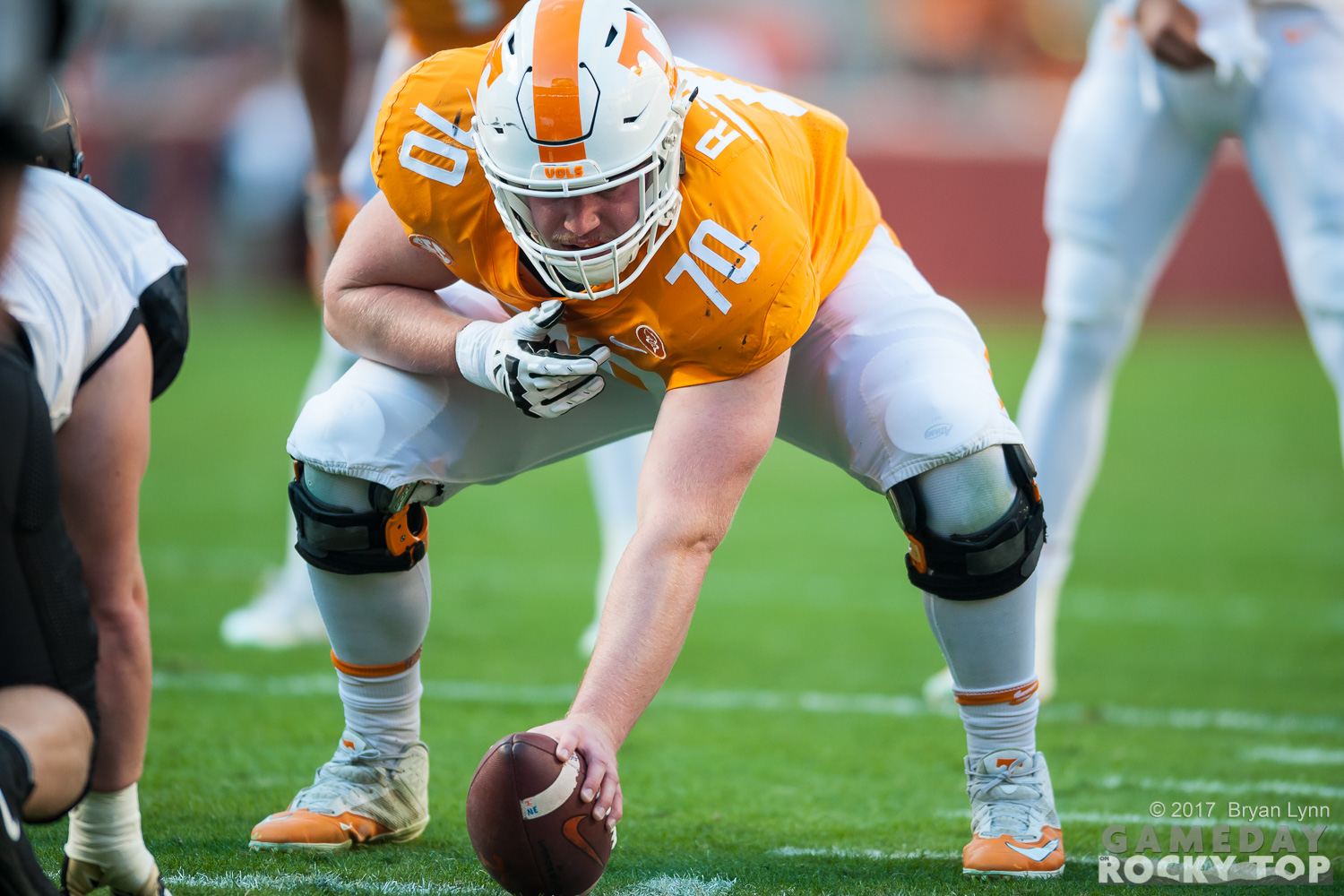
No. 4 Ryan Johnson, RS Sophomore Guard/Center

There are a ton of offensive line candidates who must step up and help star Trey Smith fortify the front, and even Smith has plenty of question marks next to his name after an undisclosed illness/injury kept him out of spring practice and there’s still a bit of uncertainty fogging his 2018 season.

A couple of players on the O-line made this list, and the first one we come to is Ryan Johnson, a former 4-star instate product from Brentwood Academy who enjoyed a solid spring and catapulted to the front of the race for the starting center gig ahead of Riley Locklear. Though Locklear may start at guard, he’s going to have plenty of competition from true freshman Jerome Carvin, and Johnson is expected to have his share of competition from Locklear as well. He’ll probablly rep at both spots. Brandon Kennedy stepping in as an Alabama transfer makes it an even healthier battle inside, and Johnson may find himself at guard.

Either way, he could settle firmly in the rotation.

He is extremely strong, possesses good size and is entering his third year of the program. It helps that Will Friend is a renowned offensive line coach who should get the most out of Johnson, especially after he’s played for unproven [Walt Wells] or flat-out bad [Don Mahoney] coaches his past two years.

At 6’6″, 305 pounds, Johnson is big enough to be a tackle, but he has never really fit at the position. After moving to the interior of the line, Johnson has proved his versatility and practiced at left guard this spring, too. So, it’s not a guarantee that he’ll play center.

To borrow a line from former coach/clown Derek Dooley, the offensive line looks like a “sack of potatoes” beyond Smith right now. Again, you could have inserted several guys like Marcus Tatum, Riley Locklear or Drew Richmond in this spot. But if Johnson can lock down the center of the line or a guard spot and not just be a leader but be a quality player, the Vols are going to surprise a lot of people on that offensive front.


DEFENSE 

No. 4 Theo Jackson, Sophomore Safety

There’s no question that Nigel Warrior is going to start at one safety spot, but the Vols have a lit-up vacancy sign opposite him. After a good spring, rising senior Micah Abernathy probably holds the edge, and another senior who has played a lot of football — Todd Kelly Jr. — will have a say in that race, too.

But Tennessee desperately needs Theo Jackson to emerge and take over that other spot on the back side.

“Needs to,” you say? Yes. He does. “Why?” you ask.

The answer is simple: He’s a big, long athlete who has blazing speed and quality ball skills. He put on 15 pounds this offseason to creep up over 190 pounds, which is huge news because he has such a wiry frame. If the scheme can click for him, Jackson could turn a major concern for the Vols into a strength.

At 6’2″ and now over 190 pounds, Jackson could be primed for a breakout sophomore year. Is he always in the proper position? Nope. But he’s still a baby, and maybe somebody can actually teach him how to play this year, right? There’s a reason why Bob Shoop and his staff loved the Overton High School product, and there’s a reason why Jeremy Pruitt, Kevin Sherrer and Co. love him. The upside is astounding.

It would be best-case scenario for the Vols if Shawn Shamburger can rise up and seize the Star position and Jackson emerges at safety. If that happens, you could have a secondary of Warrior-Jackson-Shamburger and a cornerback battle between Alontae Taylor, Bryce Thompson, Baylen Buchanan, Maleik Gray, Marquill Osborne and Kenneth George Jr. That’s a super-inexperienced group, but there would be a ton of talent and speed in that group.

And, let’s face it: The Vols badly need talent and speed on the back end of the defense. Those two things can make up for a lot of mistakes.

It’s encouraging that Jackson had a great offseason in the weight room and added some good weight. Now, he just needs to make big strides where it counts.

Here’s the first installment [Jauan Jennings and Jonathan Kongbo].

The Next-Step List: Jauan Jennings and Jonathan Kongbo

The other night, I drove past my old high school and saw the lights on at the “Pit” at Lincoln County High School. I went up to the gate, rolled the window down and smelled the wet grass on the field. It got me all gridiron-giddy.

Football is near.

And it won’t be long until we’re gearing ourselves up for the Vols to usher in the Jeremy Pruitt era.

We all know 2018 isn’t going to be a pretty sight, but that doesn’t mean we can’t talk ourselves into the Vols being much-improved under the former Alabama defensive coordinator. After all, Butch Jones is gone.

You just can’t help this time of year to be a tiny bit optimistic, even if logic (and recent history) suggests this is going to be yet another rebuilding campaign in Knoxville. Pruitt wants to win now, and he definitely isn’t used to losing after successful tenures in Tuscaloosa, Tallahassee and Athens, Georgia.

He’s outfitted UT’s roster with more size, an injection of collegiate players like Stanford quarterback Keller Chryst, Michigan State running back Madre London, JUCO defensive tackle Emmit Gooden, JUCO cornerback Kenneth George Jr., JUCO tight end Dominick Wood-Anderson, JUCO offensive tackle Jahmir Johnson, and JUCO outside linebacker Jordan Allen who need to be able to help UT right away.

And he’s won some recruiting battles for guys who must be able to come right in and make an impact.

But what about the dudes already on the team? Who needs to make a major step forward in 2018 for the Vols to rise above the 4-8 doldrums of a historically horrible season where it looked like the team quit on former coach Butch Jones and his staff?

Over the course of the next five days, we’ll look at five offensive players and five defensive players who have to emerge and go beyond what they’ve already been. For some, it’s rising above good player status and becoming reliable stars. For others, it’s about reaching the potential that Jones failed to squeeze from them.

As always, you’re encouraged to make your own additions in the comments section.

OFFENSE

No. 5 Jauan Jennings, Junior Wide Receiver

There aren’t a lot of alpha-dog difference-makers on Tennessee’s roster. After all, recruiting too many of those guys would have meant challenging Jones’ ego, and we all know that wasn’t something the former UT head honcho liked. So, too often, there were a lot of nice guys on the field who didn’t get the job done when it came crunch time.

That’s easy to look back on now, but none of us wanted to believe it as it was happening.

Jennings is a bad mamma jamma, and we all know this. Unfortunately for UT fans everywhere, he also has a history of being a bit of a turd, to put things mildly.

If you can look beyond those shortcomings, though, Jennings is a playmaker with the potential to be one of the biggest stars in the SEC. Two years ago, he had 40 catches for 580 yards and seven touchdowns for the Vols, including a soul-stealing catch-and-run score against Florida’s Jalen Tabor in a massive comeback win and the Hail Mary grab in the Dobb-nail boot win over Georgia.

Those are arguably the two most memorable plays in the past decade of Vol football.

Tennessee needs Jennings, and — let’s be honest here — Jennings needs the Vols, too. He is good enough to play in the NFL, and though that league is full of guys who’ve done much worse than Jennings, he needs to prove that he can take a second chance and run with it.

That’s exactly what’s happened so far as, after interim coach Brady Hoke, kicked him off the team, Jennings met with Jeremy Pruitt and athletic director Phillip Fulmer, who gave him a short leash and let him work his way back into the fold. He’s done nothing since that time but be an exemplary player and a leading presence.

He’s without a doubt going to have some rust after getting hurt in the season opener last year against Georgia Tech, missing the rest of the year and this past spring, but if he’s in football shape, he can plug in and be a No. 1 receiver.

Actually, he may be one of the seven best receivers in the SEC. He’s that good.

The Vols need him. Jarrett Guarantano (or Keller Chryst) needs him. And Jennings has the potential of catching an even bigger career Hail Mary and finishing a promising UT career with a flourish. If he does, it would be a storybook ending and it could help the Vols make a major leap forward in what many think will be a throw-away season.

DEFENSE

No. 5 Jonathan Kongbo, Senior Outside Linebacker

If you were to look up “Typical Butch Jones recruit” in the figurative dictionary of disgruntled Tennessee fans, Kongbo’s picture would be right there beside the definition alongside Kahlil McKenzie, Drew Richmond, Kyle Phillips, and…and…and…

Yeah, you get the picture. It’s a long list.

Which is exactly the reason why Kongbo belongs on this list. Because, mainly, Kongbo still needs to prove he belongs.

He needs to prove that he belongs up there with the 5-star status that stood on his recruiting profile out of junior college. He needs to prove he’s a havoc-wreaking force who can make a difference on UT’s defense. Simply put: he needs to prove he belongs in an SEC starting lineup.

Those may be harsh words, but they’re true words.

Much like Jennings has to prove his maturity off the field, Kongbo needs to show growth on it. We’re not real sure what he can do.

After two largely ho-hum years, Kongbo enters his final season on Rocky Top moving a level back from defensive end to outside linebacker. It’s a spot that is also occupied by another former defensive end in Darrell Taylor. There are also players such as Allen, Austin Smith, and others who’ll battle for snaps at one of the spots. Nothing is going to be given to Kongbo, but there are also reasons to hope.

He’s an athletic physical specimen who fits perfectly in a 3-4 scheme. He’s playing for a coach now in Chris Rumph who has a rich history of developing players. And Kongbo is a natural pass-rusher, who can do just that this year. Rather than always having to be in position and getting taken off the field because he’s struggling to run-fit, Kongbo can just pin his ears back and get after quarterbacks.

If he is a one-trick pony this year for the Vols, that’ll be just fine, as long as that one trick is a good one. Give us sacks, young Kongbo. If you do that — say, give UT seven or eight sacks this year — that will completely transform this defense.

In my opinion, the biggest weakness on this entire team is the inability to get after the opposing quarterback. The second-biggest weakness is lack of proven, quality cornerbacks. When you combine the two — and throw in the inability to consistently stop anybody running up the middle — you have an atrocious, historically awful defense. The Vols are trying to emerge from the forgettable Bob Shoop era and return to respectability on that side of the ball.

In order to do that, quarterbacks need to fear somebody (anybody) coming off the edge.

If you have faith that somebody will be Kongbo, you have a whole lot more faith than you should. He’s shown us very little so far. But, how much of that was the Jones-Shoop fiasco, and how much of it is Kongbo maybe just not being an SEC player?

We all hope it’s the former and not the latter.

If Pruitt, Kevin Sherrer and Rumph can turn him into the kind of player that made everybody in the country want him out of JUCO, the Vols are going to have a very impressive player already on the roster.

Tennessee Recruiting: Future of the Nose Tackle Position Takes Shape With Simmons Pledge

We may not want to be too patient throughout the 2018 football season, but help is on the way for the Tennessee Volunteers as new coach Jeremy Pruitt continues to outfit the present and future roster with size and physicality to compete in the SEC.

On the same day the news emerged that incoming freshman Kingston Harris is listed on the SEC Media Days roster at 6’3″, 316 pounds and looks primed to compete for snaps at nose tackle in the future if not right away, UT received a massive commitment for the 2019 class.

And we mean “massive” in the most literal sense.

Nashville defensive tackle Elijah Simmons committed to Tennessee over Missouri, Vanderbilt, Memphis and others. The 3-star defensive tackle may not have a ton of marquee offers, but he’s a big, physical specimen who looks tailor-made to plant in the middle of a 3-4 defensive front.

He is 6’1″, 344 pounds and is a low center of gravity who packs a mean punch at the line of scrimmage. He’s a space-eating force who can dunk a basketball at his size, and the Pearl-Cohn High School product gives UT the kind of huge, athletic presence that it doesn’t currently have.

Plus, it’s always nice when a kid looks like he wants to destroy you and then eat your face like Hannibal Lecter.

**Shudders; trickle of pee**

LOOK AWAY!

He probably will need to shed some “bad” weight, but there’s no reason why Simmons can’t play at 330 pounds and clog up running lanes in the near future. That’s exactly what UT needs for him to do to become a much-needed puzzle piece to the future.

So much of what’s yet to come from Simmons is still untapped.

“He still don’t even really know the position yet,” Pearl-Cohn head coach Tony Brunetti told GoVols247’s Ryan Callahan. “He’s still learning it. But he’s got major potential.”

Though it’s asking a ton of Simmons to be a future star when he hasn’t even played his senior year of high school yet, there are a couple of factors that are at least worth mentioning: Pearl-Cohn is the same high school that produced another pretty good UT defensive tackle in former Outland Trophy winner and long-time NFL defensive stalwart John Henderson.

Also, Simmons will be coached by another former Outland Trophy winner in Tracy Rocker.

Now, before you think we’re already putting him on early watch lists, nose tackles never win the award. But he’s going to be playing for a defensive staff that has a rich history of getting the most out of their players, and if he develops right, he could help the Vols fill a void that has plagued them for years. When’s the last time you remember UT having a quality rush defense?

I’m waiting.

Still waiting…

Thought so. Me neither.

It’s going to be interesting to see how (and if) Simmons and 3-star defensive tackle commit LeDarrius Cox fit into the same class. Cox has made no secrets that he isn’t 100 percent locked in with the Vols, and as Auburn and others come after him, he may not stick. If he does, UT will probably happily take two big dudes at the position in the 2019 class.

But it’s encouraging that a few productive months in the weight room has helped Harris, the IMG Academy under-the-radar prospect to look the way he does, and the Vols are encouraged by his early returns. Also, JUCO transfer Emmit Gooden will play the position this year along with seniors Shy Tuttle and Alexis Johnson.

Tennessee needs quality production out of that position this year and in the future, and Simmons is a player who UT worked out, he camped well, and the Vols loves what he brings to the table. He’s a very important piece of the ’19 haul.

The Vols want size, and Simmons certainly has that.

The Vols are still 18th nationally in recruiting and ninth in the SEC, but there are several other major targets expected to commit fairly soon. Though UT missed out on instate prospect Zion Logue who pledged to Georgia this past week, Simmons is a quality cog on the defensive line. There are some defensive backs who could “pop” soon, too. Jaydon Hill, Warren Burrell, Jaylen McCollough and Devin Bush are a few defensive backs with possible summer pledge dates. All of those guys have UT high on their list.

So, buckle up. It could be a strong month for the Vols, who should wind up in the top 12 or so in recruiting in this class, and that could surge with a strong showing on the field.

10 Questions for 2018: New Coach, New Chemistry

We tend to overestimate the importance of a previous coach’s weakness. Butch Jones got elite talent to Knoxville, but struggled to keep it there. Potential difference makers from Preston Williams to Venzell Boulware left the program before their time was up, and actual difference makers like Jalen Hurd did the same. You can call it chemistry or culture or whatever you like, but it’s a significant percentage of the reason Jones isn’t here anymore.

How significant will this issue be for Jeremy Pruitt, a first-time head coach?

#6: New Coach, New Chemistry

So far, it’s been a non-issue. Darrin Kirkland Jr. flirted with the idea of transferring but ultimately stayed. Rashaan Gaulden, John Kelly, and Kahlil McKenzie all went pro earlier than hoped, the latter two going only in the sixth round. But we’ve avoided the rash of transfers a new coach often deals with.

One significant difference between Jones and Pruitt: the current coach is thoroughly familiar with recruiting, coaching, and developing four-and-five-star talent. There’s no other option at Florida State, Georgia, and Alabama. Butch Jones was successful at Central Michigan and Cincinnati, but his only experience at a power five school before coming to Knoxville was two years as the receivers coach at West Virginia.

Again, we’re probably overestimating the importance of chemistry just because Jones struggled with it. But though the Vols have avoided the transfer bug, chemistry can become an issue in another way for first-year coaches.

As you’re probably aware, Nick Saban lost to Louisiana-Monroe in year one. Kirby Smart lost to Vanderbilt. Dabo Swinney lost to a 2-10 Maryland squad. It happens.

But it usually doesn’t happen out of the gate. Swinney lost to Maryland on October 3, Smart to Vanderbilt on October 15, Saban to ULM on November 17.

(Of note: if you think Lane Kiffin’s worst loss at Tennessee wasn’t the Ole Miss debacle, but the UCLA game – and I’m in this camp – that happened in week two. So this isn’t a hard and fast rule.)

When you have players who were recruited on the promise of championships, and especially players who almost got a taste of one like Alabama in 2005, Georgia in 2014, and Tennessee in 2016? They can lose interest much faster in a rebuilding year, especially if they’re seniors.

The good news on that front: the Vols only have 12 seniors, and only seven of them (Todd Kelly Jr., Micah Abernathy, Shy Tuttle, Jonathan Kongbo, Kyle Phillips, Chance Hall, Paul Bain) have been meaningful contributors. There shouldn’t be a whole lot of guys who lose interest, because most of them can be back in 2019.

The (potential) bad news: there aren’t a whole lot of guys in any one category.

You’ve got those seven seniors, plus guys like Kirkland and Jauan Jennings who know what it’s like to play in and win big games. You’ve got the major contributors from last year looking for redemption like Guarantano, Ty Chandler, Marquez Callaway, etc. You’ve got high profile recruits who haven’t gotten their chance yet like Maleik Gray and Jordan Murphy. You’ve got Pruitt’s signees. And then you’ve got a whole bunch of graduate transfers, including potential starters at quarterback and running back.

That’s a lot of ingredients in the soup bowl. We’re all wondering if it’s any good. But it’s also worth wondering if it’ll turn five or six weeks in.

The scenario some pundits play out for this team is a 2-6ish start with a chance to get bowl eligible in November via Charlotte, Kentucky, Missouri, and Vanderbilt. It’s what Derek Dooley was able to accomplish in 2010 (against a worse version of Vanderbilt and a lifeless Ole Miss team), in part by turning the team over to the future with Tyler Bray. If Jeremy Pruitt’s first year ends up in a similar ditch, he may have to make a similar call to get it back out and bowl eligible.

Chemistry is tricky business, and there are some things you just can’t learn until you’re the head coach. I don’t know if this is the sixth-most-important question this year or the tenth or the first. But it’s in there somewhere. And when the Vols lose a couple of games – hopefully later than sooner – how Pruitt gets his hodgepodge of players to respond as a team will be important.

10 Questions for 2018

10. Which backups on the defensive line will be starters in 2019?

09. Can special teams make the difference in a coach’s first year?

08. What do we know about Tyson Helton’s offense from his time at USC?

07. Who’s the third/fourth wide receiver in an offense that will actually throw them the ball?


New Vols commit Akporoghene’s highlight video is full of LOLs

Three-star offensive tackle Chris Akporoghene announced this afternoon on Twitter that he is All Vol:

The Nigeria native and former Knoxville-area resident played at The King’s Academy in Seymour, Tennessee before transferring to IMG Academy earlier this year. According to 247Sports, Akporoghene is the No. 72 offensive tackle in this year’s class, and he chose the Vols over an impressive list of other offering schools that included Texas, Miami, Auburn, Washington, Florida, Oregon, and South Carolina.

Akporoghene gives Tennessee its 13th commitment, and he joins Wanya Morris and Jackson Lampley as the offensive linemen of the Class of 2019.  The Vols currently rank 19th in the nation, but are ahead of seven higher-ranked teams in score-per-commitment.

The 3-star lineman puts UT under the coveted 50% blue-chip ratio, but he’s a really important guy to get, in part because he’s from national powerhouse IMG Academy in Florida, which is attracting blue-chip talent from all over the country. If he has any influence on his teammates, it could be a relationship that opens even more doors for the Big Orange.

Akporoghene, who moved to the Knoxville area three years ago to chase his football dreams, plans to enroll early in January to get a head start as a Vol.

Have a look at the guy’s Hudl video, which is full of LOLs.

10 Questions for 2018: Wide Receiver Depth

The best highlights of 2016 belonged to Jauan Jennings, and the best highlights of 2017 belonged to Marquez Callaway. When building the case for Tennessee’s success in 2018, they’re a great place to start.

Who’s next?

#7: Wide Receiver Depth

The Butch Jones offense threw the ball to the running back more than any other in the SEC.

In 2015 Von Pearson was Tennessee’s leader in targets at 15.4%, the lowest rate for a number one option for any team in the conference. By contrast, the Vols targeted their running backs on 21% of passes, highest in the league. Alvin Kamara was on the receiving end of 12.6% of those, the highest for any back in the SEC.

Kamara’s number increased to 14.4% in 2016, even as Josh Malone and Jauan Jennings established themselves as the top two options at receiver.  And last year it went up even more for John Kelly, getting a look on 15.8% of Tennessee’s passes (advanced stats from the always-awesome Football Study Hall).

What’s more, Tennessee tried to spread the ball around with tight ends as well. Backs and tight ends accounted for three of the Vols’ top six targets in 2015, three of the top five in 2016, and two of the top four last year. “Who is Tennessee’s number three receiver,” hasn’t mattered much during that span: Josh Smith had 12.4% of UT’s targets in 2015, 8.3% in 2016, and Josh Palmer was at 10.1% last year. Being Tennessee’s third option at receiver meant only nine catches for Palmer in 2017.

That will not be the case in Tyson Helton’s offense.

Last year USC’s four most-targeted players were all wide receivers, accounting for 67.1% of the balls Sam Darnold threw. 2015 was no different: top four targets all receivers, accounting for 65.9%. 2015 at Western Kentucky? Top four targets all receivers, accounting for 74%.

Jennings, Callaway, check. But who’s number three (and number four) is getting ready to matter a whole lot more.

Last year, Brandon Johnson was really number one. He was targeted on 18.5% of passes to lead the Vols, again a low number for a priority target. He was huge against UMass (7 for 123) and Vanderbilt (6 for 107), and was often a safety valve in an offense that needed a lot of that. If Jennings and Callaway return to health and form, he could be in for an even bigger year with less attention.

But Helton’s offense is a new lease on life for the entire receiving corps. And if history holds, one of Josh Palmer, Alontae Taylor, Latrell Williams, Tyler Byrd, Jordan Murphy, or Jacquez Jones is going to have a big year. And perhaps the best news is the entire position group contains zero seniors. What starts this fall could build into a much more dangerous passing game in 2019, especially if Guarantano wins the job.

10 Questions for 2018

10. Which backups on the defensive line will be starters in 2019?

09. Can special teams make the difference in a coach’s first year?

08. What do we know about Tyson Helton’s offense from his time at USC?


10 Questions for 2018: Tyson Helton’s Offense

We’ve learned not to assume a promising coordinator will make a smooth transition. When Butch Jones fired John Jancek and hired Bob Shoop, we thought it was the good-to-great move that could push Tennessee to a championship. Instead, through a combination of bad fit and injuries, the Vols finished 78th in yards per play allowed in 2016 and 87th last season. You just never know.

Tennessee is paying its new offensive coordinator like he’s a fantastic hire: $1.2 million would have tied Brian Daboll and trailed only Matt Canada among offensive coordinators last fall. It’s a significant investment in what could be the most important hire for a defensive-minded head coach.

The Volunteer offense had a similar look and feel for almost 20 years. Phillip Fulmer became offensive coordinator in 1989, kicking off the program’s golden era with an SEC Championship behind Reggie Cobb and Chuck Webb. That ground game would remain a staple crop in Knoxville even when Fulmer ascended to head coach in 1993 and David Cutcliffe took over, pairing Heisman finalists at quarterback with Charlie Garner, James Stewart, Aaron Hayden, Jay Graham, and Jamal Lewis. When Cutcliffe and John Chavis were the two coordinators from 1995-98, Tennessee had the highest winning percentage in college football during that span.

Randy Sanders took over from 1999-2005, guiding one of the most memorable offenses in school history in 2001 and a pair of freshmen quarterbacks (and 1,000 yard rushers) to an SEC East title in 2004. When he was asked to step aside following a 5-6 campaign, Cutcliffe returned and the Vols were in Atlanta again in 2007. Fulmer and his top assistants put a quality product on the field almost every Saturday.

But the last ten years? The Clawfense infamously finished Fulmer off. Lane Kiffin found great success with Jonathan Crompton and Montario Hardesty in the second half of 2009, then left some nice pieces for Jim Chaney under Derek Dooley. Injuries cost the Vol offense much of its promise in 2011, and in 2012 another infamous coordinator hire made a star-studded offense ineffective when the defense was giving up so many points.

Butch Jones employed three different offensive coordinators in his five years, all running a different version of his system. The results were mixed at best: great when they had to be in 2016 under Josh Dobbs, and almost good enough to make even more noise in 2015. But the consistent theme of “almost” became “never” after the first few games of 2017 under Larry Scott, as the Vols finished with their lowest yards per play (4.77) since the Clawfense (4.49).

So now it’s Jeremy Pruitt, and Tyson Helton. What will we get for $1.2 million?

#8. Tyson Helton’s Offense

While I’m not sure it was ever made clear who was calling what percentage of the plays at Southern Cal, there’s still much to learn from what the Trojans did the last two years with Helton on staff. Bill Connelly’s 2018 USC preview offers this:

USC’s offense was mostly awesome. The Trojans were efficient (12th in success rate) and packed big-play potential (seventh in gains of 20-plus yards per game), and while we paid a lot of attention to Darnold’s turnover problems, especially during the run-up to the NFL draft, those concerns were a bit overblown — the Trojans had poor fumbles luck, and nearly half of Darnold’s interceptions came in the first three games.

Connelly also notes two problem areas: negative plays leading to an abundance of third-and-long, and issues scoring touchdowns in the red zone. USC’s touchdown percentage inside the 20 was 86th nationally last year (57.6%) and 52nd in 2016 (63.2%). But it’s not a problem Helton saw at Western Kentucky, which finished ninth in that stat (72.6%) in 2015.

USC went 21-6 the last two years, including a pair of high-profile losses to Alabama in the 2016 opener and Ohio State in last year’s Cotton Bowl. Helton’s offense was ineffective against Pruitt’s Tide defense, like most, and turned it over five times against the Buckeyes.

But there is much to like in the narrative. After a 1-3 start in 2016, USC finished with eight straight wins. To close the year they won at playoff-bound Washington 26-13 behind a strong performance from Sam Darnold (23-of-33 for 287 yards, 8.7 yards per attempt), then blasted rival UCLA 36-14. The Trojans then beat Notre Dame 45-27, and won a classic Rose Bowl over Penn State 52-49 with 615 yards, 453 of them from Darnold.

Last season they lost to Washington State by three, were blown out by Notre Dame, and fell to Ohio State. But the Trojans also beat Stanford twice with 73 combined points in winning the Pac-12. (For more on each performance, check out USC’s advanced statistical profile at Football Study Hall.)

There will be some questions, of course, about how much of USC’s success the last two years came via having the third pick in the draft at quarterback. The Trojans were 14th nationally last season in passing attempts (and yards per attempt), but their run game was often swallowed up in big games (1.92 yards per carry vs Texas, 2.45 vs Notre Dame, 1.58 vs Ohio State). Finding a better balance without an elite quarterback on Tennessee’s roster will be critical.

There’s also enough excitement about Helton’s work at Western Kentucky, and with Joe Webb as the quarterbacks coach at UAB, to believe he’s got plenty of tricks up his sleeve beyond a vanilla pro-style set. Vanilla, you’ll recall, was Fulmer’s flavor of choice. With Helton, we’ll once again hope it can turn into Superman ice cream before long.


10 Questions for 2018

10. Which backups on the defensive line will be starters in 2019?

09. Can special teams make the difference in a coach’s first year?

10 Questions for 2018: Special Teams

No one reads the special teams entry in a series like this: “We need a new punter, we get it.” But if you’re trying to spring an upset in year one? The third phase can make all the difference.

#9: Special Teams

In Tennessee’s upsets and near-misses in previous year ones, special teams played a critical role:

  • You know all about Tennessee’s special teams miscues in the 2009 loss to Alabama in Lane Kiffin’s year, but don’t forget it was a successful onside kick that gave Tennessee a chance to win.
  • Butch Jones and the 2013 Vols almost beat Georgia thanks to a blocked punt returned for a touchdown…
  • …then did beat South Carolina thanks to a trio of made field goals from Michael Palardy, including the game-winner.

When you’re trying to close the talent gap, one of the quickest ways to make a difference on a fall Saturday is by making a play on special teams. So who’s going to do that for Tennessee this year?

Unfortunately, it won’t be Evan Berry and his better-to-kick-it-out-of-bounds average. But Ty Chandler did take one back to the house last year, finishing 33rd nationally in kick return average. Marquez Callaway housed a punt return in 2016; he was 28th nationally in punt return average in 2017. It may not be Evan Berry and Alvin Kamara, but there is plenty of potential in the return game.

The other side of special teams in a coach’s first year: don’t miss opportunities to score points. A good field goal kicker can make a big difference when the margin is so thin. Daniel Lincoln went 1-of-4 against Alabama in 2009, and also missed a field goal and an extra point in a four-point loss to Auburn; he rebounded to hit 10-of-11 in Derek Dooley’s first season. Meanwhile Palardy was 14-of-17 in 2013, the best kicking performance of the decade for Tennessee.

Last year Brent Cimaglia went 8-of-13, including a pair of costly misses against both Florida and Kentucky. Will he be the answer with Aaron Medley’s graduation? Or will Michigan transfer Ryan Tice get in on the action? A good way to add to frustration in any season, but especially a coach’s first, is to ride the kicker roller coaster all season.

Perhaps the biggest special teams issue will be replacing Trevor Daniel, who was second in the nation last year with 47.47 yards per punt. Freshman Paxton Brooks and Farragut sophomore Joe Doyle will be in the mix this fall.

It’s not sexy, but could make the difference between 5-7 and 6-6 this fall, or help Tennessee score a significant upset. And if the Vols find answers in Chandler, Callaway, Cimaglia, and whoever punts, they could all be around long enough for this to be a true strength in 2019.

10 Questions for 2018

#10: What backup defensive linemen in 2018 will be starting in 2019?


Tennessee Recruiting: Vols Get Big Puzzle Piece With Commitment from QB Brian Maurer

In a cycle where there aren’t a ton of highly rated quarterbacks, the Tennessee Volunteers and their first-year coaching staff wanted to see several work out before slinging offers. Last week, 3-star signal-caller Brian Maurer of Ocala, Florida, traveled to Knoxville to throw for the staff.

Both sides liked what they saw.

Wednesday morning, the West Port HS quarterback committed to the Vols, choosing UT over Ohio State, West Virginia, Central Florida and others.

After gaining the offer from Tennessee, Maurer went to Columbus to throw for the Buckeyes, who offered him on the spot, but OSU flipped a quarterback from Michigan State shortly after.

That made Maurer’s decision ultimately between the Vols and the Mountaineers, and the lure to play in the SEC and walk in the footsteps of his idol Peyton Manning were too much.

Maurer has great size, a quick release and really good accuracy. Rivals lists him at 6’4″, and 247Sports lists him at 6’2.5″, but he’s probably somewhere in the middle. That’s plenty tall enough to see over defenses.

He’s currently rated as the nation’s No. 18 pro-style quarterback nationally according to 247Sports and the 21st-rated pro-style passer according to Rivals. Those numbers will improve now that he’s done the camp circuit and showed out.

His quick release and accuracy were some of the attributes offensive coordinator Tyson Helton loved about him when he witnessed him throwing in person. Though the signal-caller grew up in the shadow of Ben Hill Griffin Stadium, probably pulling for the Gators, the Vols made a ton of sense.

Florida — who hadn’t extended an offer — will run more spread concepts under new coach Dan Mullen, so that made Maurer perhaps not the best fit for that offense. The Vols are going to be a smashmouth offense with a pro-style passer if everything works out, and there may be some West Coast elements to the scheme as well, if Helton’s body of work at USC is any indication.

This all makes Maurer’s accuracy and ability to throw on the run intriguing aspects of his game. He continues to shine no matter where he goes and throws. He made the Elite 11 Finals and finished among the final 12 quarterbacks at the event, which earned him a spot in Nike’s The Opening Finals, which starts Saturday in Frisco, Texas.

Maurer will get the opportunity to prove he’s among the top quarterbacks in the country. He runs an eye-popping 4.5 40-yard dash, which proves his athleticism. So, that’s a pretty strong skill set when you factor in everything else he brings to the table. The offense and his skills fit what UT wants to do.

“Tennessee runs a true pro-style offense,” Maurer told VolQuest.com’s Austin Price. “Tennessee has some best facilties in the country and the coaches made a big impression on me.”

It’s going to be interesting to see now what happens with quarterback recruiting for the Vols. Are they finished? With the only scholarship signal-callers on the roster being Jarrett Guarantano, Will McBride, fifth-year graduate transfer Keller Chryst and incoming freshman JT Shrout, it may not be a bad idea for UT to keep going after another quarterback it really likes. If Chryst beats out JG for the starting gig, it’s not out of the question that the latter would transfer, even though he’d still have two years of eligibility remaining after Chryst graduates.

If Tennessee is still going to recruit a quarterback, that would be Alabama commitment Taulia Tagovailoa, the Hawaiian quarterback who currently goes to school at Thompson High School in Alabaster, Alabama. Of course, he is the younger brother of Crimson Tide national championship game hero Tua Tagovailoa, who is expected to be in a heated battle with Jalen Hurts for the Tide’s starting QB gig.

There’s a chance the Vols can flip Tagovailoa from the Tide, though. Even though Alabama would seem the logical fit, the Tide also has a pledge from 4-star quarterback Paul Tyson in this class, and Tyson is the grandson of legendary coach Bear Bryant. So, the younger Tagovailoa isn’t a guarantee to be UA’s quarterback of the future, either.

If the Vols can somehow get Maurer and Tagovailoa, that would be exceptional, but Maurer is a stellar pickup all by himself. He’s got a lot of attributes that should make him a coveted player for a lot of teams if they saw them in person. That’s what happened for the Vols, who loved what they saw, and he became Helton’s hand-picked man in this class.

Like Shrout before him, Maurer has thrown his share of interceptions in high school, but that isn’t something (obviously) that scares off Tennessee coaches. Helton believes he can mold those positive attributes and turn those guys into quality SEC quarterbacks.

Head coach Jeremy Pruitt likes him, too, according to 247Sports’ Luke Stampini.

“The coaching staff, you know,” he said. “Sitting down with Coach [JeremyPruitt for about an hour and a half, him just saying I’m the guy. He doesn’t just like the way I throw the football or run. He likes my toughness most of all.”

247Sports’ Greg Biggins thinks Maurer can be “elite.”

It has been a long time since the Vols had one of those signal-callers who could get the ball downfield. Yes, Joshua Dobbs was a game-changing athlete, but he struggled throwing vertically consistently, and Butch Jones’ one-dimensional offense didn’t help. You have to go back to Tyler Bray for when UT had a quality thrower, but the lack of a running game did Tennessee in then.

Can this staff put everything together offensively? That remains to be seen. But Maurer will have the opportunity to lead Tennessee’s offense into the next generation.